28 Questions Answered by UK Scrapping Experts

Scrapping a car throws up a lot of questions, especially if you’ve never done it before. What documents do you need? Is it really free? What happens to the car afterwards? Can you get fined if something goes wrong?

We’ve pulled together the 28 questions our customers ask most often and answered every single one. No fluff, no jargon – just straight answers from people who process thousands of scrap vehicles every year.

How do I scrap my car?

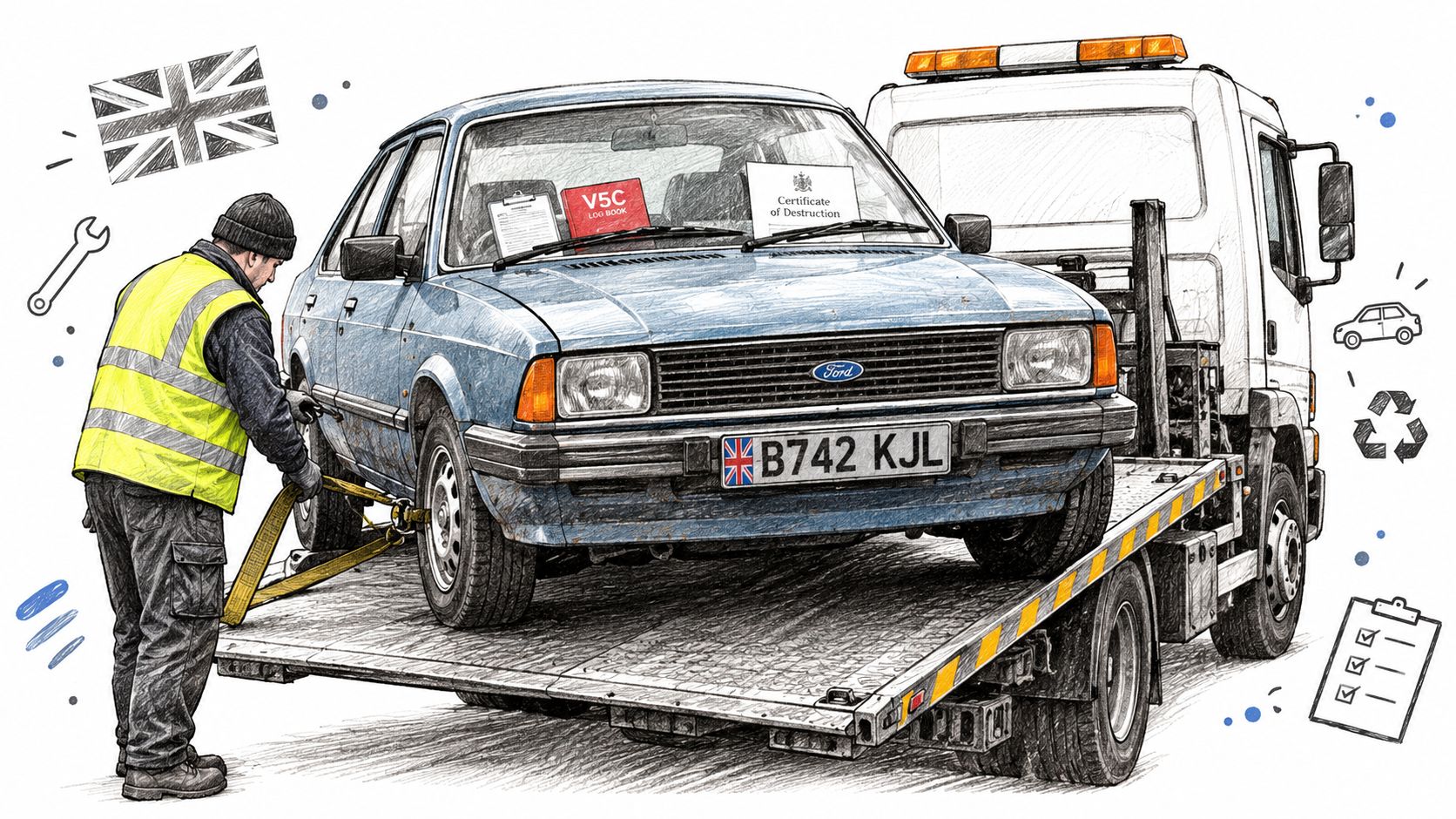
Get an instant quote online using your registration and postcode, accept the offer, book a free collection slot, and we’ll pick up the car and pay you by bank transfer on the spot. We handle DVLA notification and issue a Certificate of Destruction. The whole process can be done in 24 hours. For the full walkthrough, visit our how it works page.

When is the right time to scrap my car?

Scrap it when the cost of keeping it on the road outweighs what it’s worth. Common triggers include failing the MOT on expensive items (welding, catalytic converter, emissions), ongoing mechanical problems that cost more to fix than the car’s value, or simply needing the space. If the repair quote is more than double the car’s market value, scrapping is almost always the smarter financial decision.

Is it legal to scrap a car in the UK?

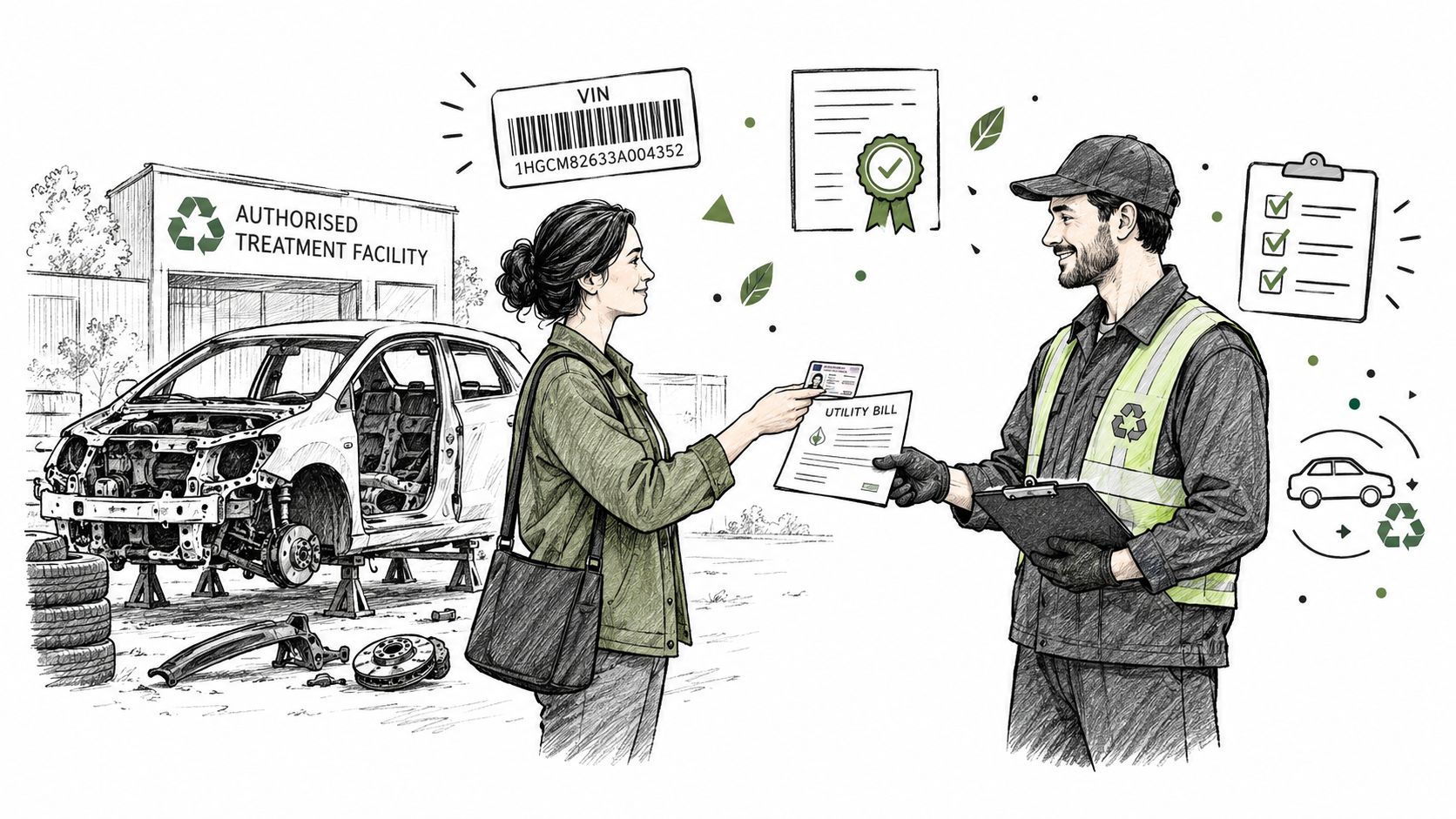
Completely legal, as long as you use a licensed Authorised Treatment Facility. ATFs are the only businesses legally permitted to scrap vehicles in the UK. They’re regulated by the Environment Agency and must meet strict depollution and recycling standards. Using an unlicensed operator is a criminal offence and can leave you liable for the vehicle.

Can anyone scrap a car, or does it have to be the registered keeper?

Only the legal owner can authorise scrapping. The registered keeper on the V5C isn’t always the owner – the V5C itself states this. If you bought the car but haven’t updated the logbook, bring proof of purchase. If you’re acting on behalf of someone else (elderly relative, for example), you’ll need written authorisation from the owner.

What’s the difference between scrapping and selling my car?

Scrapping means the car is recycled for its metal and materials – it’s crushed and the parts are recovered. Selling can mean private sale (to another driver), selling for salvage (car dismantled for reusable parts), or selling to a car-buying service. Salvage typically pays more than scrap but less than private sale. Our sell my car page compares all options side by side.

How much is my scrap car worth?

Most scrap cars in the UK fetch between £150 and £500 in 2026. The exact amount depends on vehicle weight, catalytic converter value, current scrap metal prices, make and model, and condition. Heavier cars with intact catalytic converters are worth the most. Get your specific price with our free scrap car valuation tool – it takes 30 seconds.

Why do scrap car prices change?

Because they’re tied to global commodity markets. Steel, aluminium, copper, platinum, palladium, and rhodium all fluctuate based on supply and demand. When metal prices rise, scrap car values follow. Seasonal factors play a role too – more cars are scrapped after winter (MOT failures), which can temporarily push prices down. Our quotes use live market data, so you always get the current rate.

How do you pay me?

By bank transfer (BACS) on the day of collection. Under the Scrap Metal Dealers Act 2013, it is illegal for any scrap dealer to pay cash for vehicles in England and Wales. Similar legislation applies in Scotland and Northern Ireland. We transfer the money while the driver is at your door, and it typically clears within a few hours.

Is the quoted price guaranteed?

Yes, for 7 days. As long as the vehicle’s condition matches what you described when getting the quote, the price won’t change on collection day. If you come back after the 7-day window, you’ll get a fresh quote at current market rates.

Can the driver change the price on collection day?

Only if there’s a material difference between what you described and the actual vehicle. If you said the catalytic converter was present but it’s been stolen since, or the condition is significantly worse than stated, the price may be adjusted. If you’re unhappy with any adjustment, you’re under no obligation to proceed – we’ll leave without collecting.

Is collection really free?

Genuinely free. We don’t charge for pickup, fuel, transport, admin, or paperwork. The amount quoted is the amount paid. If any scrap service tries to deduct collection costs from your quote, that’s a warning sign. Legitimate ATFs absorb collection costs because the recycling value covers it.

What documents do I need to scrap my car?

You’ll need your V5C registration document (logbook), photo ID (driving licence or passport), and your bank details for payment. Having all vehicle keys helps too. If you’ve lost your V5C, you can still scrap your car – see our guide on scrapping without a V5 for the alternative process.

Can I scrap my car without a V5C logbook?

Yes. You’ll need to provide photo ID and proof of address, and write to the DVLA separately to inform them the vehicle has been scrapped. Include the vehicle’s registration number, make, model, your details, and the name and address of the ATF. We handle this regularly and can guide you through it. It’s not complicated – it just adds an extra step.

Do I need to tell the DVLA I’ve scrapped my car?

Yes, and this is important. If you don’t notify the DVLA, you remain the registered keeper and could be fined up to £1,000. You’ll also still be liable for road tax, parking fines, congestion charges, and any other penalties associated with the vehicle. When you use our service, we handle the DVLA notification for you using Section 9 of your V5C. Full details on our DVLA guide.

What is a Certificate of Destruction?

A Certificate of Destruction (CoD) is a legal document issued by the ATF confirming that your vehicle has been properly scrapped and deregistered. Only licensed Authorised Treatment Facilities can issue one. It’s your proof that the car was processed legally – keep it safe in case you ever need to show that the vehicle is no longer your responsibility. We issue one within 7 days of collection. Learn more on our Certificate of Destruction page.

Will I get a road tax refund when I scrap my car?

If your car is taxed at the time of scrapping, the DVLA will automatically refund any full remaining months of road tax. The refund goes to the registered keeper and usually arrives within 4–6 weeks. You don’t need to apply for it separately – it happens automatically once the DVLA processes the scrapping notification.

Can I keep my private number plate?

Yes, but you must apply to the DVLA to retain or transfer the plate before the car is scrapped. The fee is £80. Once the vehicle has been processed at the ATF, the registration number is permanently destroyed and cannot be recovered. So if your plate has value, sort this out first. The DVLA’s online service makes it fairly straightforward.

Can you collect a car that doesn’t run?

Absolutely. Our collection vehicles carry winches and ramps specifically for non-runners. Dead battery, seized engine, flat tyres, no wheels – we can handle all of it. We collect non-running vehicles every single day. If your car hasn’t moved in years, we’ll still get it loaded. More details on our non-runners page.

Does my car need MOT, tax, or insurance for collection?

No to all three. Since our driver brings a flatbed or recovery truck, your car never goes on the public road under its own power. It can be completely unroadworthy – no MOT, no tax, no insurance. That’s one of the main advantages of using a collection service rather than trying to drive it to a scrapyard yourself.

How quickly can you collect my car?

Same-day collection is available in most areas if you book before midday. Next-day is almost always possible. At worst, we’ll have someone with you within 48 hours. We collect Monday to Saturday, typically 7am to 6pm. For more on turnaround times, check our same-day scrap car collection blog post.

Where do you collect from?

Anywhere in the UK – England, Scotland, Wales, and Northern Ireland. Your driveway, workplace, garage, car park, roadside (legally parked), or storage compound. Even remote and rural locations. If a recovery truck can physically reach your vehicle, we’ll collect it. Browse our locations page to find your nearest collection area.

Can I scrap a car that’s been in an accident?

Yes. We buy accident-damaged vehicles of all types – Cat B (break only), Cat S (structural damage), Cat N (non-structural damage), and unrecorded damage. In many cases, accident-damaged cars are worth more through salvage buyers because the undamaged parts still have resale value. Get a quote and we’ll tell you which route pays best. See our accident-damaged page.

Can I scrap a van or commercial vehicle?

Yes. We buy vans and light commercial vehicles up to 3,500kg – Transit, Sprinter, Vivaro, Berlingo, Caddy, and everything else. The process is identical to scrapping a car: quote, book, collect, pay. For larger fleet disposals, contact us directly for bulk pricing. More on our van disposal page.

What if my car doesn’t have wheels?

We can usually still collect it, but it requires specialist equipment. Let us know when you book so we can send the right recovery vehicle. A car without wheels may receive a slightly lower quote because it affects loading and processing, but it won’t prevent us from making an offer.

What happens to my car after it’s scrapped?

It goes to a licensed ATF where it’s depolluted first – all hazardous fluids (fuel, oil, coolant, brake fluid, air conditioning gas) are safely drained. Then usable parts are removed, tested, and sold as quality second-hand components. Finally, the shell is crushed, shredded, and the metals are separated for recycling. UK ATFs recover over 95% of all materials. Read the full process on our ELV recycling page.

Is car scrapping bad for the environment?

Done properly through a licensed ATF, it’s actually the environmentally responsible option. Depollution prevents hazardous substances contaminating soil and water. Parts reuse extends the life of functional components. Metal recycling recovers steel, aluminium, and copper for remanufacturing. The End of Life Vehicle Directive requires 95% of a vehicle’s weight to be recovered. Leaving an old car to rust on your drive is far worse for the environment. See our sustainability page.

Can I scrap a car that’s still on finance?

Not directly. With HP, PCP, and lease agreements, the finance company owns the vehicle until it’s fully paid off. Contact your provider for a settlement figure, pay the balance, get written confirmation the agreement is closed, and then you’re free to scrap. The one exception is a personal loan not secured against the car – in that case, you already own the vehicle.

Can I remove parts from my car before scrapping?

The DVLA says you can remove parts for use on another vehicle you own. However, you’ll need to SORN the vehicle first, and all depollution work must be done at an ATF. Bear in mind that removing parts (especially the catalytic converter, wheels, or engine) will significantly reduce your scrap value. In most cases, you’re better off selling the car complete.

What if I don’t receive my Certificate of Destruction?

Contact us and we’ll chase it with the ATF. By law, the CoD should be issued within 7 days. If the ATF fails to provide one, report it to the Environment Agency – it’s a serious compliance issue. Without a CoD, you have no legal proof the vehicle was scrapped, which means you could still be held responsible for it.

Can I cancel after booking collection?

Yes, at any time before the driver arrives. No fees, no penalties, no questions asked. If you change your mind on collection day before the car is loaded, you can still cancel. It’s your vehicle and your decision. We’re not going to pressure you.

Ready to? Scrap?

Now that you know the process, get a guaranteed price from our network of approved buyers.

Scroll to Top