You want the car gone and money in return, and you’ve probably seen the signs tied to lampposts shouting “cars bought today, cash paid”. So can you still scrap my car for cash and walk away with notes in your hand? Not quite, and the reason matters. Since 2013, paying literal cash for a scrap car has been illegal, but you can still get paid quickly and securely. This guide explains how payment really works now, how much you can expect, and how to spot the operators who’ll land you in trouble.
Can you still get cash for a scrap car?
You can get paid for a scrap car, just not in physical cash. Under Section 12 of the Scrap Metal Dealers Act 2013, it is a criminal offence for a scrap dealer to hand over cash for scrap metal, and an end-of-life vehicle counts as scrap metal because it’s dismantled and depolluted for its metal content. So when a yard or an online service advertises “cash for cars”, what that means in practice is a fast, secure payment, almost always a bank transfer.
Only two payment methods are legal here, namely electronic transfer, usually straight into your bank account, or a non-transferable cheque. That’s it. That phrase, “cash for cars”, has simply stuck around as a figure of speech, the same way people still say they’re taping a programme. Your money is real and reaches you quickly. It just arrives as a transfer rather than a wad of twenties. None of this makes scrapping any harder for you. It simply changes the form the money takes.
Why the cash ban actually protects you
Lawmakers brought it in to tackle a wave of metal theft, when criminals were stripping cables, rail lines and even memorial plaques to sell for quick, untraceable cash. Forcing every payment through a bank or a cheque means each sale now leaves a clear record, which makes stolen metal far harder to offload. That is the headline reason, but there is a quieter benefit that lands squarely in your favour.
A bank transfer creates a permanent record of the whole transaction. If a question ever comes up with the DVLA about when you handed the car over, you can pull up your bank statement and show exactly when you were paid. Selling to a licensed dealer who pays properly also keeps you clear of trouble if that car is later linked to crime, which is a genuine risk with a cash-in-hand sale to someone unlicensed. A crossed cheque, with its two parallel lines, gives you similar protection because nobody can simply cash it over the counter. Either way, the paper trail is working for you, not against you, and it costs you nothing to have it. It also stops a rogue trader claiming later that they paid a different amount, because the transfer speaks for itself.
How you get paid when you scrap your car
Once you know the shape of it, the process is quick. You hand over your bank or building society details, either when you book, to the driver on collection day, or over the phone with the office. Your account name needs to match your identification, since the dealer has to verify who they are paying.
Most reputable services pay by secure bank transfer on the day they collect the car, often within hours of it leaving your drive. Some run a single daily payment batch in the late afternoon, so the money lands that evening or the next working day, and a standard bank transfer can take up to 48 hours to fully clear. None of that is cause for worry, but it is worth asking about timing upfront if you are counting on the funds quickly. You’ll also receive a digital trail along the way, including a waste transfer note, an invoice, and your Certificate of Destruction once the vehicle is processed.
No bank account? You are not stuck. The payment can go to the account of someone you trust, using their details, or you can ask for a cheque instead. Crucially, a legitimate buyer will always route the money through a traceable method, never press physical cash on you. It is also fair to confirm how and when you will be paid before the car is loaded, so there are no surprises once it’s gone.
Getting cash for a car that doesn’t run or has no logbook
Plenty of cars headed for scrap are far from showroom shape, and that rarely changes whether you can sell one. A car that won’t start, has failed its MOT, or has sat on the drive for months is still worth money for its metal and parts, and a collector will tow it away regardless. There’s no need to get it running first.
Missing paperwork is more of a wrinkle, though not a dead end. Ideally you hand over the V5C logbook, but if you have lost it you can usually still scrap the car by proving your identity and ownership instead. A written-off car in an insurance category can be scrapped as well, provided the buyer records it correctly. Even one declared beyond economical repair still holds scrap value in its shell and its salvageable parts. One thing to hold onto is honesty about the car’s condition and status, since a reputable buyer prices and documents it properly either way and still pays you securely.
How much cash can you get for a scrap car?
There’s no single figure, because the value rests on your car’s weight, its engine and the current price of metals like steel, aluminium and the platinum group metals in the exhaust. A small hatchback sits at the lower end, while a heavy diesel estate or a 4×4 brings more metal to the table and tends to pay more. Location plays a part too, as collection distance and local demand both feed into the offer.
Those metal markets move daily, so a quote is a snapshot rather than a fixed price, and it pays to compare rather than taking the first number you’re given. Its valuable components matter as well, particularly the catalytic converter and the battery, which is why a complete car is worth more than one that has been picked over. For a full breakdown of what shapes the figure, our guide on how much you get for scrapping a car walks through every factor, and our overview of scrap metal prices explains why the rate shifts week to week.
A fair way to judge an offer is to gather two or three quotes for the same car and see how they line up. Genuine buyers tend to land in a similar range, so a figure that is wildly higher than the rest can be a bait price that quietly drops on collection day. Steady, clearly explained quotes are usually the ones worth trusting, and a good buyer will stand by the figure when the car is collected.
How to avoid cash-for-cars scams
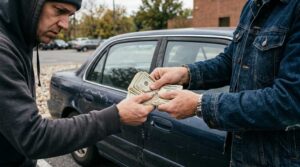
That same demand that makes scrapping easy also attracts operators who cut corners, and the warning signs are easy to read once you know them. Anyone offering you physical cash is breaking the law and is very likely unlicensed, so treat that as a hard no rather than a tempting shortcut.
- Cash in hand. Handwritten lamppost signs and community-group posts promising immediate notes for your car are the clearest red flag of all.
- No identity check. A licensed dealer has to verify your ID and keep records. If nobody asks for any, walk away.
- “We’ll pay cash and mark it as a transfer.” This is an offer to falsify records, and it tells you everything about who you’re dealing with.
- No licence or paperwork. Ask for the scrap metal dealer licence number and waste-carrier registration. Both can be checked online, and a genuine operator will share them happily.
There is more at stake than a poor price. Sell to an unlicensed cash buyer and you could be held responsible if the car resurfaces in a crime or is dumped, since there’s nothing to prove you passed it on legally. If you suspect waste crime, you can report it to the Environment Agency on their hotline or to Crimestoppers anonymously, and you can check a dealer’s licence with your local council through GOV.UK. Spending two minutes checking a buyer’s credentials is the cheapest insurance you will ever buy, and a trustworthy buyer never minds the question.
How to scrap my car for cash the right way
Doing it properly is quick and keeps you fully protected. These steps are the whole job from start to finish.
- Get a quote. Enter your registration and postcode for a no-obligation figure based on your exact car and current rates.
- Book free collection. Pick a day and place that suits you. A runner or a non-MOT car is fine, as it’s going to be recycled.
- Hand it over with the V5C. Give the logbook to the collector and take your waste transfer note and, shortly after, your Certificate of Destruction.
- Get paid by bank transfer. Provide your account details so payment reaches you securely, usually on collection day.
- Tell the DVLA. Notify them the car has been scrapped so you’re no longer liable, and claim any road tax refund you’re owed.
That last step matters, and our guide on how to notify the DVLA your car has been scrapped covers it in detail. When you’re ready, you can check what your car is worth, get an instant online quote, and book free collection anywhere in England, Wales and Scotland. Because we only work with licensed Authorised Treatment Facilities, you can also confirm one on the GOV.UK scrap your vehicle service, and you can read the cash rule for yourself in Section 12 of the Scrap Metal Dealers Act 2013.
Keep your own copy of the Certificate of Destruction and the payment confirmation together once it is all done. The two of them are all the proof you would ever need that the car was scrapped legally and that you were paid in full.
Frequently asked questions about scrapping a car for cash
Can I get cash in hand for my scrap car?
No. Paying physical cash for a scrap car has been illegal in the UK since the Scrap Metal Dealers Act 2013. A licensed buyer pays by bank transfer or non-transferable cheque, and anyone offering notes in hand is breaking the law and probably unlicensed.
Is it illegal to be paid cash for scrapping my car?
It is illegal for the dealer to pay you cash, and dealing with one who does can leave you exposed too. Under Section 12 of the Act, vehicles count as scrap metal, so payment must be electronic or by cheque. Sticking to a licensed buyer keeps the whole sale traceable and safe.
How soon do I get paid after scrapping my car?
Most services pay by bank transfer on collection day, often within hours. Some use a daily payment run, so the money can arrive that evening or the next working day, and a standard transfer can take up to 48 hours to clear. Ask about timing when you book if you need the funds fast, and check whether payment goes out on collection day or in a later run.
How much money will I get for my scrap car?
It depends on the car’s weight, engine and condition, plus current metal prices and your location. Heavier cars and those with valuable parts like the catalytic converter pay more. Compare quotes rather than accepting the first, since rates move daily.
What do I need to get paid for my scrap car?
You will need photo ID and proof of address, your V5C logbook, and bank or building society details in a name that matches your ID. If you have no bank account, payment can go to a trusted person’s account or be made by cheque.