Scrap car prices in the UK in 2026 range from £180 to £500, and the figure your buyer offers comes down to a fairly simple sum: kerb weight multiplied by today’s scrap metal rate per tonne, plus the value of your catalytic converter and any reusable parts, minus collection costs. Every licensed Authorised Treatment Facility (ATF) uses the same formula. What changes from one quote to the next is the numbers fed into it.
If you want to skip the maths, get an instant scrap car valuation using your reg and postcode. The rest of this guide explains what is happening behind that figure, why two cars that look almost identical can be £100 apart, and how to push your quote to the top end of the range.
How Is Scrap Car Value Worked Out in the UK?
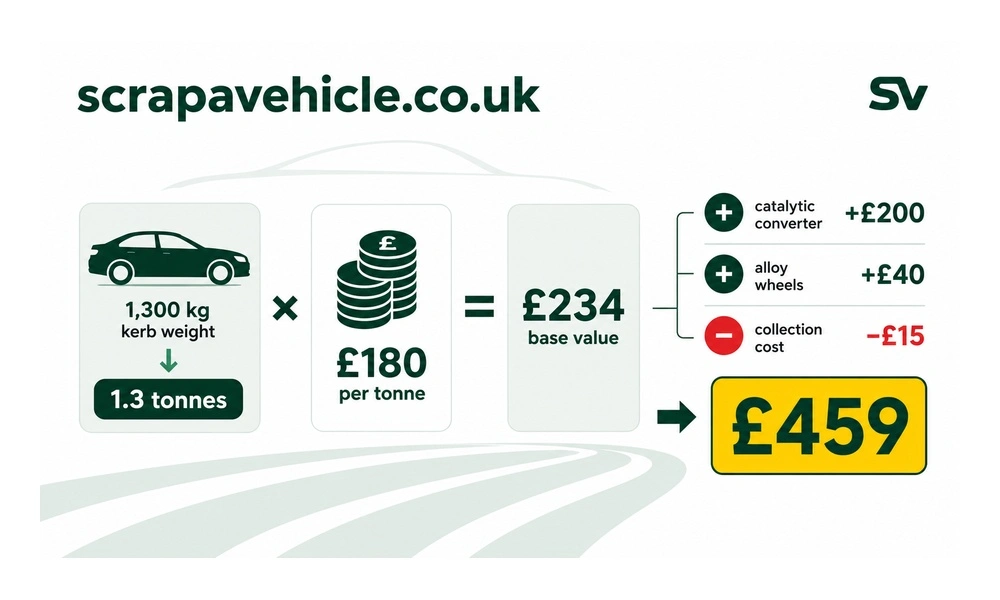
UK scrap dealers price cars on tonnage. Your car’s kerb weight gets converted to tonnes (a 1,300 kg Ford Focus is 1.3 tonnes), then multiplied by the current per-tonne rate paid for end-of-life vehicle steel. In May 2026 that rate sits around £180 per tonne, though it moves weekly with global commodity prices.
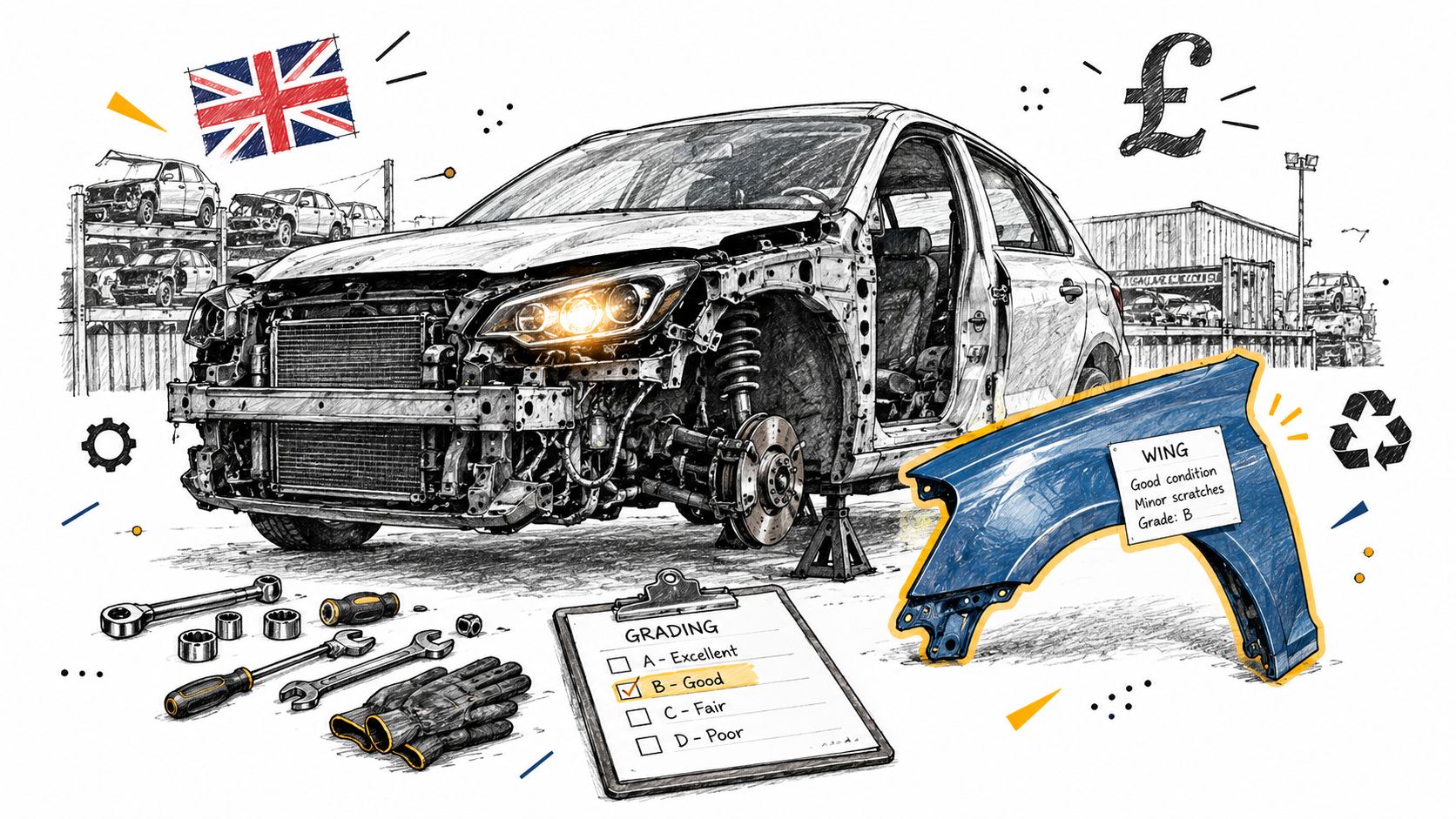
The catalytic converter is treated separately, because the platinum, palladium and rhodium inside it are worth more per gram than the rest of the car combined. A working cat usually adds £100 to £400 to your quote. Other reusable parts (alloy wheels, gearbox, battery, alternator) push the price higher again if a salvage yard can resell them.
After all that, the buyer deducts what it costs to collect your car. A scrap yard in Glasgow picking up an immobile car in rural Ayrshire has to factor in two hours of recovery truck time. That gets shaved off the final offer.
The Scrap Car Pricing Formula (With a Worked Example)
Here is the exact calculation that produces nearly every UK scrap quote, using a real-world example: a 2010 Ford Focus 1.6 with a working catalytic converter and original alloy wheels.
| Calculation step | Value |
|---|---|
| Kerb weight (1,300 kg ÷ 1,000) | 1.30 tonnes |
| × Per-tonne scrap rate (May 2026) | £180 |
| = Base metal value | £234.00 |
| + Working catalytic converter | +£200 |
| + Original alloy wheels (set of 4) | +£40 |
| − Collection cost (15-mile distance) | −£15 |
| Final scrap quote | £459 |
The same Focus might score £510 in London and £390 in rural Mid-Wales. Same car, same formula, different inputs.
What Is the Average UK Scrap Car Price in 2026?
Quotes across the UK in May 2026 are sitting in these brackets. The top of each range applies when the car is complete with a working cat; the bottom when it is stripped or has been off the road for years.
| Car size | Example models | Typical 2026 quote |
|---|---|---|
| Small hatchback | Ford Fiesta, Vauxhall Corsa, Kia Picanto | £180 – £280 |
| Medium family car | VW Golf, Ford Focus, BMW 1 Series | £250 – £380 |
| Large saloon / estate | Vauxhall Insignia, BMW 5 Series, Audi A6 | £300 – £450 |
| SUV / 4×4 | Nissan Qashqai, Toyota RAV4, Range Rover | £350 – £550 |
| Van | Ford Transit, Renault Master, Mercedes Sprinter | £350 – £600 |
Heavier vehicles win on metal alone, but a 12-year-old Land Rover Discovery with a working cat will often beat a newer Fiesta with a missing cat by £200 or more.
Scrap Metal Prices Per Tonne in 2026
The per-tonne rate is the single biggest lever on your final quote. Mixed light iron (what most of a car shell is made of) currently trades at £120 to £180 per tonne. Aluminium and copper sit much higher, but you do not get paid those rates directly because your car is mostly steel.
| Metal | Found in your car | Per-tonne rate (May 2026) |
|---|---|---|
| Mixed light iron | Body shell, chassis, doors | £120 – £180 |
| Heavy iron | Engine block, gearbox casing | £140 – £200 |
| Aluminium | Alloy wheels, some engine parts | £700 – £950 |
| Copper | Wiring loom, motor windings | £4,500 – £6,000 |
| Catalytic converter | Exhaust system | Priced per unit (£100 – £400) |
Rates change weekly. Global steel demand, particularly from Chinese manufacturing, is the main driver. When Chinese mills are buying heavily, UK scrap rates rise within days. When they pull back, scrap quotes soften.
How Much Does Your Catalytic Converter Add to the Price?
The cat is the single most valuable component on most petrol and diesel cars. Inside the steel casing is a ceramic honeycomb coated with platinum, palladium and rhodium. Those three metals trade between £25,000 and over £400,000 per troy ounce in 2026.
A working catalytic converter still fitted to your car adds £100 to £400 to your scrap quote. A missing cat (a common loss in London due to theft) reduces your offer by exactly the same amount. If thieves have already been at it, expect to receive £100 to £400 less than the standard quote for your model.
Hybrid catalytic converters are worth even more, because hybrids run lean and need a higher precious-metal loading to convert the same volume of exhaust gas. Older Japanese hybrids in particular often carry the highest cat values.
Do Scrap Car Prices Differ by Region in the UK?
Yes, and the gap is meaningful. London consistently pays £30 to £100 more than the UK average for the same car, driven by demand and the number of yards competing for stock. Scotland sits slightly below the UK average, partly because per-tonne rates Scottish ATFs receive are lower and partly because transport costs in the Highlands and Islands are higher.
| Region | Typical Focus quote | Driving factor |
|---|---|---|
| Central London | £320 – £510 | Highest demand, dense network of ATFs |
| Manchester / Birmingham | £290 – £400 | Strong urban scrap network |
| Bristol / Leeds / Liverpool | £270 – £370 | Solid mid-range, good port access |
| Glasgow / Edinburgh | £260 – £350 | Scottish hubs near transport routes |
| Rural Wales, Cornwall, Highlands | £220 – £300 | Long collection distances reduce offer |
One thing worth knowing if you are scrapping in Scotland: the environmental regulator is the Scottish Environment Protection Agency (SEPA) rather than the Environment Agency for England, and Natural Resources Wales (NRW) handles Welsh ATFs. The price formula and DVLA process is identical UK-wide; the only difference is which body licenses the ATF processing your car.
What Reduces Your Scrap Car Quote?
Five things consistently knock pounds off a scrap offer. Knowing them in advance means no nasty surprises when the collection driver arrives.
| Issue | Typical deduction |
|---|---|
| Missing catalytic converter (theft or removed) | −£100 to −£400 |
| Stripped engine or gearbox | −£100 to −£300 |
| Alloy wheels swapped for steels | −£30 to −£60 |
| No V5C logbook (replacement needed) | −£20 to −£30 |
| Difficult collection (steep drive, narrow lane) | −£15 to −£50 |
The biggest of those is a missing catalytic converter. The second biggest, surprisingly, is making the car difficult to collect: if your car is on a steep driveway, double-parked, or up a single-track road, the recovery cost climbs and the buyer has to recover that money somewhere.
How to Get the Best Scrap Car Price
Six things you can do this week to push your quote to the top of the range:
- Compare at least three quotes. The variance between buyers is wider than people expect, often £50 to £100 on the same car.
- Leave the cat fitted. Even if you could sell it separately, the hassle rarely justifies the £50 you might pocket above the scrap premium.
- Give the exact registration. Quote tools auto-pull weight and engine data from DVLA records, which is more accurate than guessing your kerb weight from the handbook.
- Get a fixed quote, not an estimate. Some buyers offer a tempting number that quietly drops when the driver arrives. Ask explicitly: “Is this the price you will pay on collection?”
- Confirm free collection. A £40 collection deduction wipes out a price advantage from elsewhere.
- Time it loosely. Do not chase the market; the difference is usually £20 to £50. But if metal prices are clearly rising, waiting a fortnight can be worth it.
Scrap Value vs Salvage Value vs Parts-Out: Which Is Right for You?
Scrap is not the only option. Three routes give different returns depending on the state of your car:
| Option | When it makes sense | Typical return |
|---|---|---|
| Scrap | End-of-life car, no MOT, major faults, body damage | £180 – £500 |
| Salvage | Cat S/N write-off, repairable, under 10 years old | £500 – £5,000+ |
| Parts-out | High-demand parts (rare model, modified, recent) | Variable, more effort |
A 12-year-old Focus with no MOT is almost always scrap. A 5-year-old Cat S Audi A4 might be worth £4,000 to a salvage buyer who can repair and resell it. If your car sits between the two, our full scrap car guide walks through how to decide. For valuable parts like a working battery, see our breakdown of scrap battery values and our used car parts options.
Frequently Asked Questions
How much does a Ford Fiesta scrap for in 2026?
A 2010 to 2015 Ford Fiesta typically scraps for £250 to £320 in 2026. The exact figure depends on weight (the 1.6 diesel models are heavier than the 1.0 petrol), whether the catalytic converter is fitted, and your location. London quotes lean toward the upper end; rural Welsh quotes toward the lower.
Do I get more for a complete car or a stripped one?
A complete car wins almost every time. Pulling parts before scrap costs you the labour, the disposal headache for components you cannot sell, and the salvage buyer’s premium for a complete vehicle. Removing a working catalytic converter alone can wipe £200 to £400 off your quote.
Can I scrap my car if I have lost the V5C logbook?
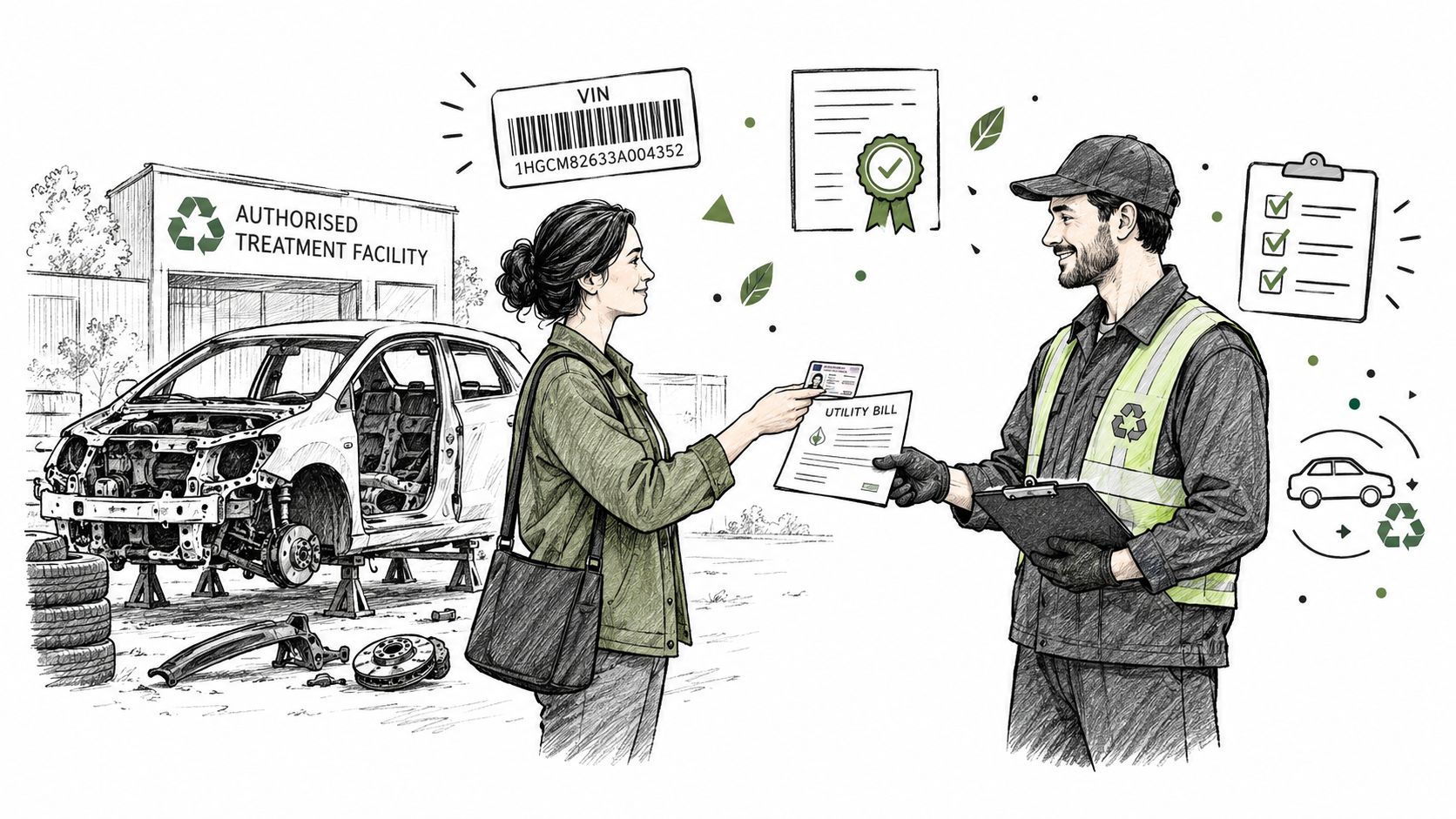
Yes. Expect a £20 to £30 deduction for the ATF applying for replacement paperwork via the DVLA. You will need to prove identity and that you owned the vehicle. Our scrap car FAQs walk through every paperwork scenario, including stolen and inherited cars.
How are scrap car prices different in Scotland?
Scottish quotes are usually £30 to £70 lower than the UK average. The gap comes from transport costs (further from England’s main metal export ports) and slightly lower per-tonne rates Scottish ATFs receive. The pricing formula and DVLA notification process is identical; the only legal difference is that Scotland uses SEPA as the environmental regulator instead of the Environment Agency.
Is there a best time of year to scrap a car?
Spring and early autumn tend to be slightly stronger because Chinese steel mills run hardest then, lifting global scrap demand. The difference is usually £20 to £50 on an average car, not enough to wait if your car is costing you in insurance, tax or storage. If your car is sat on the drive losing value and racking up bills, the smart move is to scrap now and stop the bleed.
Get an Accurate Scrap Quote Today
The formula is straightforward, but the inputs change every week. The only way to know what your car is actually worth in 2026 is a live quote against today’s market.
Enter your reg and postcode and we will return a real figure in 30 seconds, drawn from our UK-wide network of licensed ATFs. Free collection included, DVLA notification handled, and your Certificate of Destruction issued within seven working days.
Get your instant scrap quote or start the scrap process with us today.
This guide was reviewed by the Scrap A Vehicle Team. Last updated: May 2026. We work with DVLA-Authorised Treatment Facilities (ATFs) across England, Scotland and Wales. For official guidance on notifying the DVLA of a scrapped vehicle, visit gov.uk/scrap-vehicle.