You’ve handed over a failed-MOT car, damaged vehicle, or long-standing end-of-life vehicle, and the collection driver has driven away. The important question isn’t only whether you’ve been paid. It’s whether the vehicle has been properly recorded as destroyed and removed from your responsibility at the Driver and Vehicle Licensing Agency, or DVLA.
That proof is the Certificate of Destruction, commonly shortened to CoD. A genuine CoD isn’t just a receipt from a scrapyard. It’s the document that confirms an authorised treatment facility, or ATF, has accepted the vehicle for treatment and completed the destruction notification that closes its DVLA record.
Table of Contents
- Introduction to the Certificate of Destruction in the UK
- What a Certificate of Destruction Is and Why It Is Legally Important
- How the Certificate of Destruction Differs from Other DVLA Documents
- Which Vehicles Qualify for a Certificate of Destruction
- How to Obtain a Certificate of Destruction Through an Authorised Treatment Facility
- What a Genuine Certificate of Destruction Looks Like and What It Must Contain
- How the Certificate Protects Sellers From Fines and Ongoing Liability
- Common Documentation Errors That Delay Your Certificate and How to Avoid Them
Introduction to the Certificate of Destruction in the UK
Consider a typical handover. Your car may no longer be roadworthy, but its registration record still exists. Until the compliant destruction process is completed, the vehicle can remain connected to you in DVLA records, which creates avoidable concerns about tax, enforcement notices, and future responsibility.
The CoD solves that problem by creating a formal link between three parties: the vehicle keeper, the ATF, and DVLA. Under the UK’s end-of-life vehicle framework, the ATF processes the vehicle and submits the relevant notification through the controlled DVLA service. Once the CoD is raised, the vehicle record is permanently closed.
Practical rule: Treat the Certificate of Destruction as evidence that your keeper responsibility has ended, not as proof that a company merely collected the car.
This matters most when you’re scrapping an MOT failure, an accident-damaged vehicle, a non-runner, or a car that has reached the end of its useful life. A collection note may show that somebody took possession of the vehicle, but it doesn’t provide the same legal proof as an official CoD issued by a valid ATF.
The terms you need to know
An authorised treatment facility is a site with the required permit to depollute and dismantle end-of-life vehicles. Only a valid ATF can access the online DVLA service used to issue a CoD or submit a Notification of Destruction.
An end-of-life vehicle, or ELV, is a vehicle that has become waste because it’s unwanted, uneconomic to repair, or otherwise intended for treatment and scrapping. The DVLA maintains the registration record and processes the closure notification.
This guide focuses on the practical questions owners usually have:
- What the CoD legally does
- Which vehicles qualify
- How an ATF issues it
- What information the certificate must contain
- Why prompt processing protects you
- Which document errors commonly cause delays
The central point is straightforward. If your vehicle has been scrapped, you should receive official evidence that the ATF completed the destruction process and that DVLA closed the record.
What a Certificate of Destruction Is and Why It Is Legally Important
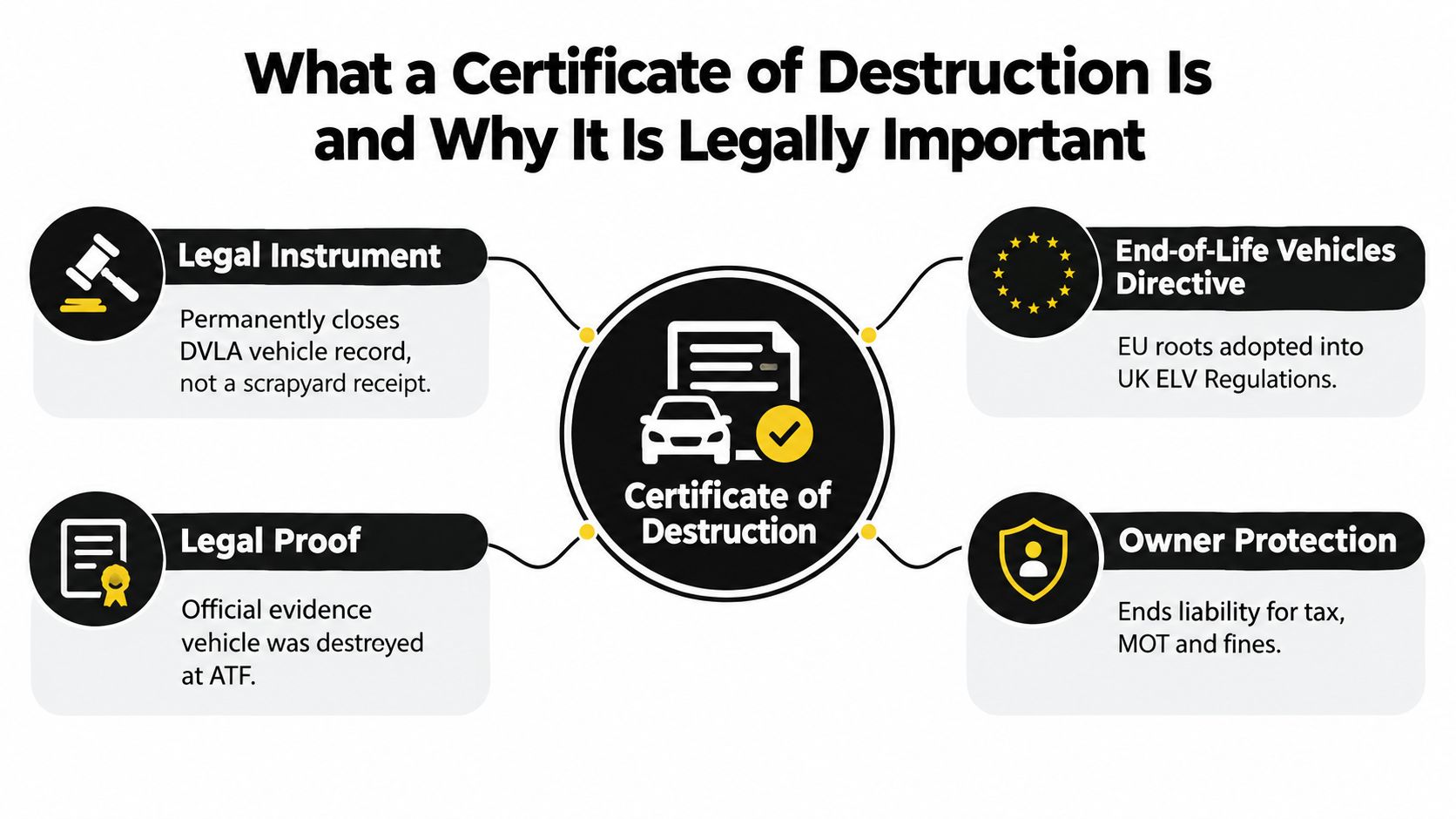
A Certificate of Destruction is a legal instrument, not an informal scrap receipt. It records that an ATF has accepted an end-of-life vehicle for treatment and has completed the formal destruction process required by the UK vehicle regulations.
The system is rooted in the End-of-Life Vehicles Regulations 2003. Regulation 27 makes CoD issuance mandatory when an ATF accepts a qualifying end-of-life vehicle, while regulation 29 requires the certificate to contain at least the information listed in Schedule 3. That structure places the UK within the wider European-style approach to vehicle depollution, recycling, and deregistration established in the early 2000s.
What happens inside the DVLA system
The legal effect is the part owners often miss. When the ATF raises the CoD through the DVLA system, the vehicle record is permanently closed. That means the registration no longer continues as an active keeper record waiting for another transfer or change of ownership.
The closure releases the owner from ongoing responsibility connected with the vehicle, including road tax, fines, and future liability, provided the vehicle has been processed correctly. Government guidance describes the CoD as proof that the vehicle was handed to a registered ATF and is no longer on the road. See the official DVLA CoD and Notification of Destruction service guidance for the controlled process.
That distinction explains why a broker, collector, or ordinary purchaser can’t substitute their own paperwork for the official certificate. They may arrange collection or transfer the vehicle to an ATF, but the ATF must complete the destruction record.
Why Schedule 3 matters
Schedule 3 sets the minimum information that must appear on the certificate. The requirement makes the CoD traceable to the specific vehicle and facility involved. It prevents a generic document saying only that “a car was scrapped” from being treated as equivalent legal proof.
The framework also supports lawful depollution. ATFs remove fluids, hazardous materials, and other components before dismantling and recycling the vehicle. The CoD therefore sits within a regulated treatment pathway, linking environmental handling with permanent deregistration.
For a seller, the practical test is simple: ask whether the document is an official CoD generated by the ATF through the DVLA service. If it’s only a collection receipt or payment record, the legal closure may not have happened.
How the Certificate of Destruction Differs from Other DVLA Documents
Vehicle paperwork becomes confusing because several documents can appear during a sale or scrappage transaction. They don’t all perform the same job. The V5C, the CoD, the Notification of Destruction, and a scrap receipt each belong to a different part of the process.
CoD vs other DVLA proof at a glance
| Document | Issuer | Legal effect | When you need it |
|---|---|---|---|
| Certificate of Destruction | The authorised treatment facility through the DVLA online system | Permanently closes the vehicle record after qualifying treatment | When a qualifying vehicle has been accepted for depollution and scrapping |
| Notification of Destruction | The authorised treatment facility through the DVLA online system | Notifies DVLA that the vehicle has been destroyed and supports automatic record closure | When the ATF completes the relevant destruction declaration |
| V5C logbook | DVLA issues the document to the registered keeper | Records vehicle and keeper details while the vehicle remains in the registration system | During normal ownership, sale, or keeper administration |
| Scrap or collection receipt | Collector, purchaser, or scrap business | Shows handover, payment, or collection, but doesn’t itself prove DVLA closure | As commercial evidence of the transaction |
A V5C isn’t a CoD. The logbook identifies the registered keeper and vehicle details, but it doesn’t prove that an end-of-life vehicle has been destroyed. Handing the V5C to a collector also doesn’t automatically close the DVLA record.
A Notification of Destruction is the electronic declaration used in the ATF workflow. The customer may receive a CoD as the practical proof, while DVLA receives the underlying notification electronically. The two terms relate closely, but they aren’t interchangeable pieces of customer paperwork.
Why informal receipts cause trouble
A weighbridge ticket, payment confirmation, or collection note can be useful if you need to establish when the vehicle changed hands. It won’t necessarily prove that a registered ATF accepted the vehicle, depolluted it, and closed the DVLA record.
DVLA guidance for waste sites says that the CoD must be generated once the vehicle has been decided for depollution and scrapping, and that the person bringing the vehicle to the site should receive it. After the CoD is completed, the DVLA record closes automatically, and no further action is processed, including a keeper change or issue of a V5C. The DVLA guidance for end-of-life vehicles at waste sites confirms this finality.
If you’re offered only a receipt, ask directly when and how the ATF will issue the official CoD. Don’t assume that a paid collection equals deregistration.
Which Vehicles Qualify for a Certificate of Destruction
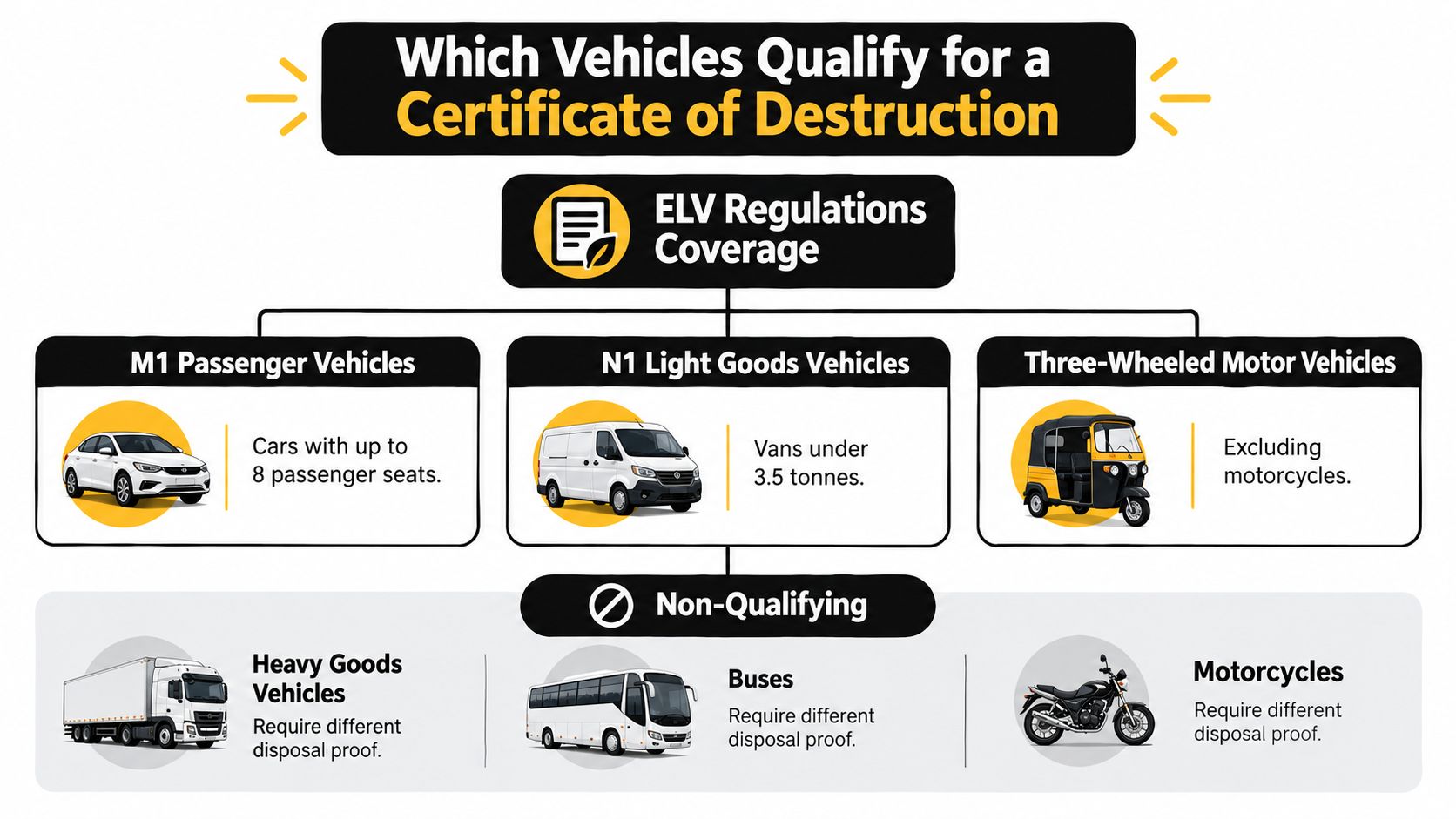
A CoD isn’t issued for every vehicle that reaches a scrapyard. The qualification depends on the vehicle category and whether it falls within the End of Life Directive and the UK End-of-Life Vehicles Regulations 2003.
The main legal category is the M1 passenger vehicle. This covers passenger cars designed for carrying people. In practical UK industry guidance, CoDs are also commonly issued for light goods vehicles up to 3,500 kg and eligible three-wheel motor vehicles, subject to the applicable rules.
Common qualifying examples
A passenger car: A family hatchback, saloon, estate, or small car that is being scrapped as an ELV will normally fall within the passenger vehicle framework.
A light goods vehicle: A qualifying van within the light goods category may receive a CoD where it falls within the applicable weight and regulatory scope. Industry guidance identifies light goods vehicles up to 3,500 kg as commonly covered.
An eligible three-wheel motor vehicle: Some three-wheel vehicles qualify, but the category has limits. The relevant guidance excludes tricycles from the commonly issued three-wheel vehicle description, so the ATF should confirm the classification rather than relying on appearance alone.
The government INF169 guide to Certificates of Destruction explains that CoDs should only be issued for vehicles covered by the relevant directive and regulations. The classification isn’t a technicality. It determines whether the ATF should create a CoD or use another disposal record.
Vehicles that need confirmation
Heavy goods vehicles, buses, motorcycles, and vehicles outside the ELV categories may not qualify for a legal CoD under this framework. That doesn’t mean they can be abandoned or handled informally. It means the operator must use the correct disposal and waste documentation for that vehicle type.
Ask the facility before collection if you’re unsure. Give the ATF the registration number, vehicle type, and any unusual details such as an import history, modified body, or three-wheel design.
Before collection: Confirm the vehicle category with the ATF, especially if it’s a van, motorcycle, tricycle, bus, or specialist vehicle.
A compliant facility should make the eligibility decision as part of its acceptance and check-in process. It shouldn’t promise a CoD for a vehicle that falls outside the legal scope just because the customer expects one.
How to Obtain a Certificate of Destruction Through an Authorised Treatment Facility
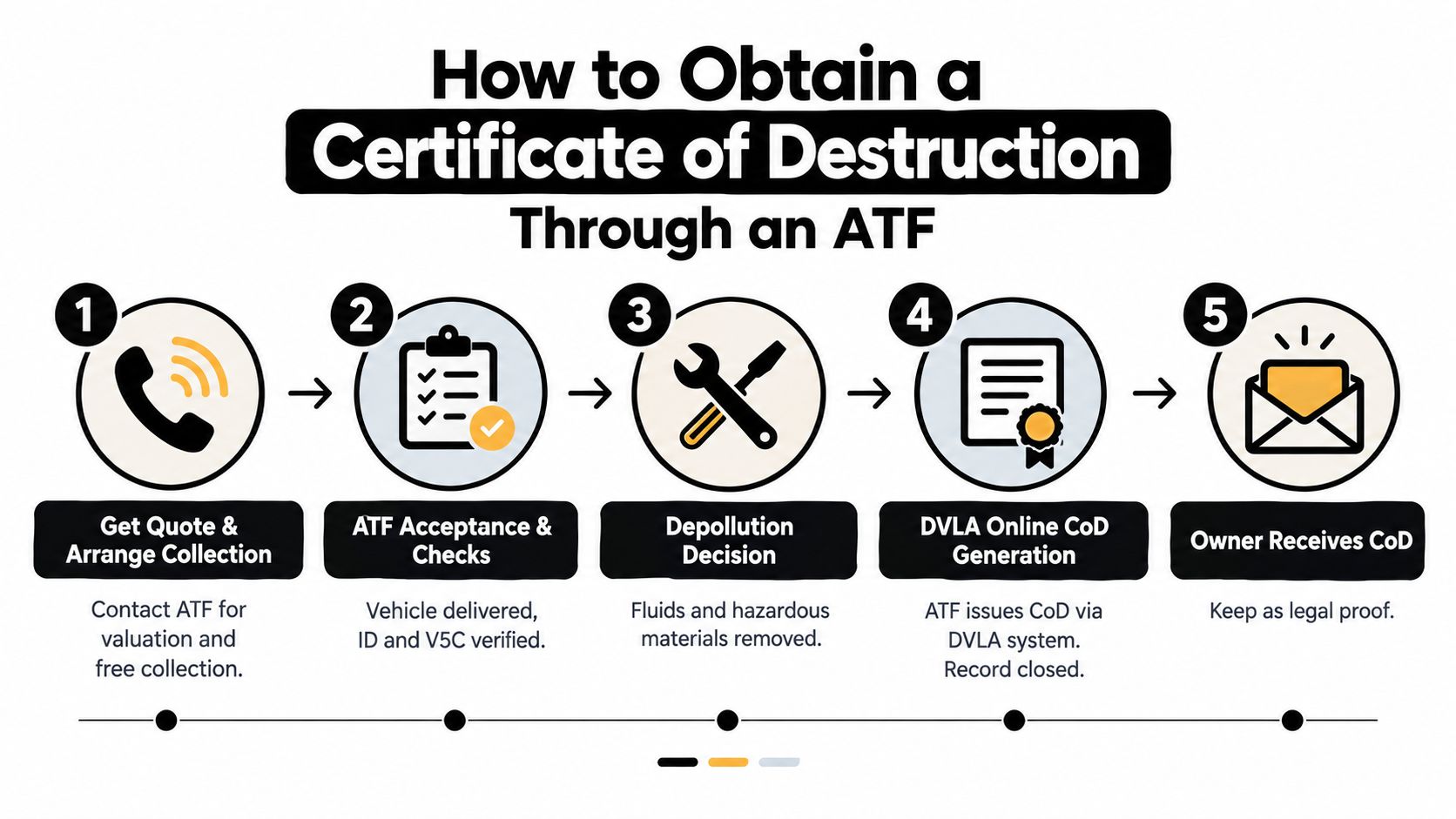
The process starts with the vehicle, not the paperwork. You arrange collection or delivery, the ATF accepts the vehicle, and the facility decides that it’s destined for depollution and scrapping. The CoD follows that treatment decision.
Only a person or company holding a valid ATF permit can access the online DVLA service. This control matters because the certificate is the event that closes the official record. A purchaser or unlicensed intermediary can’t generate a valid CoD independently.
The usual workflow
-
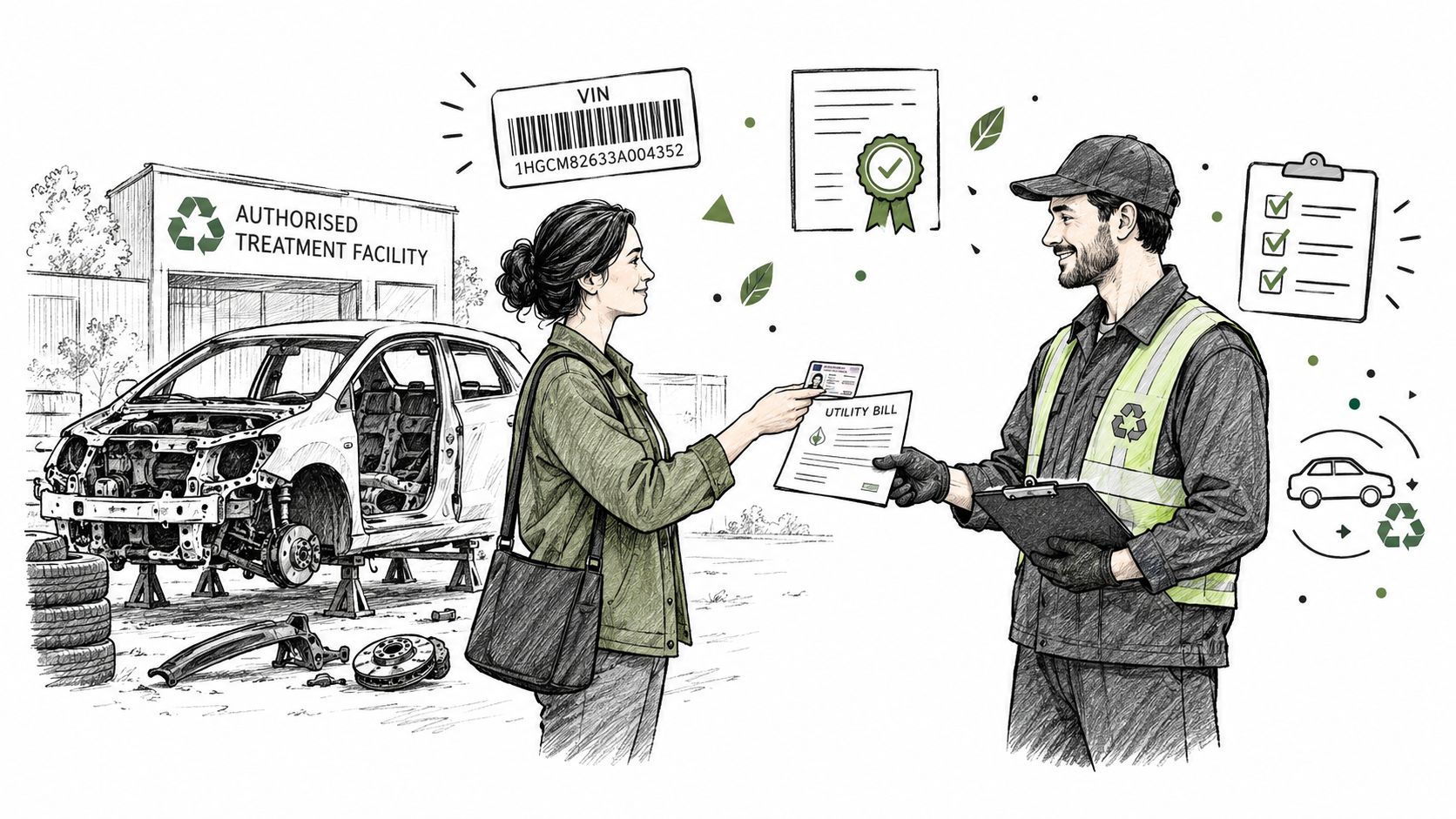
Arrange the handover. You provide the registration number and vehicle details, agree the collection or delivery arrangements, and confirm that the receiving business works with a registered ATF.
-
Complete ATF acceptance checks. The site or collection team verifies the vehicle information and records the person delivering it. The DVLA guidance on notifying a scrapped car also reinforces why accurate registration information matters.
-
Make the depollution decision. Once the vehicle is accepted as an ELV for treatment, the ATF moves it into the regulated depollution and scrapping workflow.
-
Generate the CoD online. The ATF submits the destruction information through the DVLA system. The notification closes the vehicle record automatically.
-
Give the certificate to the relevant person. The ATF may issue the physical CoD to the keeper or the person who delivered the vehicle. Keep it as permanent evidence.
How long issuance should take
Government guidance says that for a car, light van, or eligible three-wheeled vehicle, the CoD should be issued within 7 days after the vehicle has been depolluted or destroyed. The INF169 user guide sets out that operational expectation.
Some ATF networks issue the certificate immediately after the relevant checks and acceptance. Scrap A Vehicle states that it often immediately issues a CoD because it works with registered ATFs and scrapyards approved by the relevant regulatory bodies. Immediate issuance can remove uncertainty, but the legal requirement still depends on the ATF completing the correct process for the qualifying vehicle.
Before handover, prepare the V5C if you have it, check the registration number carefully, and retain the collection or delivery details. If the V5C is missing, tell the ATF rather than supplying guessed information.
What a Genuine Certificate of Destruction Looks Like and What It Must Contain
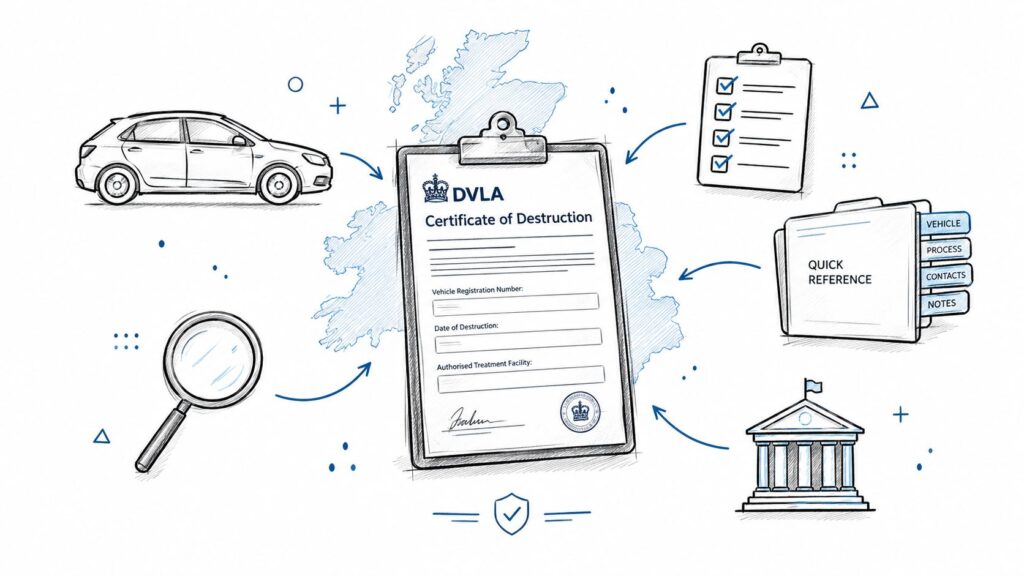
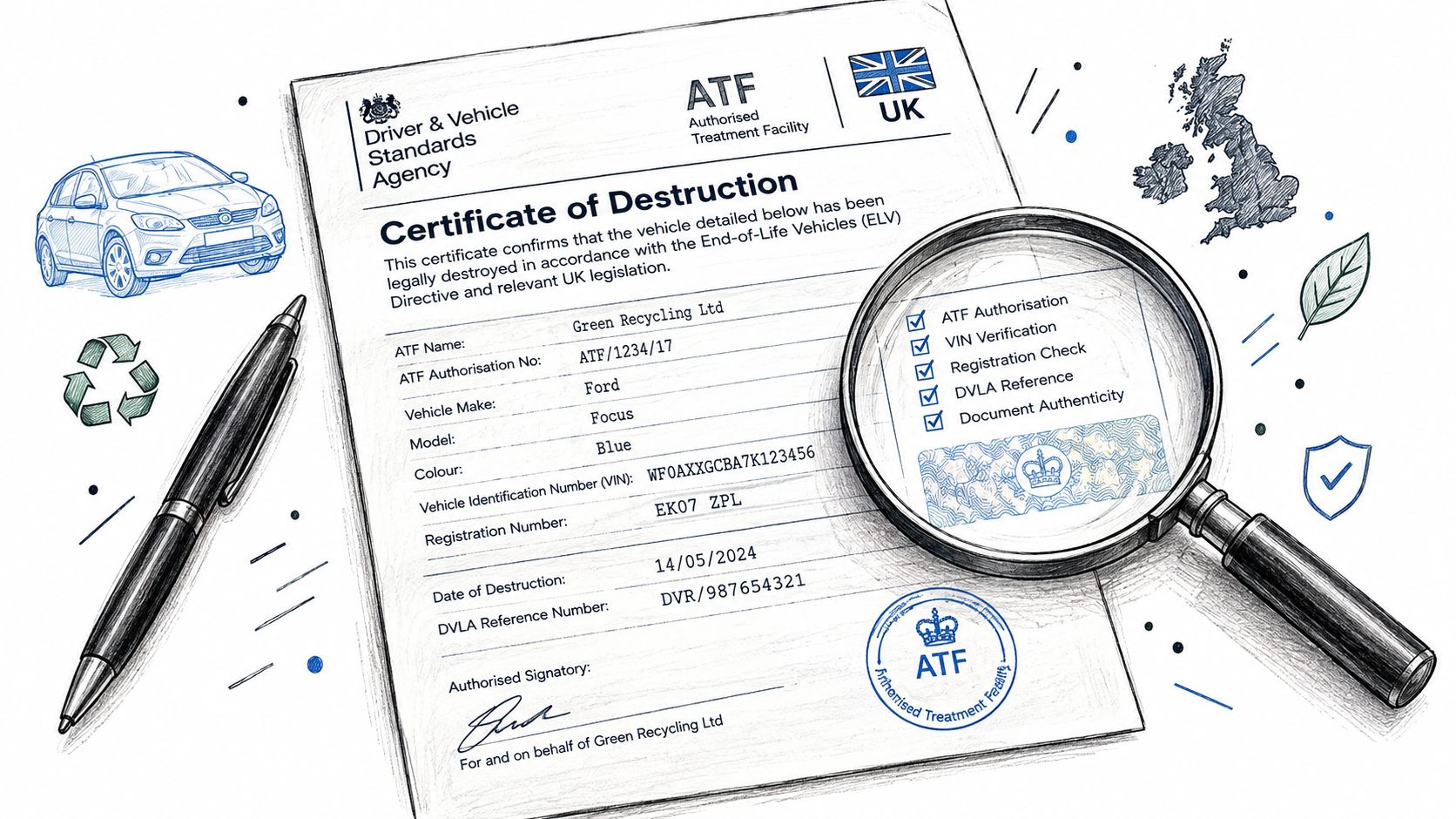
A genuine CoD should identify the vehicle, the treatment facility, and the destruction event clearly enough for the record to be audited. It won’t look like a generic receipt with a vehicle description and payment amount.
The legal foundation is Schedule 3 of the End-of-Life Vehicles Regulations. That schedule sets the minimum information the certificate must contain, so the document should include identifiable details rather than broad wording.
The fields to inspect
Start with the vehicle:
- Registration mark: It must match the vehicle you handed over.
- Vehicle identifiers: The certificate should connect the record to the relevant vehicle details.
- Date information: The destruction or treatment event should be identifiable.
- Keeper or deliverer details: The document should show who brought or surrendered the vehicle where required.
- ATF information: The issuing facility should be identifiable as the authorised operator.
Next, check the certificate’s relationship with DVLA. A genuine document should represent the ATF’s completed DVLA-system action, not merely a business-generated confirmation that the vehicle was collected.
The certificate may be issued to the keeper or the person who delivered the vehicle. That’s why you should confirm at handover who will receive it and whether it will arrive electronically, physically, or through another agreed method.
How to spot weak paperwork
Be cautious if the document:
- Calls itself a “scrap certificate” without identifying it as a DVLA Certificate of Destruction
- Omits the registration number or uses a number that doesn’t match your car
- Names a collector but doesn’t identify the ATF
- Provides only a payment figure or collection date
- Gives no indication that the DVLA destruction process was completed
The government INF169 guidance says the keeper should retain the CoD indefinitely. That long-term retention makes sense because the document is your evidence that the vehicle was handed to a registered ATF and is no longer on the road.
If any field is wrong, contact the issuing ATF promptly. Don’t edit the certificate yourself. The facility that created the DVLA record is the party best placed to correct an input error or explain what happened.
How the Certificate Protects Sellers From Fines and Ongoing Liability
The CoD protects the seller by creating a clear end point. Before the ATF submits the destruction notification, the vehicle can still appear in the DVLA system. Once the notification is completed, the record closes automatically.
That timing matters for vehicles collected near the end of a month. A collection team may have the car physically, while the DVLA record remains open because the ATF hasn’t yet completed the CoD declaration. Until the record closes, the former keeper may still face uncertainty over tax, enforcement correspondence, or other record-related obligations.
Why internal reconciliation matters
A disciplined ATF doesn’t rely on memory. It compares collected vehicles with completed CoD records and investigates anything that remains outstanding. Scrap A Vehicle describes a process that checks before the end of the month for vehicles collected but not yet CoD’d, with the aim of deregistering them before DVLA produces fines.
That process doesn’t replace the legal requirement. It supports timely completion by identifying the gap between physical collection and electronic destruction notification.
The vehicle leaving your driveway and the DVLA record closing are separate events. The CoD connects them.
A useful owner example is a damaged car collected from a workplace. The driver takes the car away, but the registration is entered incorrectly at check-in. The vehicle may reach the ATF, yet the destruction record could fail to match the correct DVLA record. Prompt reconciliation gives the operator a chance to identify and resolve the discrepancy.
Keep evidence after closure
Even when everything has gone smoothly, keep the CoD indefinitely. If a letter later arrives concerning the vehicle, the certificate gives you a direct document showing that the ATF accepted it and completed the destruction process.
The CoD doesn’t excuse a keeper from responding to a genuine mistake or enforcement notice. It gives you evidence to explain that responsibility ended through the regulated scrappage pathway. That’s much stronger than relying on a text message, bank transfer, or collection photograph.
Common Documentation Errors That Delay Your Certificate and How to Avoid Them
The most frustrating CoD delays often begin with a small check-in error. A vehicle can be collected successfully, paid for, and delivered to an ATF, yet the certificate process can still require investigation if the identifying information doesn’t line up.
The three recurring problems are straightforward:
- Missing certificate handover or paperwork: The customer doesn’t provide the expected V5C or doesn’t confirm what documentation is available.
- Incorrect registration number: A character is mistyped, read incorrectly, or supplied from the wrong vehicle.
- Mismatched keeper details: The person delivering the vehicle, the registered keeper, and the information recorded at acceptance don’t align.
A simple pre-collection check
Before the vehicle leaves, write down the registration number exactly as it appears on the number plates and V5C. Check letters and numbers separately, especially where a plate character could be misread.
Prepare the documents you have, but don’t invent information if something is missing. Tell the ATF about a missing V5C, a recent change of address, a company-owned vehicle, or a vehicle being delivered by someone other than the keeper.
At check-in, ask the operator to repeat the registration number back to you. Confirm that the vehicle description matches the car being handed over and ask how the CoD will be issued.
How structured check-in prevents avoidable errors
A proper check-in process captures the registration number, vehicle identity, delivery details, and available paperwork before the ATF submits the destruction record. Scrap A Vehicle says its check-in process is designed to identify registration and documentation errors before they cause a problem.
If you notice an error after collection, contact the operator immediately. Give the correct registration number, explain what was entered, and keep any collection confirmation. The ATF must handle corrections through the appropriate process because owners can’t amend the DVLA destruction record themselves.
The publisher says its ATF network has produced 20,000 CoDs in the last 12 months, based on its own operational information. That figure doesn’t change the legal test for an individual vehicle, but it indicates why a repeatable check-in and reconciliation process matters at scale.
Use the Scrap A Vehicle service to arrange compliant vehicle collection through its ATF network, confirm the registration details at handover, and ask when your official DVLA Certificate of Destruction will be issued. Keeping the certificate indefinitely will give you a clear record that the vehicle was processed and your DVLA responsibility ended.