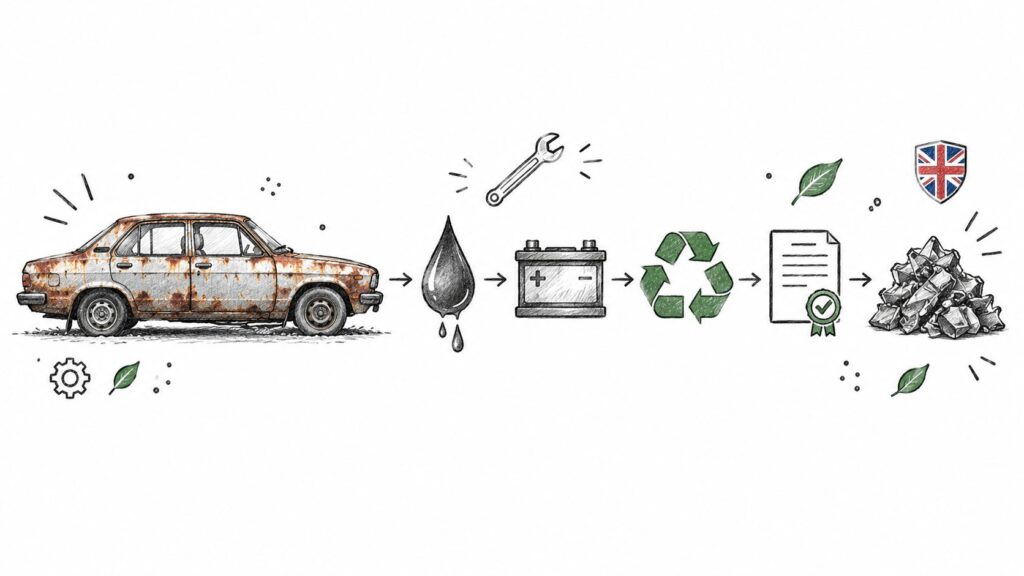
Your car has failed its MOT, the repair quote is higher than you expected, and it’s sitting on the drive losing value by the day. Perhaps it won’t start at all, or perhaps you’ve reached the point where tax, insurance, servicing, and repairs no longer make financial sense. The difficult part isn’t only finding someone to take it away. You need the right buyer, the right paperwork, and a clear decision about whether the car should be scrapped, sold for salvage, or dismantled for parts.
An end of life vehicle must enter a controlled process. In the UK, that means using an Authorised Treatment Facility, checking who is collecting the vehicle, and making sure the DVLA receives the correct notification. The guide below gives you the owner’s version of that process, including how to protect yourself from illegal collectors and weak offers.
Table of Contents
- What This Guide Covers and Who It Is For
- What Counts as an End of Life Vehicle in the UK
- How ATFs Depollute and Issue the Certificate of Destruction
- Owner Options When Your Car Reaches the End of the Road
- The Scrap A Vehicle Workflow Step by Step
- Risks, Red Flags, and How to Verify a Legitimate Buyer
- Putting It All Together and Getting Paid the Right Amount
What This Guide Covers and Who It Is For
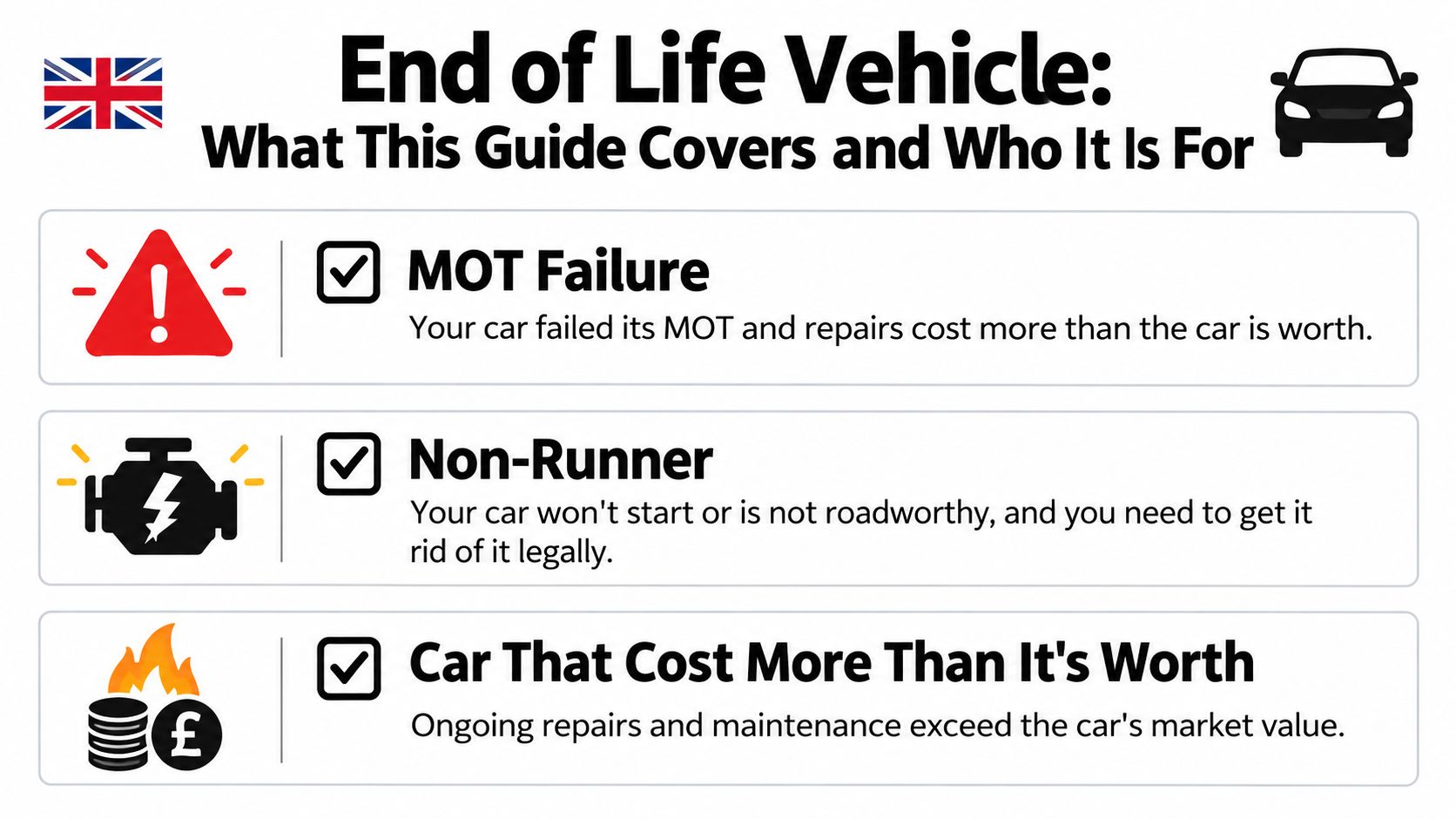
You are likely reading this after an MOT failure, a breakdown, or a repair quote that makes continued ownership hard to justify. This guide is for keepers deciding whether to scrap the car, sell it for salvage, or recover its parts value.
Accepting the first collection offer can cost you money and leave you exposed. A collector who removes the vehicle quickly but fails to provide the correct disposal evidence may leave you dealing with tax records, penalties, or questions about what happens to the car afterwards. Check the buyer, confirm the collection arrangements, and agree the payment before the vehicle leaves.
You’ll learn what legally counts as an ELV, because damage, a failed MOT, or a non-running engine does not automatically make a vehicle scrap. Condition, mileage, repair prospects, ownership status, and paperwork determine whether disposal, salvage, or parts recovery makes better financial sense.
The decisions that affect your risk
The guide follows the keeper’s decisions through a legitimate Authorised Treatment Facility, including how to check the route offered and what paperwork should follow collection. It explains the controlled treatment process, including removal of batteries, airbags, fuel, oils, coolant, brake fluid, and air-conditioning gases before dismantling or shredding, in line with Environment Agency ATF requirements.
The Certificate of Destruction gets specific attention. It confirms that the vehicle has entered the formal disposal process and gives you evidence to retain. You’ll also see what to check if a buyer offers collection without clearly explaining the certificate or DVLA notification.
The owner options are compared in practical terms, followed by the Scrap A Vehicle process from quote to payment. A short verification routine helps you check the buyer before collection, rather than discovering a problem after the car has gone.
Practical rule: Judge a scrap service by its paperwork, price clarity, and legal trail, not just its collection speed.
The closing action plan covers quotes, ATF checks, collection, payment, DVLA records, and the files to keep. It is written for owners who want the car removed properly and the amount agreed fairly.
What Counts as an End of Life Vehicle in the UK
A vehicle becomes an end of life vehicle when its registered keeper decides to discard it rather than repair it, sell it for continued road use, or keep it for parts. The owner’s decision matters, but so does the route chosen. Handing the vehicle to an authorised treatment operator places it into formal disposal.
The UK framework comes from the End-of-Life Vehicles (Producer Responsibility) Regulations 2005. It sets national targets of at least 95% reuse and recovery and 85% reuse and recycling by average weight for each ELV. Producers must meet annual targets and report recovery, reuse, and recycling information to Defra. The GOV.UK guidance also explains that tyres can contribute around 3 percentage points towards the relevant reuse and recycling obligation.
For an owner, those targets provide a practical test. A regulated route involves controlled treatment, not loading the car onto a truck and selling the shell as mixed metal. The facility should deal with hazardous materials, assess reusable components, separate recyclable materials, and send the remaining vehicle for controlled recycling or recovery.
An ELV isn’t the same as every unwanted car
Accident damage does not automatically make a car an ELV. It may still have salvage value. A failed MOT does not settle the question either, because the vehicle might be repairable and suitable for a trader. A SORN vehicle retained for parts remains with its keeper until the owner chooses to dispose of it.
| Category | Definition | Typical buyer | Required paperwork |
|---|---|---|---|
| End of life vehicle | A vehicle being discarded and sent for formal treatment | Authorised Treatment Facility | V5C details, collection record, Certificate of Destruction |
| Damaged but roadworthy car | A vehicle that can still be used or repaired for road use | Private buyer, trader, or salvage buyer | V5C transfer and sale record |
| Salvage-category write-off | A damaged vehicle that may retain repairable or resale value | Salvage trader, repairer, or parts buyer | Sale record, category details, V5C where applicable |
| SORN vehicle kept for parts | A vehicle declared off-road but retained by the keeper | Owner or parts buyer | SORN compliance, sale or disposal paperwork if later transferred |
Official UK reporting recorded 92.8% reuse, recycling, and recovery in 2018, below the 95% target. The narrower reuse and recycling result was 85.2%, just above its threshold. The reported total was about 1,354,008 tonnes in 2018, compared with 1,359,465 tonnes in 2017, according to the Defra-linked environmental dataset.
The owner’s practical lesson is simple. Vehicle weight alone does not prove proper recycling. Before collection, ask where the car is going, confirm the buyer’s treatment route, and establish how DVLA notification will be handled. If those answers are vague, keep the keys and choose another buyer.
How ATFs Depollute and Issue the Certificate of Destruction
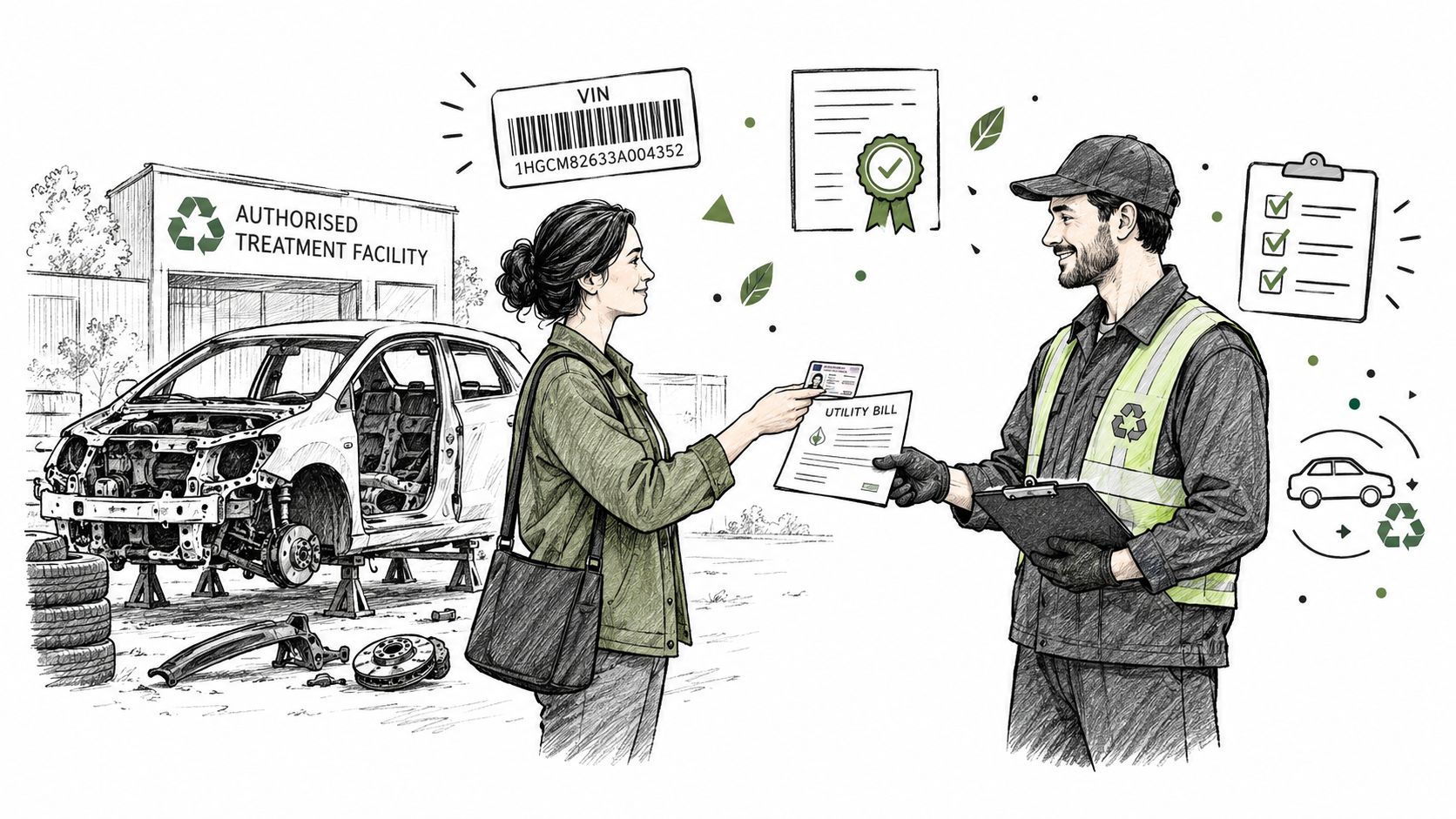
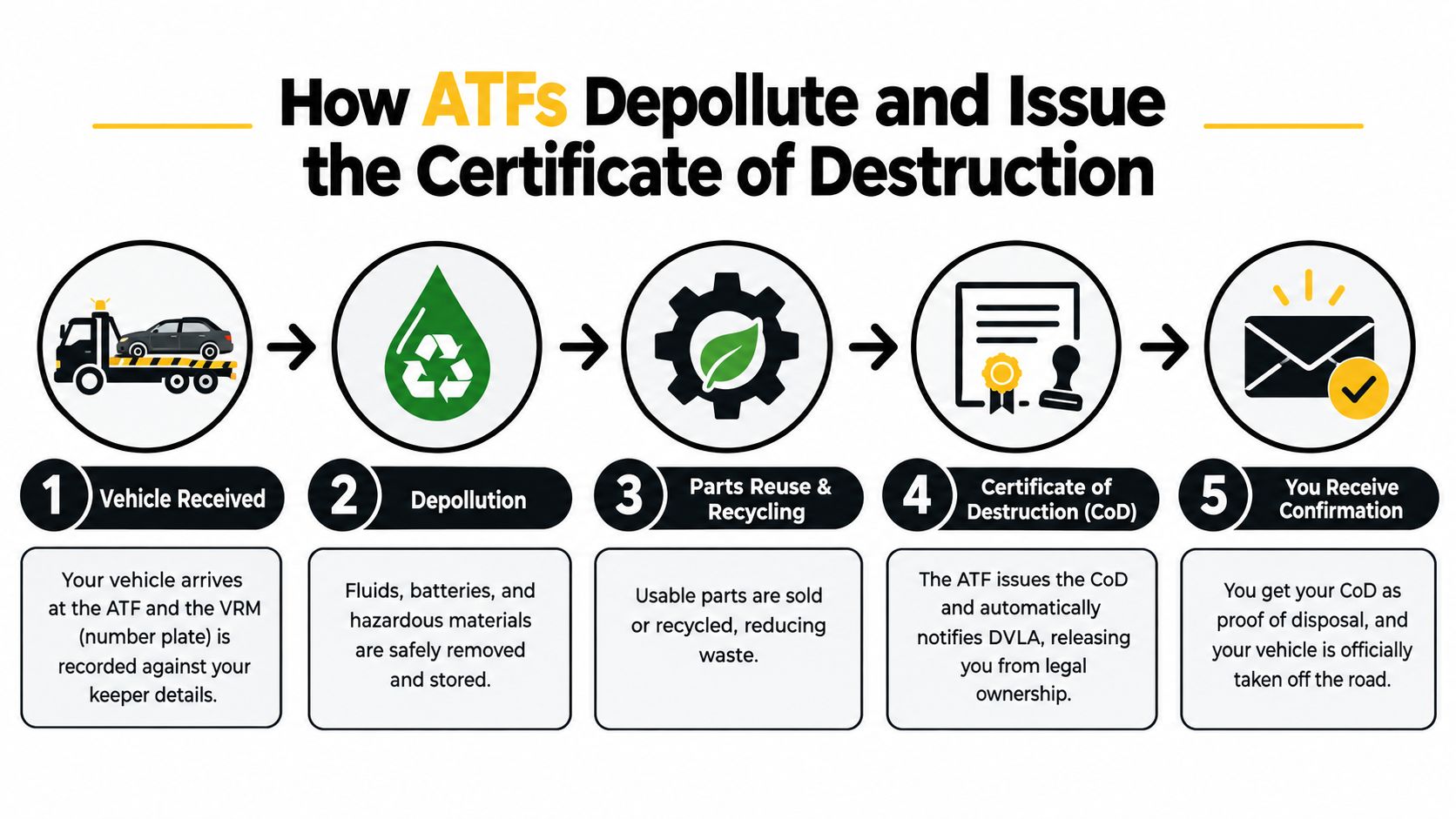
Your protection starts at handover. An authorised treatment facility records the registration number, confirms the vehicle identity, and links the intake record to the keeper’s details. That traceability separates a controlled disposal from an informal collection with no reliable paper trail.
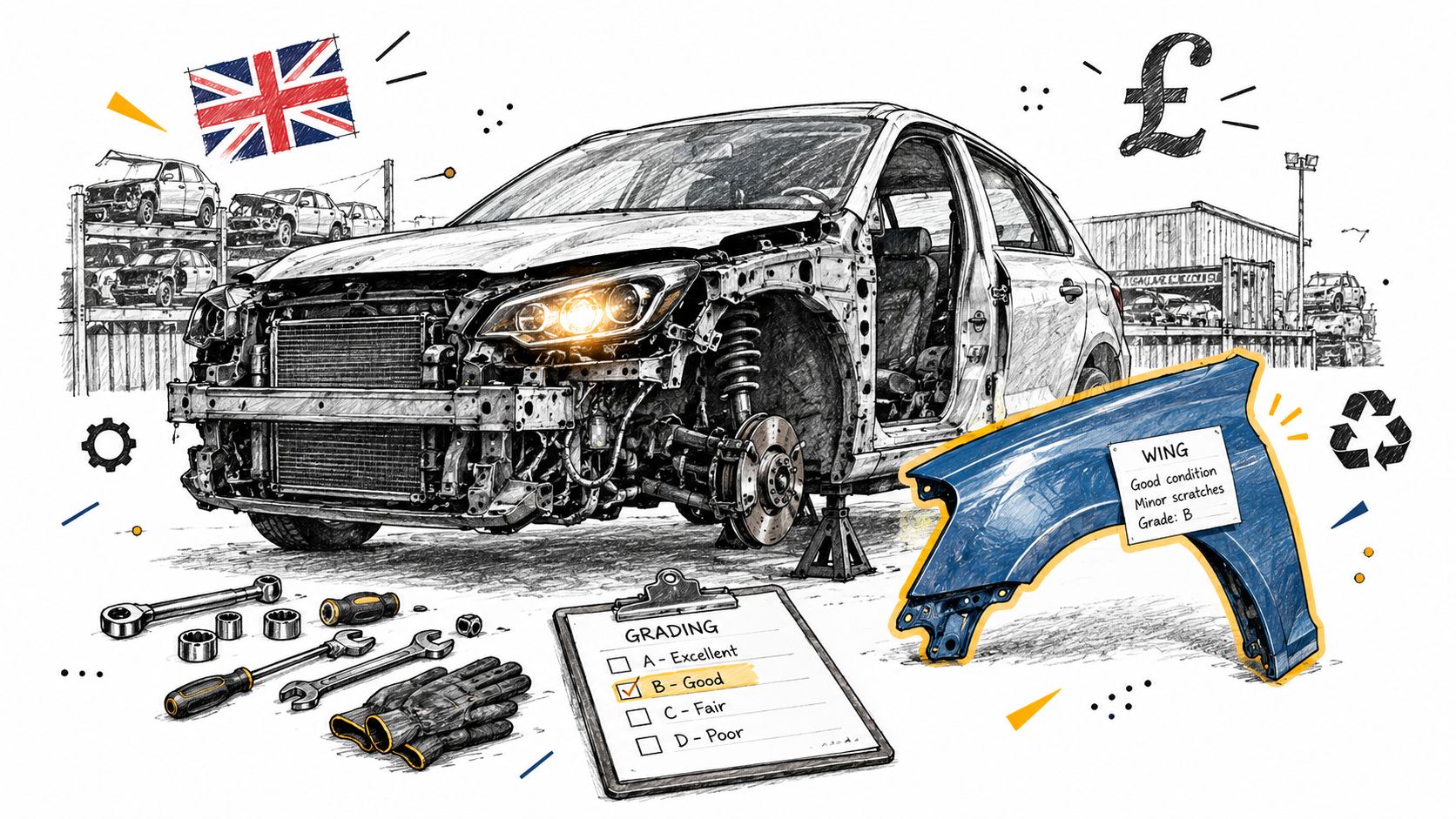
The facility carries out depollution before dismantling or shredding. Fuel, oils, coolant, antifreeze, brake fluid, and air-conditioning gases must be removed because they can contaminate soil, water, equipment, and later recycling streams. Ask the buyer to confirm that the vehicle is going to an ATF, not an unknown yard.
What the facility removes
The operator’s treatment duties include removing batteries, liquefied gas tanks, explosive components such as airbags, and operational fluids before further processing. The Environment Agency treatment requirements set out the controls the facility must follow.
The practical sequence normally includes:
- Secure receipt and identification. The operator confirms the vehicle identity and records its arrival.
- Hazard removal. Batteries, gas tanks, airbags, and other hazardous components are handled safely.
- Fluid drainage. Fuel, oils, coolants, antifreeze, brake fluid, and refrigerant gases are removed and stored correctly.
- Parts assessment. Usable components, tyres, catalysts, glass, plastics, and metals are separated where recovery is viable.
- Final material processing. The remaining shell is prepared for shredding, recycling, or recovery.
For the keeper, the key point is control. The car enters a regulated treatment route instead of being dismantled casually. You can compare the steps with this Certificate of Destruction and vehicle recycling guide.
Why the CoD matters
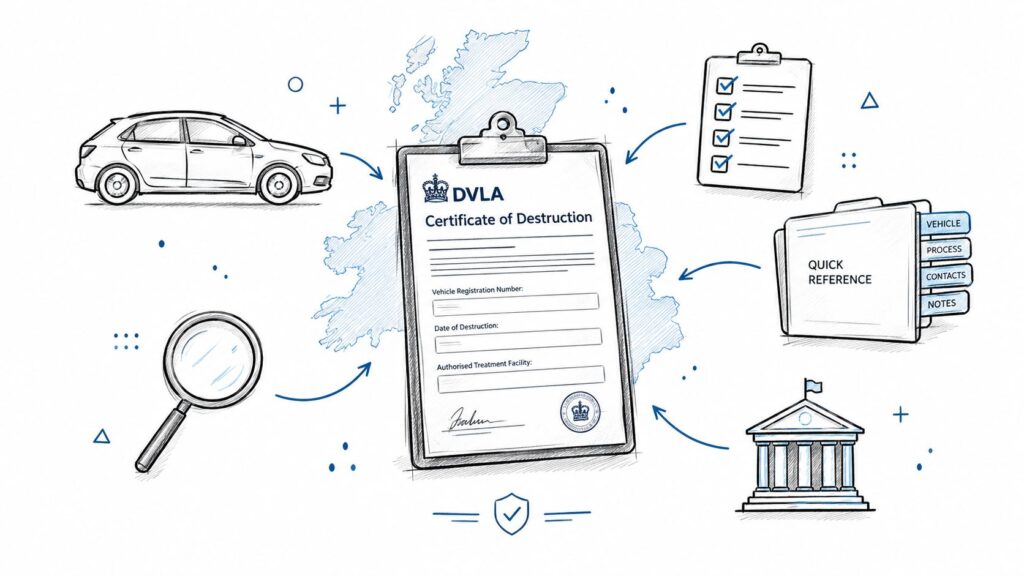
The Certificate of Destruction is formal proof that the vehicle has been accepted for destruction. The ATF sends the relevant treatment information to DVLA, and you receive the certificate or disposal confirmation connected with the vehicle.
Keep the CoD with your sale record, collection details, payment confirmation, and handover photographs. Those records establish when the car left your control and identify the operator that accepted responsibility if a dispute arises later.
Do not accept “we’ll sort the DVLA later” instead of documented confirmation. Your legal protection comes from recorded treatment and notification, not a verbal promise made on your driveway.
Owner Options When Your Car Reaches the End of the Road
You’ve usually got three sensible choices. Scrap it through an ATF, sell it for salvage, or sell its parts. The best route depends less on how old the car looks and more on whether its remaining value is in the whole vehicle, repairable condition, or individual components.
Scrapping is the cleanest option when the repair bill exceeds realistic resale value, the vehicle is badly damaged, or the car is a non-runner with little prospect of economical repair. The ATF handles depollution and formal disposal, and the keeper should receive a Certificate of Destruction.
Salvage may produce a better return when the car is relatively desirable, lightly damaged, or mechanically sound despite a failed MOT. A salvage buyer may repair and resell it, so the vehicle doesn’t necessarily enter the ELV route. That means you need clear written confirmation of the sale arrangement and the buyer’s intended use.
Parting the car out can work for a popular model with sought-after engines, gearboxes, body panels, lights, interior trim, or electronic modules. It also demands time, storage, listings, packaging, customer messages, and responsible disposal of fluids and unusable remains. Most owners underestimate the work involved.
| Option | Best when | Paperwork produced | Typical payment speed | Keeper effort |
|---|---|---|---|---|
| ATF scrappage | Repairs exceed value, or the vehicle is beyond economical use | Collection record and Certificate of Destruction | Usually at collection, subject to buyer terms | Low |
| Salvage sale | The vehicle has repairable damage or continued resale value | Sale record and ownership transfer paperwork | At handover or under agreed terms | Moderate |
| Part-out | Components have strong demand and you have time and space | Individual sale records, disposal evidence for remains | Staged as parts sell | High |
Mileage matters because a high-mileage vehicle may still contain valuable parts, while a lower-mileage car can be a poor salvage proposition if structural damage is severe. Outstanding finance must be resolved before sale, and a write-off category should be disclosed accurately.
The worst option is leaving an unwanted car uninsured and unattended while hoping to decide later. Deal with the vehicle, its tax position, and its paperwork before the problem grows.
A SORN declaration doesn’t transfer responsibility to anyone else. If you’re scrapping the vehicle, arrange collection through an authorised route rather than leaving it on private land indefinitely.
The Scrap A Vehicle Workflow Step by Step
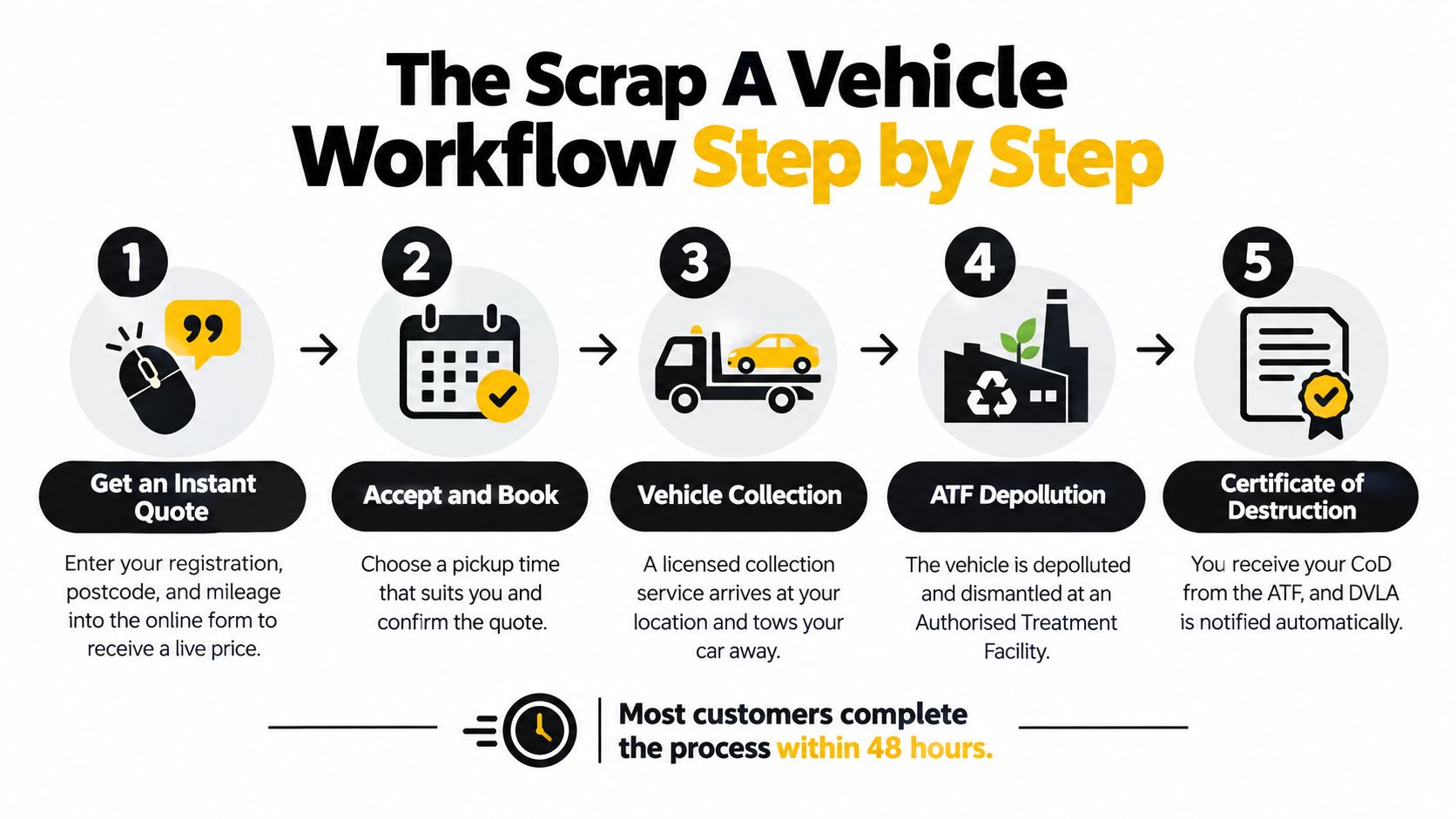
The process should feel predictable. You provide accurate vehicle details, receive an offer, agree collection, verify the driver, and keep evidence of payment and disposal.
Start with an accurate quote
The online form asks for the registration, postcode, mileage, and condition. Describe the car. State whether it starts, rolls, has missing wheels, holds a valid MOT, or has accident damage. A non-runner needs different collection equipment from a driveable car, and hiding a major fault can create an argument at the kerb.
The matched offer should reflect more than bare metal. Parts, alloy wheels, catalytic converter, model demand, and salvage potential can all affect the valuation. Compare the offer against at least one alternative, but don’t compare a formal ATF service with a cash collector until you’ve included the value of the paperwork and legal protection.
Book and prepare the handover
Choose a collection slot and remove personal belongings, parking permits, toll tags, fuel cards, documents, and aftermarket equipment you intend to retain. Have the V5C ready and make sure the keeper named on the registration understands the handover.
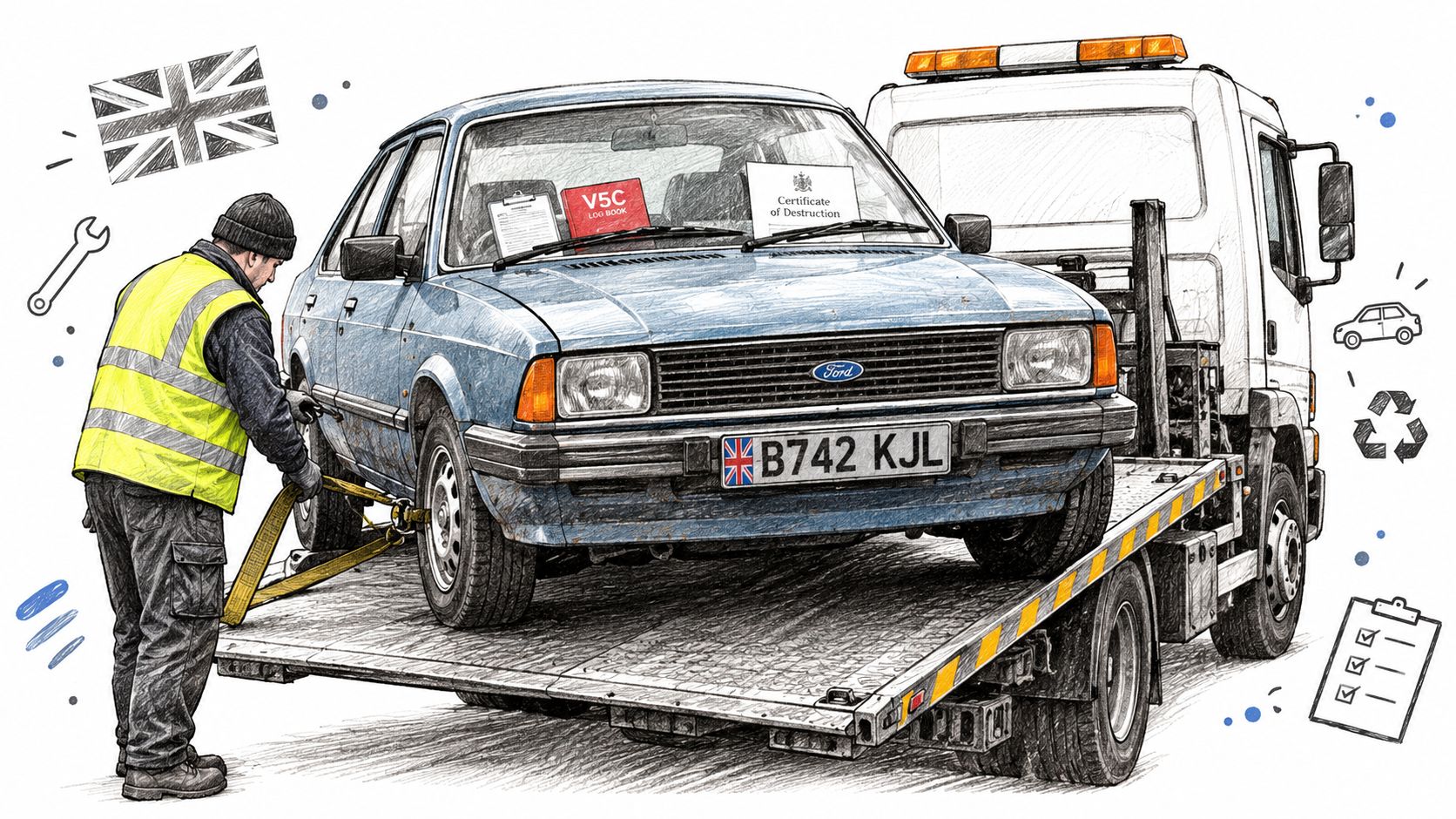
On collection day, check the driver and collection vehicle details. Photograph the car, its number plate, and its condition before loading. Read the handover or transfer note before signing it, and don’t sign a blank document.
The stated service workflow includes free collection, a typical 24-hour pickup from acceptance, and instant Faster Payment on collection, as set out in the publisher information. Treat the payment as incomplete until the money appears in your bank account and you’ve checked the amount.
The car then goes to an ATF for depollution and dismantling. You should receive the Certificate of Destruction from the ATF or through the arranged service, while DVLA is notified through the formal process.
Keep these records:
- The accepted quote: Save the agreed price and vehicle description.
- Collection evidence: Retain the signed handover document and photographs.
- Payment proof: Keep the bank confirmation showing the Faster Payment.
- Disposal proof: File the Certificate of Destruction with your vehicle documents.
This video gives a visual overview of the owner-facing collection and recycling journey.
Risks, Red Flags, and How to Verify a Legitimate Buyer
A collector who arrives quickly isn’t necessarily a legitimate disposal operator. The dangerous offer is the one that removes the car without leaving a reliable trail.
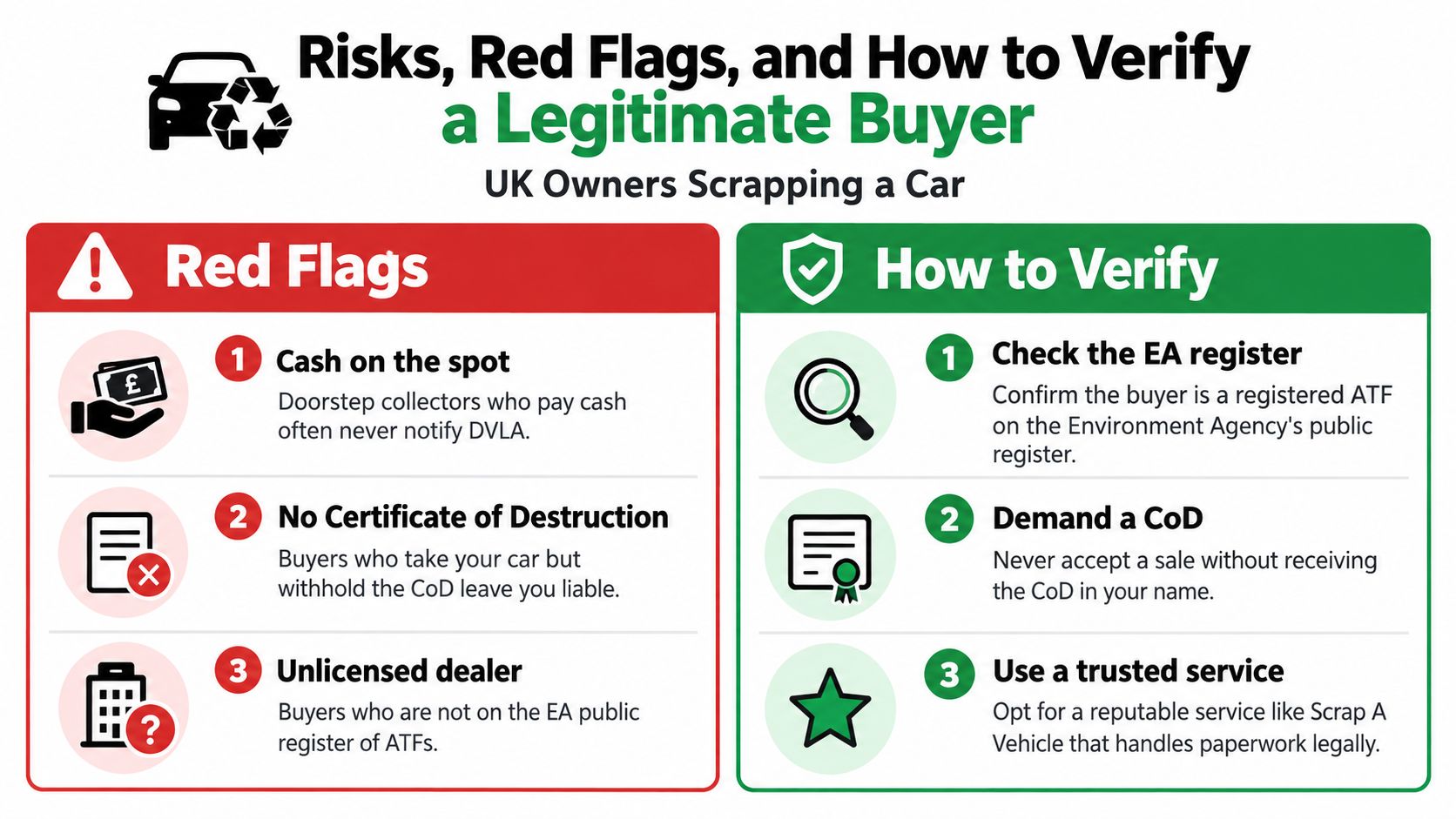
Some doorstep buyers pay cash, provide little paperwork, and disappear. If the vehicle is later driven uninsured, abandoned, or connected with an offence, you may struggle to prove when it left your possession. A buyer who refuses to discuss the Certificate of Destruction should be rejected immediately.
Run the five-minute check
Use the Environment Agency public register of authorised treatment facilities to confirm the facility’s name and location. Don’t rely on a trading name alone. Ask which ATF will receive your vehicle and check that the details match.
Then ask the collector for evidence of waste carrier registration. A collector who can’t identify the carrier, treatment facility, or paperwork route isn’t giving you enough information to proceed.
Before agreeing, confirm the following in writing:
- ATF destination: Ask for the named authorised facility.
- DVLA notification: Confirm who submits the disposal information.
- Certificate of Destruction: Ask when and how you’ll receive it.
- Final price: Get the agreed amount and collection conditions in writing.
- Payment method: Reject unclear promises about cash or later payment.
- Vehicle description: Make sure the offer records non-runner status and major damage.
The 2025 competition-law case referenced in the verified brief confirmed that manufacturers must provide a free recycling route for ELVs with no or negative value. That reinforces the principle that the system is meant to be traceable and compliant, not dependent on an unverified collector turning up with a trailer.
Don’t confuse convenience with protection
A cash payment can look attractive because it feels immediate. It doesn’t prove that the car has been destroyed, depolluted, or reported to DVLA. A written record, bank payment, named ATF, and CoD give you far stronger evidence.
If a buyer pressures you to hand over the V5C without explaining the process, refuses to provide a collection receipt, or changes the price after seeing the car, stop the transaction.
Putting It All Together and Getting Paid the Right Amount
Treat disposal as a short project. First decide whether the vehicle has reached the end of its useful life or still offers salvage value. Then obtain competing quotes and compare the full service, including collection, payment timing, ATF treatment, and paperwork.
A fair valuation depends on more than the vehicle shell. Condition, usable parts, alloy wheels, the catalytic converter, model demand, and whether the car starts can all affect the offer. A non-runner may require specialist loading, while a damaged but complete vehicle can be worth more for salvage than its scrap weight suggests.
Your action list for this week
- Choose the route. Select ATF scrappage, salvage, or part-out according to repair cost, condition, mileage, and demand.
- Gather documents. Find the V5C, keys, MOT information, finance details, and repair estimates.
- Request competing quotes. Describe the vehicle accurately and ask whether each price is fixed.
- Verify the operator. Check the named facility against the Environment Agency register and confirm the waste carrier arrangements.
- Book collection. Agree the time, loading requirements, payment method, and paperwork before arrival.
- Record handover. Photograph the vehicle, check the collection note, and retain the signed copy.
- Confirm payment. Check that the Faster Payment has reached your account before the vehicle leaves.
- Keep the CoD. File the Certificate of Destruction and any DVLA confirmation with your records.
The UK handled about 1,354,008 tonnes of ELVs in 2018, compared with 1,359,465 tonnes in 2017, as noted earlier. That volume shows why formal treatment matters, but your protection depends on the individual collection record, payment evidence, and CoD.
Do not let a quick collection replace proper records. After handover, check your bank statement, retain every disposal document, and watch for tax-related correspondence. If the buyer has not supplied the promised certificate or confirmation, contact them promptly and keep written records of each message.
Scrap A Vehicle provides online valuations, free UK collection, same-day bank payment on handover, and disposal through licensed Authorised Treatment Facilities. Prepare your vehicle details and visit Scrap A Vehicle to request a quote and arrange a documented end-of-life vehicle collection.