That old car on your drive isn’t just clutter anymore. It’s still tied to your name, still sitting in the DVLA record, and still capable of causing grief long after it stopped moving.
Many assume car disposal in the UK is one handover and done. It isn’t. It’s a chain. The car changes legal status, the right site has to take it, the DVLA record has to be closed, and the Certificate of Destruction has to exist. Miss one link and you can stay on the hook for a vehicle you thought had gone.
Table of Contents
- When Disposal Stops Being Optional
- Your Four Realistic Options in the UK
- How to Scrap a Car Step by Step
- DVLA Paperwork and the Certificate of Destruction
- Why Licensed ATFs Matter More Than the Quoted Price
- Common Disposal Mistakes UK Owners Make
- What to Do Before You Book a Collection
When Disposal Stops Being Optional
Three winters on the drive. Flat battery. Green on the seals. MOT long gone. Tax deadline creeping up. That’s usually when people finally realise they’re not dealing with an “old motor” anymore. They’re dealing with unfinished paperwork attached to a dead asset.
In practice, disposal stops being optional when keeping the car becomes more expensive, more risky, or more annoying than getting rid of it properly. That could be because it won’t start, because the council has taken an interest, or because you’ve had enough of paying to store something that’s going nowhere.
Treat it like a compliance chain
The mistake is thinking the job ends when a truck turns up.
It doesn’t.
You need three things to happen:
- The vehicle leaves your possession
- The destruction is notified correctly
- The DVLA record is closed with a Certificate of Destruction
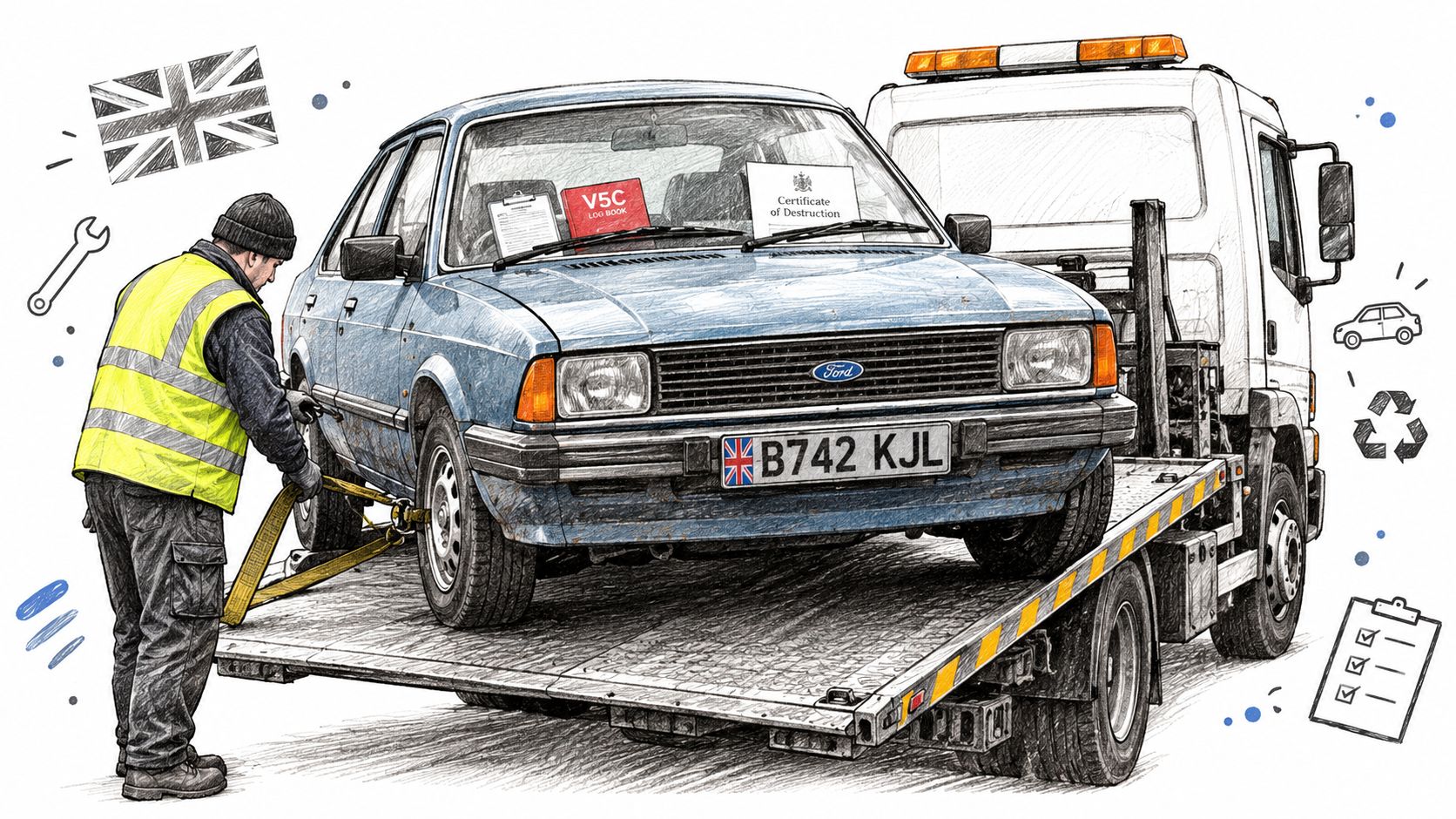
The UK already has a mature legal system for this. GOV.UK’s guidance says scrap cars must be issued an official Certificate of Destruction, and that process applies to passenger vehicles, light goods vehicles under 3.5 tonnes, and 3-wheeled motor vehicles through the DVLA destruction system used by authorised treatment facilities, as set out in DVLA guidance on Certificates of Destruction.
Practical rule: If you can’t say who is closing the DVLA record and issuing the CoD, you haven’t finished disposing of the car.
Why this matters now
This isn’t a niche problem. The Scottish Environment Protection Agency says around 2 million new vehicles are registered in the UK each year and a similar number are scrapped, producing about 2 million tonnes of vehicle waste annually. The same source notes an ageing car parc, with one 2026 analysis reporting 8.67 million licensed cars aged 13 years or more, equal to 25% of a 34.5 million-vehicle fleet. Older cars tip into uneconomic repairs faster, which means more owners end up needing documented disposal through the proper route, according to SEPA’s ELV factsheet.
That’s why I tell people to stop thinking “Who’ll take it?” and start asking “Who clears me off it?”
Your Four Realistic Options in the UK
You’ve usually got four real routes. Scrap it. Sell it. Donate it. Break it for parts. The right answer depends on condition, time, and whether the car still has a proper life left in it.
Choosing the right route
| Car condition | Best route | Typical UK value |
|---|---|---|
| Non-runner, failed MOT, severe corrosion, major fault | Scrap at an ATF | Usually scrap value or salvage value, depending on recoverable parts |
| Roadworthy, current MOT, presentable condition | Sell privately or to a dealer | Often above scrap value |
| Roadworthy and you want a straightforward exit with charitable intent | Donate | Financial return varies, but disposal is cleaner and simpler |
| Older vehicle with desirable components but weak whole-car demand | Part-out | Can exceed scrap value if you know what you’re doing |
Scrap at an ATF
If the car has failed on structural issues, emissions, or expensive mechanical faults, scrapping is usually the cleanest answer. It’s also the legal answer when you want the vehicle properly depolluted, dismantled, and removed from the register.
UK ELV disposal follows a hard compliance route. The vehicle goes to an Authorised Treatment Facility, the ATF depollutes and dismantles it, and the last owner gets a Certificate of Destruction so DVLA can remove it from the register. The statutory benchmark is 95% recovery and 85% recycling by average vehicle weight, with producers reporting performance to Defra, as outlined in the UK end-of-life vehicle dataset and regulatory summary.
Sell it if it still has life left
If it has an MOT, decent tyres, and no nasty surprises, selling can beat scrap. You need patience, though. Buyers ask questions, haggle, vanish, then reappear three days later offering less.
This route suits people who can wait and who have a car that still looks usable rather than terminal.
Donation works for some owners
If the car is roadworthy and you care more about convenience and cause than squeezing every pound out of it, donation can make sense. It’s not for everyone, but it’s a decent route for people who want the car gone without the faff of private sale.
Part-out can pay, but it’s work
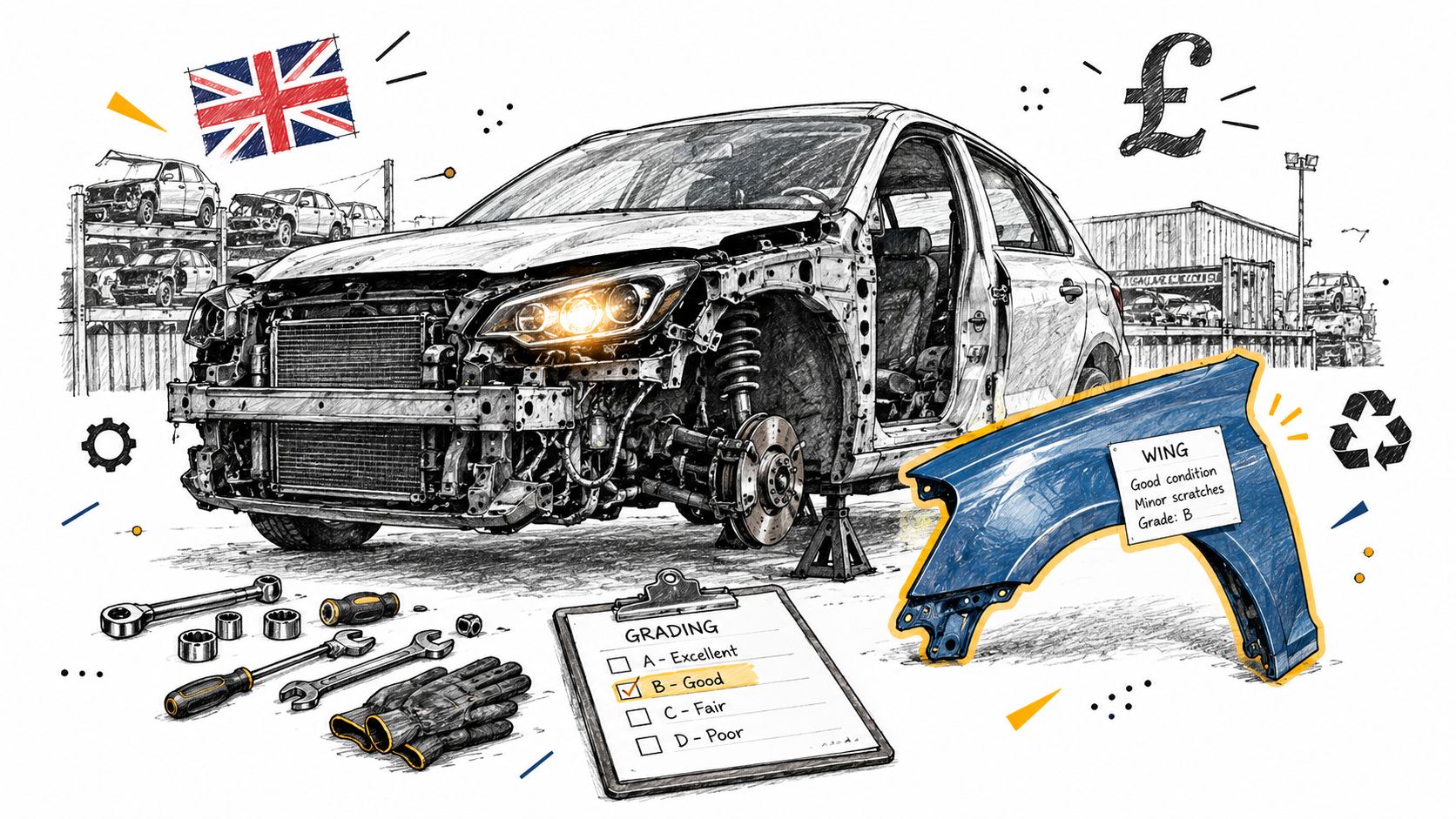
Breaking a car for parts only makes sense if you know what you’re doing, have space, and can be bothered with messages, listings, storage, and leftovers. Cats, alloys, ECUs, trim, and other reusable components can carry value, but then you still need to dispose of the shell properly.
If you want speed and legal closure, scrap it properly. If you want to maximise every last pound, be ready to do the labour yourself.
How to Scrap a Car Step by Step
Your car is dead on the drive, the MOT has run out, and a buyer on Facebook says he can “sort the paperwork later”. That is how owners stay tied to a vehicle they thought had gone. Scrapping a car is not one handover. It is a compliance chain. You need the right buyer, the right handover, and proof that your responsibility ended when the car left.
The practical part is usually simple if you choose the right route. You get quotes, confirm the site handling the car is authorised, book collection or delivery, hand the vehicle over, get paid by bank transfer, and make sure the destruction process is started properly. Keep it boring. Boring is what legal disposal looks like.
Start with quotes, then check who is actually handling the car
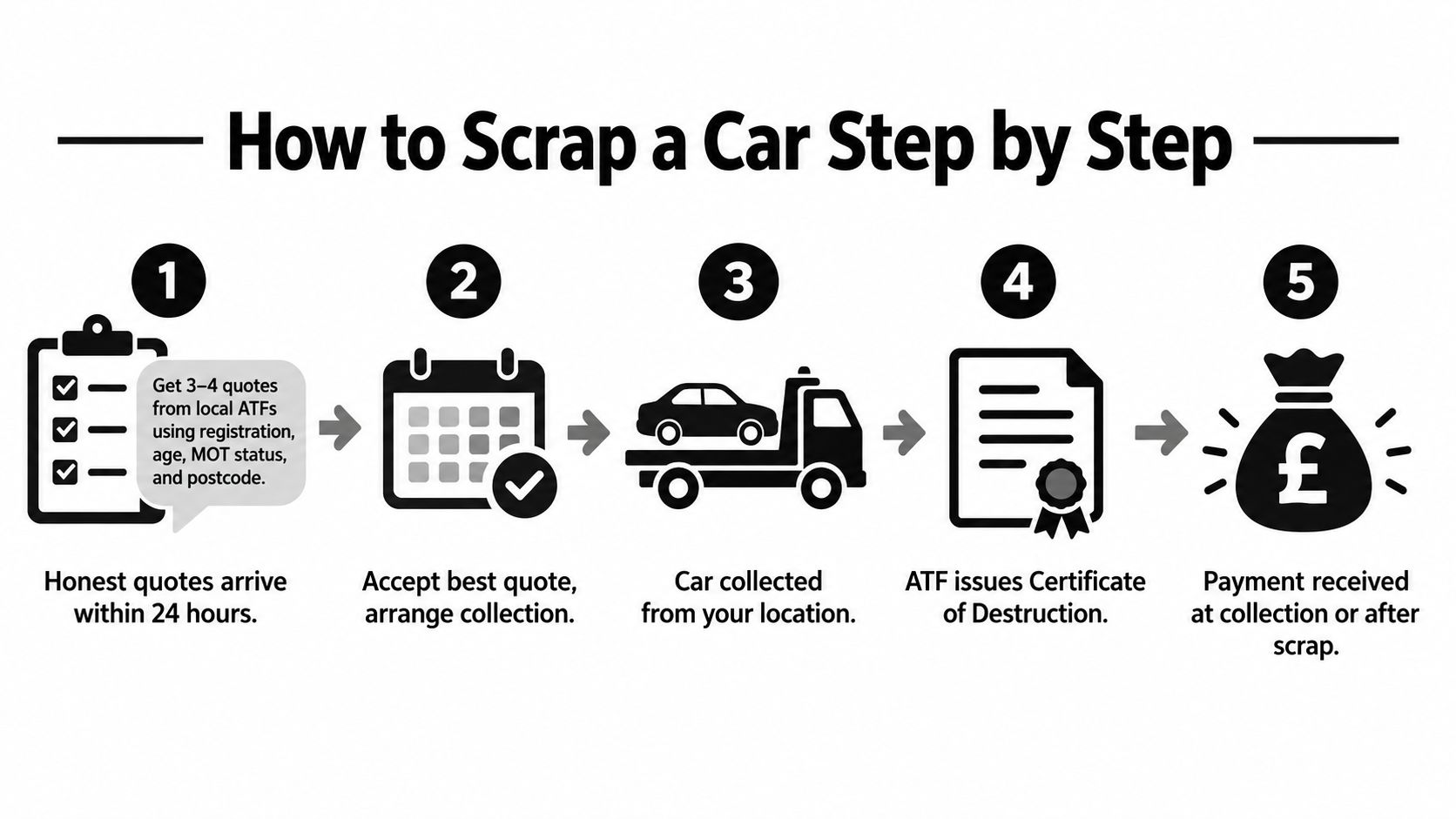
Get 3 or 4 quotes from local ATFs, or from vehicle buying services that pass cars into ATFs. Give the registration, postcode, make, model, whether it starts, and whether major parts are missing. A quote that sits far above the rest usually drops after collection fees, weight deductions, or last-minute excuses.
Then check the disposal route before you book. The DVLA states that only a person or company with a valid ATF permit can access the Certificate of Destruction or Notification of Destruction service, and the ATF can issue a physical CoD to the keeper or the person who presented the vehicle. DVLA also says the CoD permanently closes the vehicle record once the car has been depolluted or destroyed, as set out in DVLA’s CoD and NoD service guidance.
If a buyer cannot tell you which ATF is taking the car, stop there.
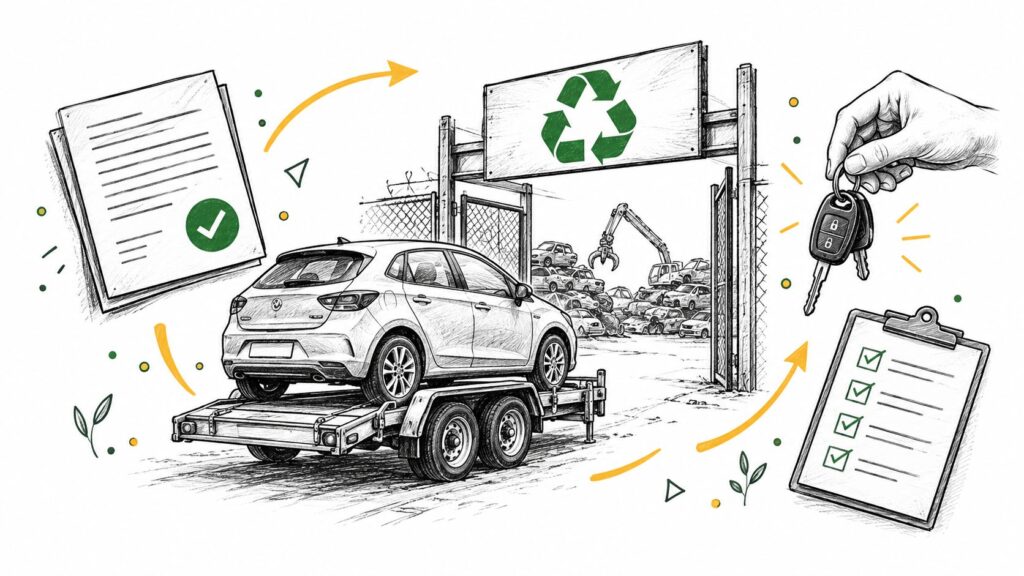
A simple visual summary helps:
Get the car and paperwork ready
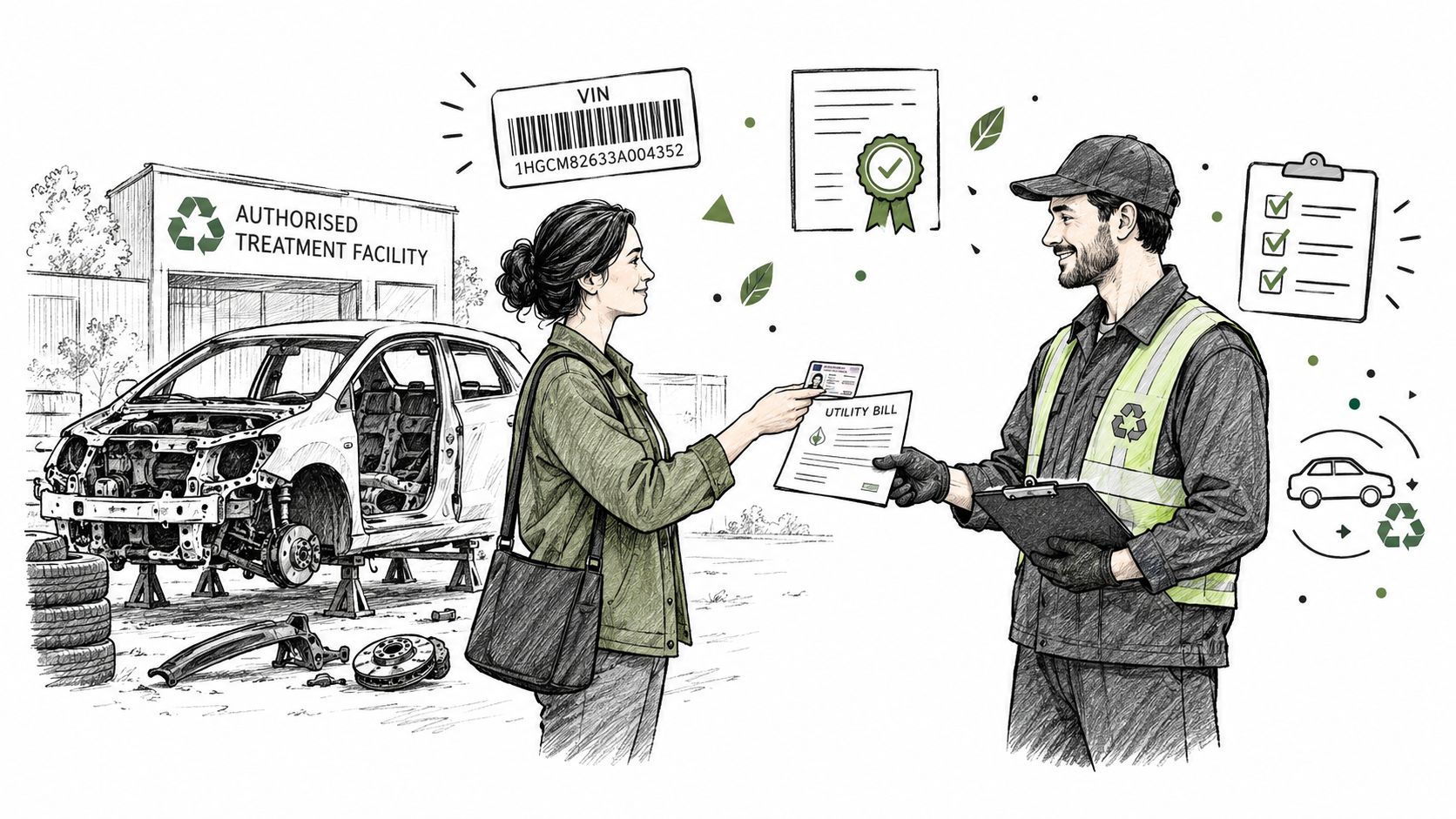
Do the admin before the truck turns up. Rushed handovers are where owners lose documents, leave personal items in the boot, or sign over a car with finance still attached.
Use this checklist:
- Clear any finance first: Do not book collection until you have dealt with outstanding finance.
- Have the V5C ready: Keep a photo or copy of the details for your records.
- Prepare ID and payment details: Payment should go by bank transfer, not cash.
- Empty the car properly: Check the glovebox, boot, under seats, door bins, and spare wheel well.
- Remove what you are keeping: Private plates, chargers, tools, child seats, and any personal paperwork.
If you want one practical explanation of the handover process, this video is a decent shorthand before collection day:
What should happen on collection day
Collection day should be short and clear. The driver checks the vehicle details, loads the car, confirms payment, and records the handover so the authorised disposal route can continue. If the process feels vague, it usually is.
Expect these steps:
- Identity and vehicle details checked
- Car loaded or accepted for drop-off
- Bank payment confirmed
- Destruction process started through the ATF route
Some operators, including Scrap A Vehicle, offer free collection and process purchased scrap vehicles through licensed ATFs with same-day CoD handling and bank payment. Compare every quote against that standard. A slightly higher offer means nothing if the paperwork chain is weak and the old V5C still leaves you exposed.
The common first-timer mistake is handing the car to a collector who sounds legitimate but is not clear about the ATF behind the deal. If the compliance chain is fuzzy at the start, it usually gets worse after the car has gone.
DVLA Paperwork and the Certificate of Destruction
This is the part owners mess up most. Not because it’s complicated, but because they assume the buyer has “sorted it”. Sometimes they have. Sometimes they absolutely haven’t.
What actually clears the car off your name
The legal end point is the Certificate of Destruction. That’s the proof the car has been destroyed through the official route and the DVLA record has been shut down.
Government guidance on end-of-life vehicles says an ELV is waste, must be depolluted by an authorised treatment facility, and partially depolluted vehicles are hazardous waste. It also makes clear that cars under 3,500 kg generally need a Certificate of Destruction, while lorries, buses, and motorbikes do not follow the same CoD route, according to GOV.UK guidance for waste sites handling end-of-life vehicles.
That legal status matters more than most public guides admit. Before depollution, you’re not just moving an unwanted car around. You’re dealing with a waste vehicle inside a regulated chain.
Keep control of the paperwork
You need to know what was sent, when it was sent, and what proof exists. Don’t hand over the logbook and forget it.
Use this checklist:
- Keep a copy of the V5C details: Photo is fine.
- Make sure the ATF details are recorded: Name, site, and collection date.
- Ask when the CoD will be issued: Don’t settle for “soon”.
- Keep the payment record: Bank transfer trail beats promises.
For a more detailed breakdown of the document you’re waiting for, this guide to the Certificate of Destruction in the UK is worth reading.
The paperwork flow looks simple when it’s done right:
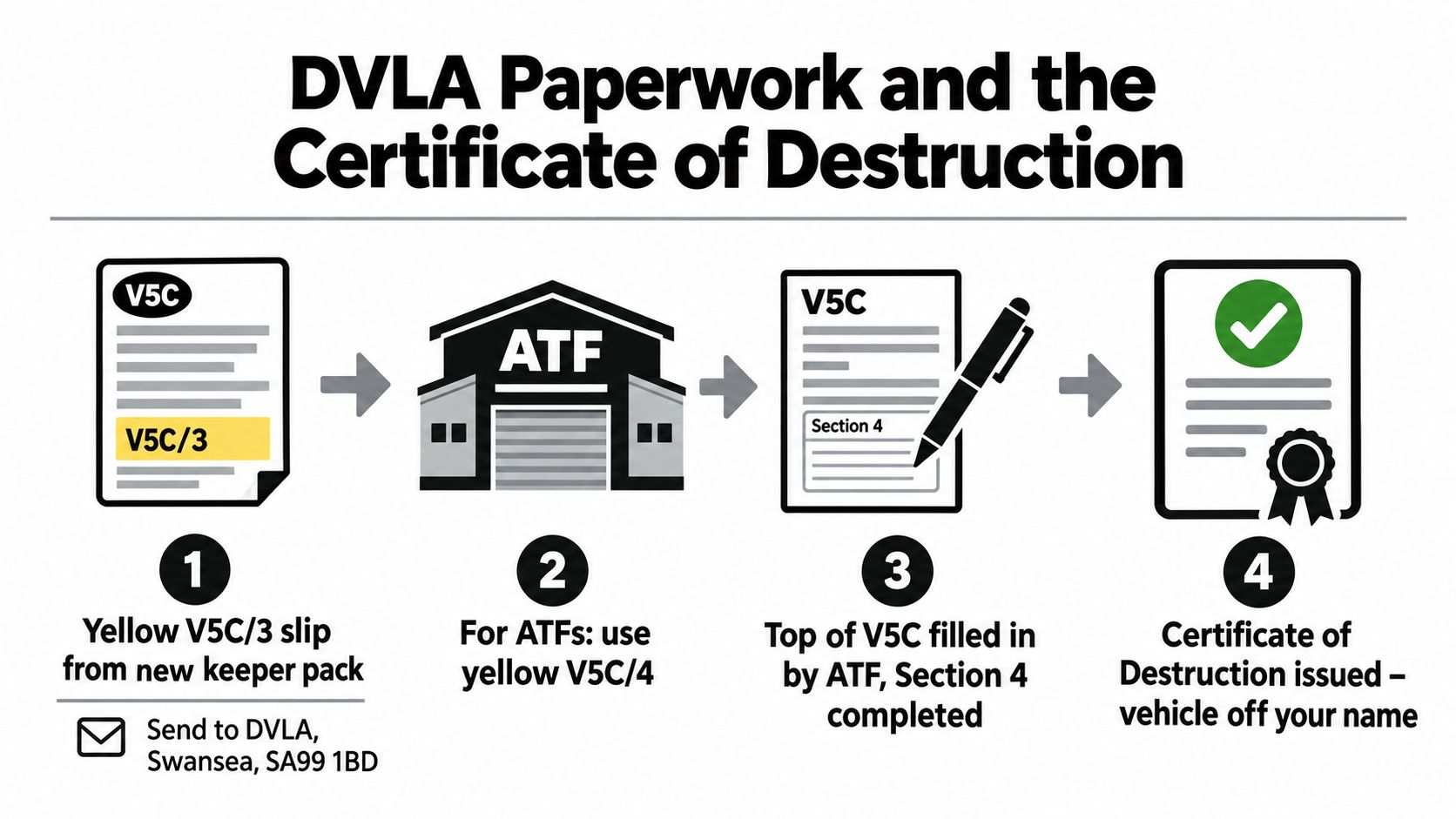
Your real receipt isn’t the bank transfer. It’s the CoD.
Don’t confuse handover with closure
A truck taking the car away is not the same thing as the DVLA record being closed. That’s the whole point.
If you haven’t got proof of destruction, keep checking until you do. In car disposal UK owners get into trouble when they treat collection as the finish line. It isn’t. The finish line is documentary closure.
Why Licensed ATFs Matter More Than the Quoted Price
People love comparing offers and ignoring the bit that protects them. A higher quote from the wrong buyer is often the more expensive mistake.
The product isn’t collection
Two buyers can sound similar on the phone. Both say they’ll collect. Both say they’ll pay. Only one may be able to complete the legal chain.
An Authorised Treatment Facility is the route that matters because that’s where lawful depollution, dismantling, and destruction notification happen. UK capacity is already under strain. Industry figures indicate roughly 1,951 ATFs are processing about 1.5 million vehicles per year, while around 17 million ELVs are expected over the next five years. That implies a required annual throughput near 3.5 million vehicles and a backlog-clearing horizon of roughly 11.6 to 12 years at today’s rate, according to industry analysis on projected ELV volumes and ATF capacity.
That means serious operators care about intake, depollution, scheduling, and documentation. Casual collectors care about getting the shell and disappearing.
ATF vs Unlicensed Collector
| Feature | Licensed ATF | Man in a Van |
|---|---|---|
| Can issue official Certificate of Destruction | Yes | No guarantee |
| Works within the regulated disposal chain | Yes | Often unclear |
| DVLA destruction route | Clear | Often vague |
| Audit trail | Usually documented | Often weak or missing |
| Risk left with keeper | Lower when paperwork is completed | Higher |
What to look for
Don’t obsess over the last few quid. Check for signs of a proper operation instead.
- Written quote: If they won’t confirm the price in writing, assume it can change on the driveway.
- ATF status explained clearly: They should tell you how the CoD gets issued.
- No vague collection story: You want to know who is turning up and where the vehicle is going.
If the cheap buyer can’t explain the destruction process in plain English, they’re not cheaper. They’re riskier.
Common Disposal Mistakes UK Owners Make
Most disposal problems aren’t caused by complicated law. They’re caused by lazy handovers, missing records, and owners trusting the wrong person.
The mistakes that keep people on the hook
The biggest one is using a buyer who isn’t a licensed ATF. I see this all the time. Someone gets tempted by a tidy-sounding offer, the car disappears, and then they’ve got no proper destruction record, no confidence the site was environmentally compliant, and no certainty they’ll even be paid properly.
The other avoidable mess is poor preparation. Owners leave belongings in the car, can’t find ID, haven’t checked finance, and only ask about the CoD after the vehicle has gone.
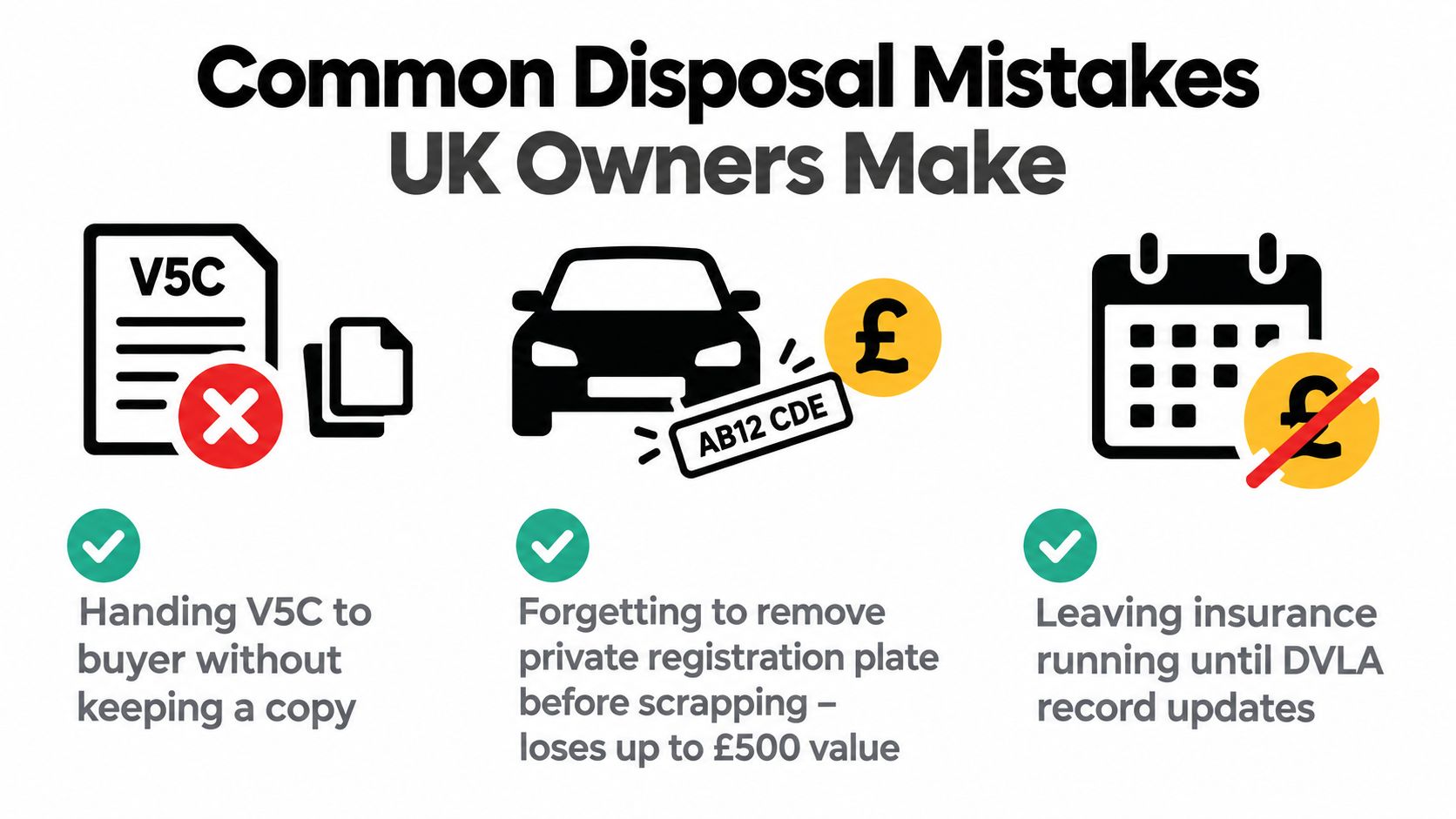
This is the short version of what goes wrong most often:
Mistakes that cost money
Some errors don’t just create admin trouble. They cost value.
The economics of disposal are more nuanced than people think. Neutral UK reporting says between 1.6 million and 2 million end-of-life vehicles are scrapped annually in the UK, around 95% of every scrapped car processed by an ATF is recovered and recycled, and average scrap car prices stabilised at £227 in Q1 2025 after a slow start, according to Car.co.uk’s scrap car market report.
That matters because value isn’t only about metal weight anymore. Sometimes the smarter question is whether the vehicle should be scrapped whole, sold as salvage, or stripped of recoverable components first.
A blunt list of what not to do
- Don’t hand over documents blindly: Keep copies of what you sign and what you give away.
- Don’t forget private plates: If there’s a registration worth keeping, sort that before disposal.
- Don’t assume “for spares” means “paperwork done”: It usually doesn’t.
- Don’t turn up disorganised: No ID, no bank details, and no clear keeper record slows everything down.
- Don’t chase the highest verbal number: A quote is meaningless if the compliance chain is missing.
A buyer taking the car is easy. A buyer clearing your liability is the part that matters.
What to Do Before You Book a Collection
Most headaches get prevented before anyone books a slot. Ten minutes of prep saves weeks of chasing.
Your pre-booking checklist
Run through this before you agree a date:
- Check finance status: If the vehicle isn’t clear, deal with that first.
- Find your ID and bank details: Handover goes faster when you’re ready.
- Empty the car fully: Don’t leave paperwork, keys, tools, or personal items in hidden compartments.
- Photograph the car: Get the condition, mileage, and registration on record.
- Ask how quickly collection happens: A practical benchmark is around 72 hours in many cases, though some services can take same-day drop-offs.
- Ask when the CoD is issued: If they hesitate, keep looking.
A simple reminder list helps keep the job tidy:
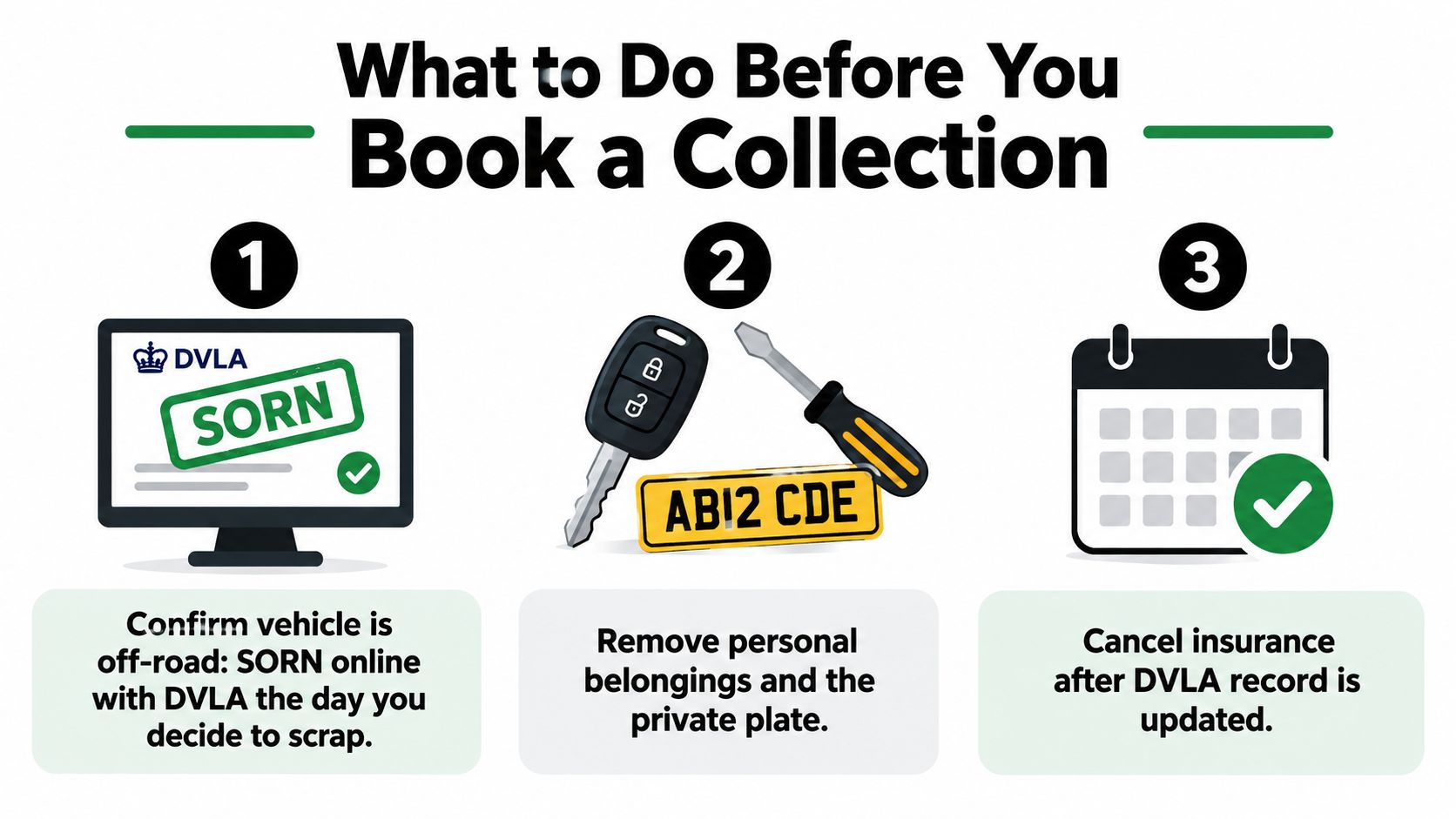
What good preparation actually does
Good prep doesn’t just make collection smoother. It protects the value that’s still there and speeds up the paperwork after handover.
If you’re a first-time disposer, my advice is simple:
- Use a licensed ATF route
- Have your documents and payment details ready
- Don’t let the car leave without clarity on the CoD
That’s what car disposal UK should look like in real life. Not glamorous. Not complicated. Just clean, documented, and finished properly.
If you want a straightforward route, Scrap A Vehicle offers instant online valuations, free collection across the UK, bank payment on collection, and official DVLA Certificates of Destruction through licensed ATFs. If your car has failed its MOT, become uneconomic to repair, or you just want the paperwork handled cleanly, visit Scrap A Vehicle and get the process moving properly.