Your car’s failed its MOT, taken a front-end hit, or stopped moving and now it’s sitting on the drive becoming a problem. Most owners start in the same place. They want it gone quickly, they don’t want a low offer, and they don’t want paperwork coming back to bite them later.
That’s where a lot of people go wrong. They assume a damaged car is only worth scrap weight. Sometimes it is. Often it isn’t. In the UK, the right route depends on the damage, the write-off category, whether the car starts and drives, and whether there’s salvage demand for parts, repair, or specialist components like hybrid and EV batteries.
A smooth sale usually looks simple from the outside. You send the registration, location, damage description, and photos. A buyer works that into a pricing matrix, decides whether the vehicle is scrap, salvage, or repairable stock, then arranges collection and payment. If the details are accurate, the handover is quick. If the details are vague, that’s when collections stall and prices get questioned on the day.
Table of Contents
- Introduction to Selling a Damaged Car in the UK
- Understanding Your Damaged Car Value Routes
- What to Prepare Before You Request an Offer
- How Valuation Free Collection and Same Day Payment Work
- Proven Ways to Maximise Your Damaged Car Offer
- Final Checks Paperwork and Avoiding Costly Mistakes
Introduction to Selling a Damaged Car in the UK
Your insurer has called it a write-off, the car will not pass another MOT, and you need it off the drive without the usual argument at collection. That is the point where the route matters most, because a damaged car in the UK can be worth repair money, parts money, battery money, or only end-of-life metal value.
I buy damaged vehicles every week, and the biggest pricing mistakes usually happen before anyone has seen the right photos. Owners describe a car as “scrap” when it is really a Category S or N salvage car. Others assume a non-runner has no value, then find out the catalytic converter, alloy set, serviceable engine, or hybrid battery pack is doing most of the work in the offer.
The legal side matters too. In the UK, insurance write-offs are grouped into Categories A, B, S and N, and each category affects what a buyer can do with the vehicle after purchase. GOV.UK explains that Category A vehicles must be crushed, Category B vehicles can be broken for parts but the shell must be crushed, and Category S and N vehicles may be repaired and returned to the road if they are made roadworthy again in the government’s write-off guidance.
That category does not set the sale price on its own.
A Category N car with light panel damage, two keys, full V5C details and clean interior photos can attract stronger bids than a rougher Category S car with missing paperwork and no proof it starts. The same applies at the lower end of the market. If the vehicle is only fit for dismantling, the offer still changes depending on whether it must go through an Authorised Treatment Facility, whether the converter is present, and whether there is recoverable value in the battery or other non-ferrous metals.
Why this market catches owners out
A damaged-car buyer is not just pricing bent metal. They are pricing legal route, collection cost, resale risk, storage time, parts demand, and whether the description will hold up when the truck arrives.
That is why two offers on the same car can be miles apart.
One buyer may only want it for scrap weight. Another may be set up to handle salvage, strip usable parts, or process end-of-life vehicles properly through an ATF. On hybrids and EVs, battery condition can shift the number sharply in either direction. A complete, undamaged pack may add real value. An unsafe or water-damaged pack can do the opposite because handling and storage become more difficult.
Practical rule: Ask what market your car fits before you ask what it weighs.
What helps you get a firm price before collection
The cleanest deals come from clear evidence. If you want a guaranteed price that does not get cut on the driveway, send the details that buyers use to make a decision:
- Registration and postcode. These confirm the vehicle and the collection cost.
- Write-off category if known. S and N often sell differently from A or B.
- Six to twelve clear photos. Front, rear, both sides, each corner, dashboard with mileage, VIN plate if available, wheels, interior, engine bay, and the exact damaged area in good light.
- Running status. Starts and drives, starts but will not move, no crank, or complete non-runner.
- Missing or deployed items. Airbags, catalytic converter, keys, logbook, charger cable for EVs, parcel shelf, seats, and major trim.
- Recent work or valuable parts. New tyres, rebuilt gearbox, replacement engine, upgraded alloys, or proof of battery replacement.
Short, vague descriptions slow everything down. “Front damage” could mean a cracked bumper or full structural impact. “Battery issue” could mean a flat 12V battery or a failed high-voltage pack. Buyers price risk first, so missing detail usually lowers the opening offer or turns a firm quote into a provisional one.
Understanding Your Damaged Car Value Routes
A damaged car can attract three very different prices on the same day, depending on who is buying it and what they can legally do with it.
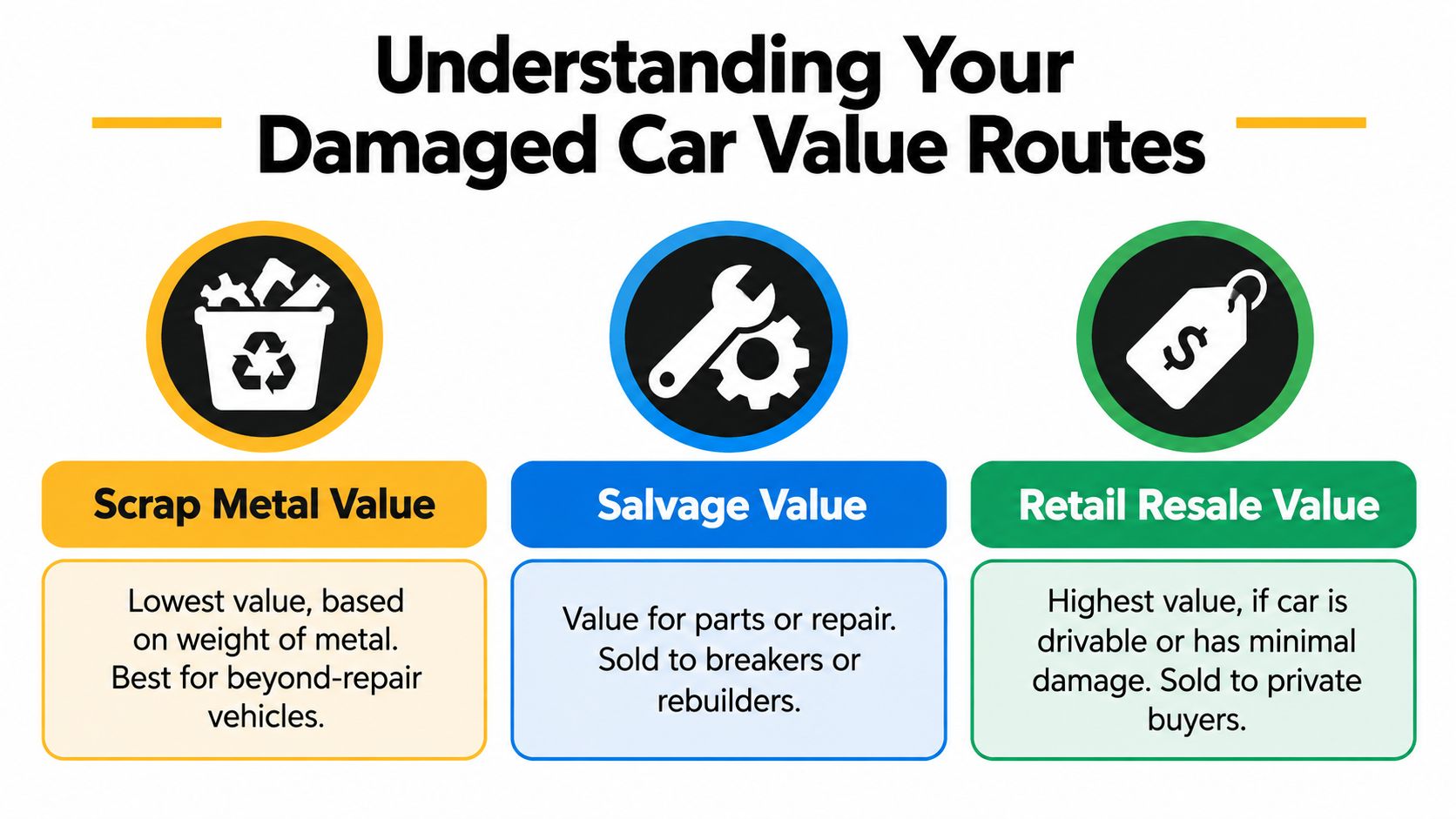
I see this every week. One owner gets a scrap figure based on weight. Another sends proper damage photos, confirms the write-off category, mentions the catalytic converter is still fitted, and the price jumps because the car clearly belongs in a different market.
Scrap, salvage, or repairable sale
Start with the route, not the reg plate.
If the car has reached end of life, the baseline is scrap value through an Authorised Treatment Facility. That figure is driven mainly by weight, collection cost, and whether the shell still has major metal-bearing parts attached. A missing catalytic converter, stripped interior, removed wheels, or absent battery usually drags the offer down because the buyer is left with less recoverable material and more handling time.
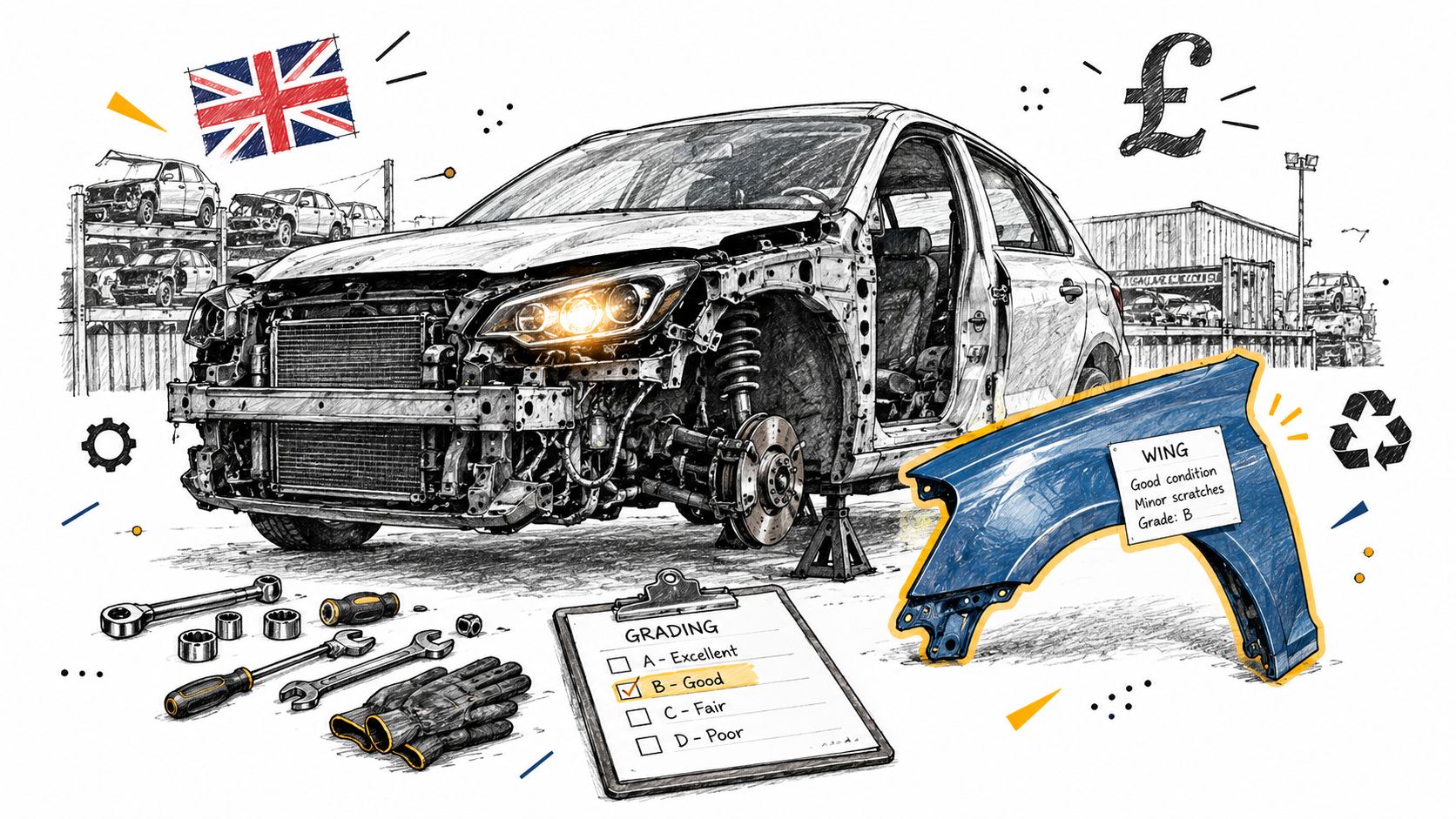
If the car is damaged but still useful for parts, salvage value often beats straight scrap. Engines, gearboxes, headlights, infotainment units, alloy wheels, tailgates, doors, interior trim, hybrid components, and undamaged panels can all move the price well above metal value. The write-off category matters in a practical way. Cat B can only go for parts and scrap through the right route. Cat S and Cat N may still have rebuild demand, depending on the damage and the model.
Repairable cars sit in a different bracket again. A light Cat N with cosmetic panel damage, working airbags, and no suspension issues can attract offers from rebuilders that a breaker would never match. The same car described badly often gets priced as risk.
The wider ELV system supports that logic. A European Commission annex covering UK end-of-life vehicle treatment recorded high levels of reuse by weight, and later UK industry reporting noted strong recycling and reuse performance in the sector in this UK ELV treatment reference. Buyers are not just pricing a shell. They are pricing what can be reused, removed, sold, or processed compliantly.
Damaged Car Value Routes Compared
| Route | Best For | Value Driver | Paperwork |
|---|---|---|---|
| Scrap metal value | End-of-life vehicles, severe fire or crush damage, vehicles with no viable repair or resale route | Metal content, missing parts, collection distance, and compliant recycling route | ATF handover and end-of-life processing |
| Salvage value | Cat B parts cars, Cat S and Cat N cars with usable components or rebuild potential | Engine, gearbox, panels, interior, modules, wheels, battery condition, and buyer demand | Write-off status must be clear before sale |
| Retail resale for repair | Lightly damaged or repairable cars where a buyer wants to fix and keep or resell | Repair cost, finished value, parts availability, and drivability | Full disclosure of condition and category |
Why write-off category changes the offer
Category labels do not set the price on their own, but they heavily influence who can buy the car and what they will pay.
Cat A and Cat B narrow the market fast. Cat A is effectively finished. Cat B still has parts value, but the bodyshell cannot return to the road, so that removes rebuild buyers completely. Cat S can still be attractive if the structure is repairable and the numbers stack up. Cat N often causes the biggest pricing mistakes because non-structural damage covers a wide range, from minor cosmetic knocks to expensive electrical faults and airbag issues.
That is why two Cat N cars of the same age can be hundreds or thousands of pounds apart. A bolt-on wing and bumper is one thing. Flood-affected wiring, multiple warning lights, and hidden module faults are another.
A write-off category tells a buyer the type of recorded damage. It does not confirm parts value, repair cost, or whether the first offer is the right one.
ATF rules and battery value can shift the result
ATF rules matter most at the low end of the market. If a vehicle is only suitable for dismantling or destruction, it needs to go through a compliant treatment route. That affects what a buyer can do with it, what paperwork they need, and how much margin is left after recovery, depollution, storage, and transport.
Hybrids and EVs add another layer. Some damaged electric cars are worth more than owners expect because the buyer is pricing the battery, inverter, charging components, drive unit, and high-voltage ancillaries, not just the body damage. Others are worth less because a water-damaged or impact-damaged battery pack creates risk, specialist handling requirements, and extra storage controls.
Battery material content also matters. Research cited by a salvage-sector source notes that lithium-ion packs contain meaningful amounts of copper and aluminium per kilowatt-hour, which helps explain why some badly damaged EVs still attract strong salvage bids as outlined by Salvargo.
The practical takeaway is simple. A petrol hatchback with rear damage, a Cat S diesel van, and a non-running EV should never be priced on the same logic. Route, category, and recoverable components decide the offer first.
What to Prepare Before You Request an Offer
The fastest way to lose money is to ask for a price with half the story. The fastest way to lock in a proper price is to send a buyer exactly what they need to assess it.
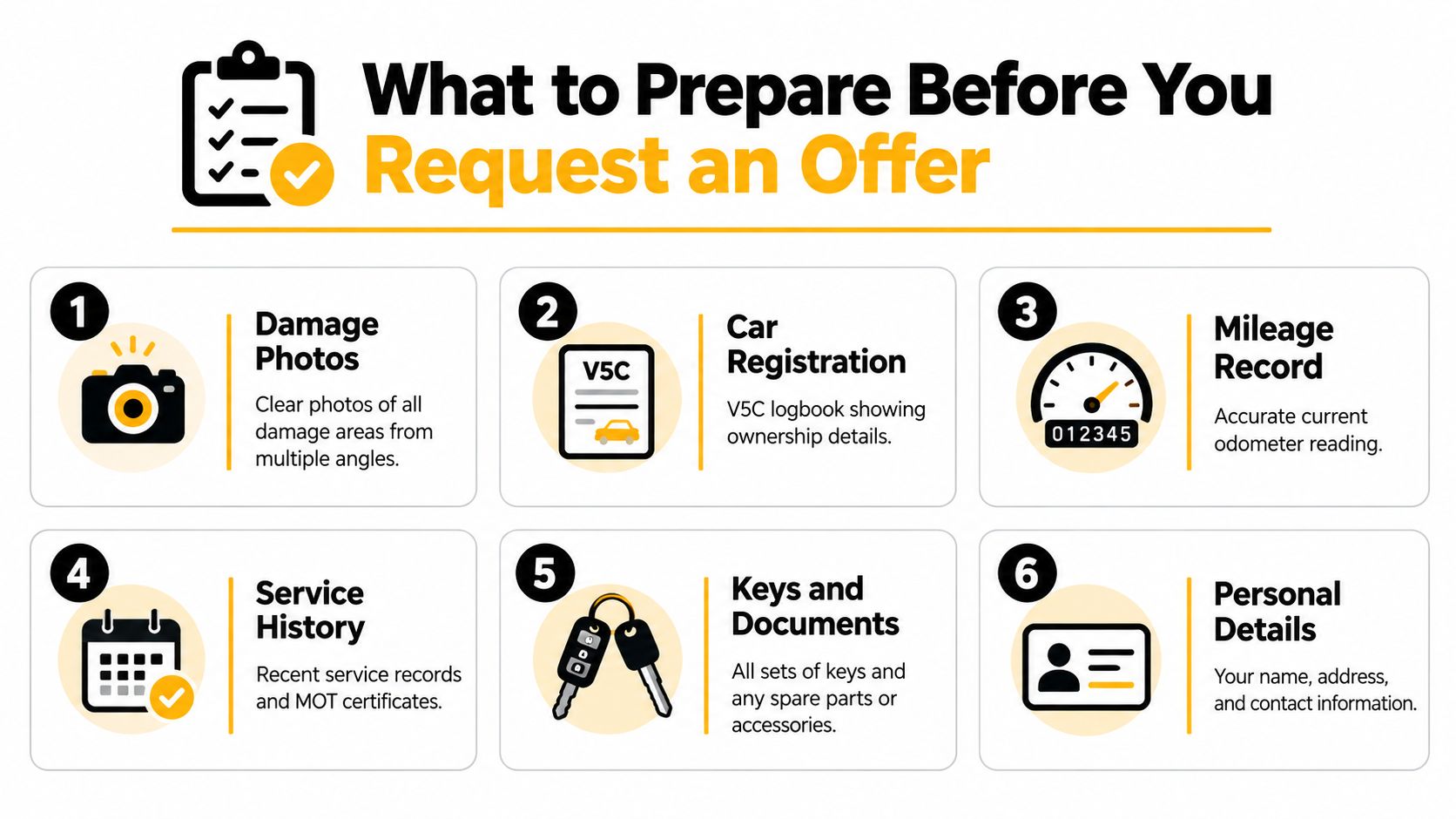
When pricing damaged cars, we ask customers for a damage description first. That gets mapped into a pricing matrix. In some cases, photos are needed to determine the true extent of the damage and guarantee the price. That’s the difference between a rough estimate and an offer that can survive collection day.
The information that actually changes the offer
Start with the basics, but don’t stop at the basics.
- What happened to the car: Accident, MOT failure, flood exposure, electrical fault, vandal damage, or mechanical failure.
- How bad the damage is: Front corner, side impact, suspension damage, airbag deployment, engine issue, gearbox issue, or cosmetic panel damage.
- Whether it starts and drives: Say clearly if it starts, moves under its own power, steers, brakes, or is a complete non-runner.
- Mileage and identification: Current mileage and VIN help match the vehicle properly.
- What’s been done recently: New tyres, replacement gearbox, recent service, catalytic converter, inverter, or battery work all matter.
The single best way to improve a damaged car’s perceived value before collection is simple. Provide as much verified information as possible, including the vehicle’s condition, any recent repairs, and any new parts fitted. UK damaged-car guidance also supports documenting service history, repair invoices, paperwork, and specific damage, plus whether the car starts and drives or is a non-runner in this Financial Ombudsman decision material.
The photo set buyers need
A proper photo set answers questions before anyone books a truck. UK repair-assessment guidance asks for a full written description of what happened plus multiple image angles, including front, rear, both sides, VIN, mileage, wider shots of each damaged area, close-ups, and any additional damage details in this estimate photography guide.
Use that exact logic when you want to sell your car.
- Front and rear shots: Show alignment, bumper damage, lights, and bonnet or tailgate gaps.
- Both sides: Buyers need to see whether damage is isolated or runs further down the body.
- Close-ups of each hit area: Cracked mounts, wheel position, deployed airbags, fluid leaks, and broken trim can change a valuation.
- VIN and mileage photos: These reduce admin mistakes and help firm up the quote.
- Interior and dashboard: Warning lights, airbag lights, and trim damage matter more than many owners think.
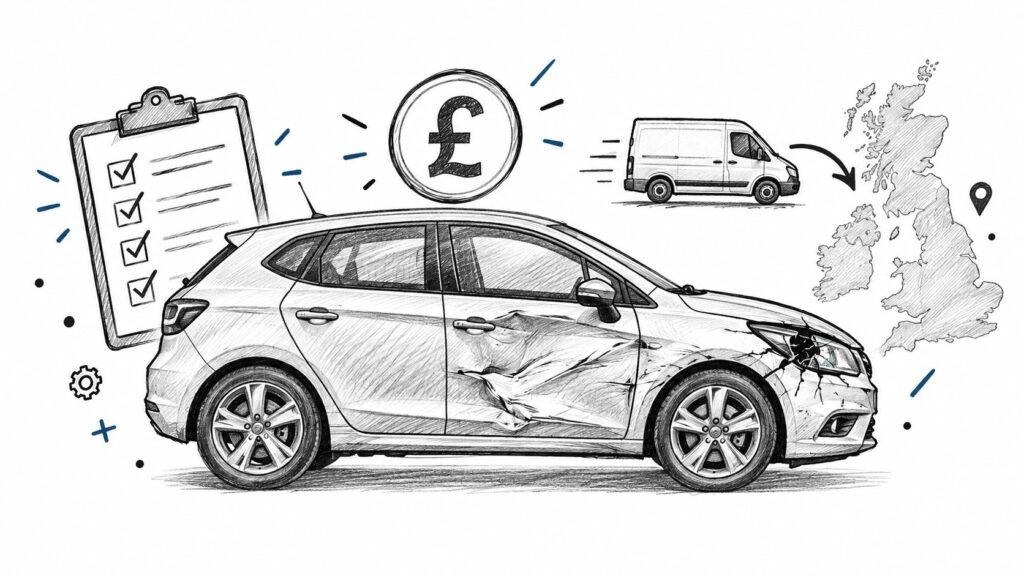
Here’s a useful visual summary before you send your details:
What usually causes price changes on collection
It’s rarely the buyer being awkward. It’s usually one of these:
| Issue found later | Why it affects price |
|---|---|
| Hidden side or rear damage | It changes repair scope or parts value |
| Airbags deployed but not mentioned | It often indicates a bigger repair bill |
| Non-runner described as running | Collection and resale route both change |
| Missing keys or logbook details | Delay, admin friction, and lower buyer confidence |
| Water ingress or interior mould | Reduces salvage quality significantly |
Send more than you think you need. Extra detail rarely reduces a sound offer, but missing detail often does.
How Valuation Free Collection and Same Day Payment Work
Once the details are in, the process should move in a straight line. The best transactions feel boring. That’s a good sign.
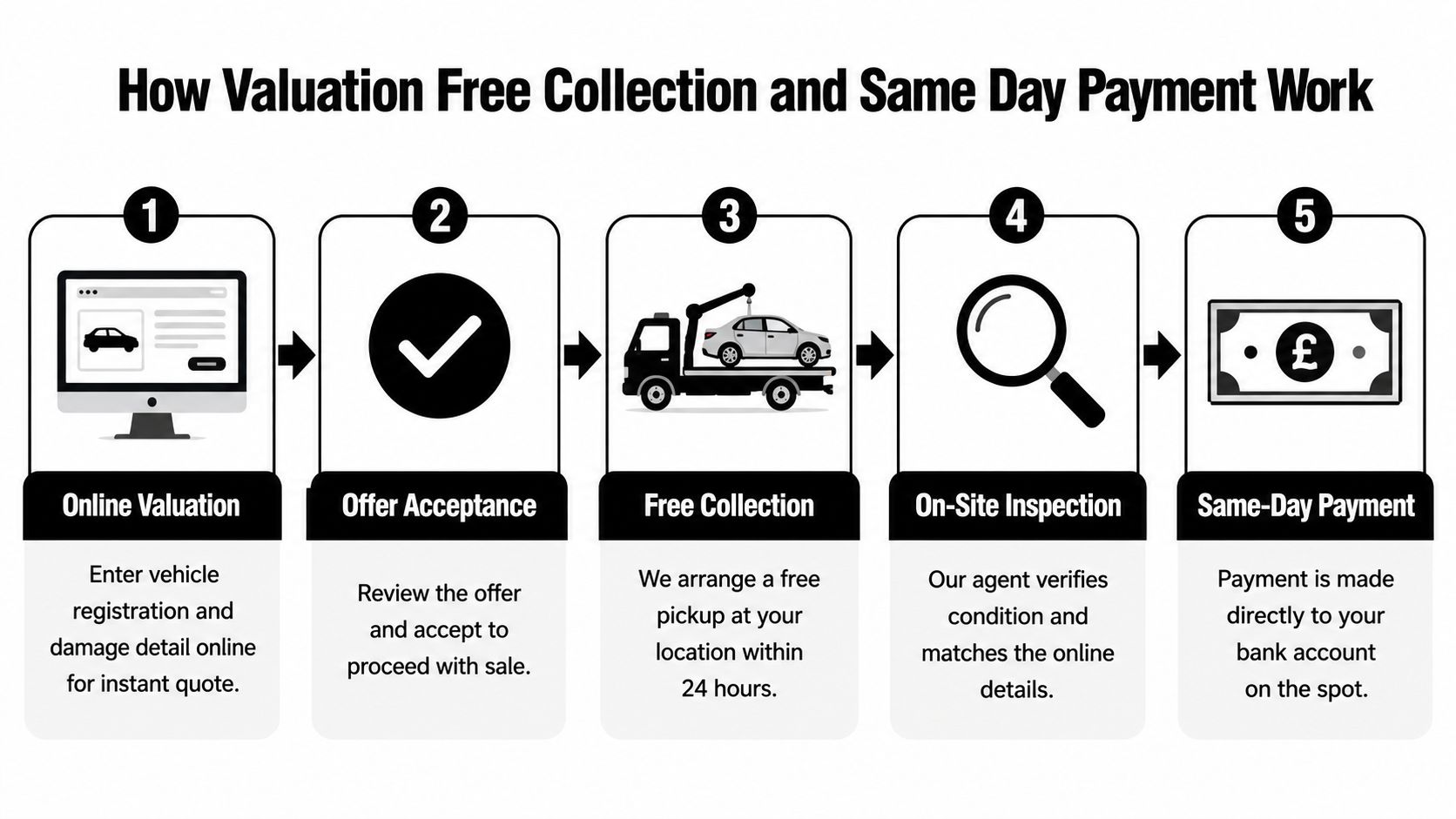
A typical damaged-car sale starts with registration and postcode, followed by the damage description and images. Those details are matched to the likely disposal route and current buyer appetite. If the buyer is handling the job properly, they’re not just throwing out a number. They’re deciding whether the vehicle suits scrap, salvage dismantling, or repairable stock.
How the quote becomes a workable collection
Once the vehicle is accepted, collection gets booked around where the car is and whether it rolls, steers, or needs specialist recovery. Accurate disclosure saves time. A car that’s accessible on a driveway with keys and paperwork ready is always easier to move than one boxed into a tight street with flat tyres and no steering.
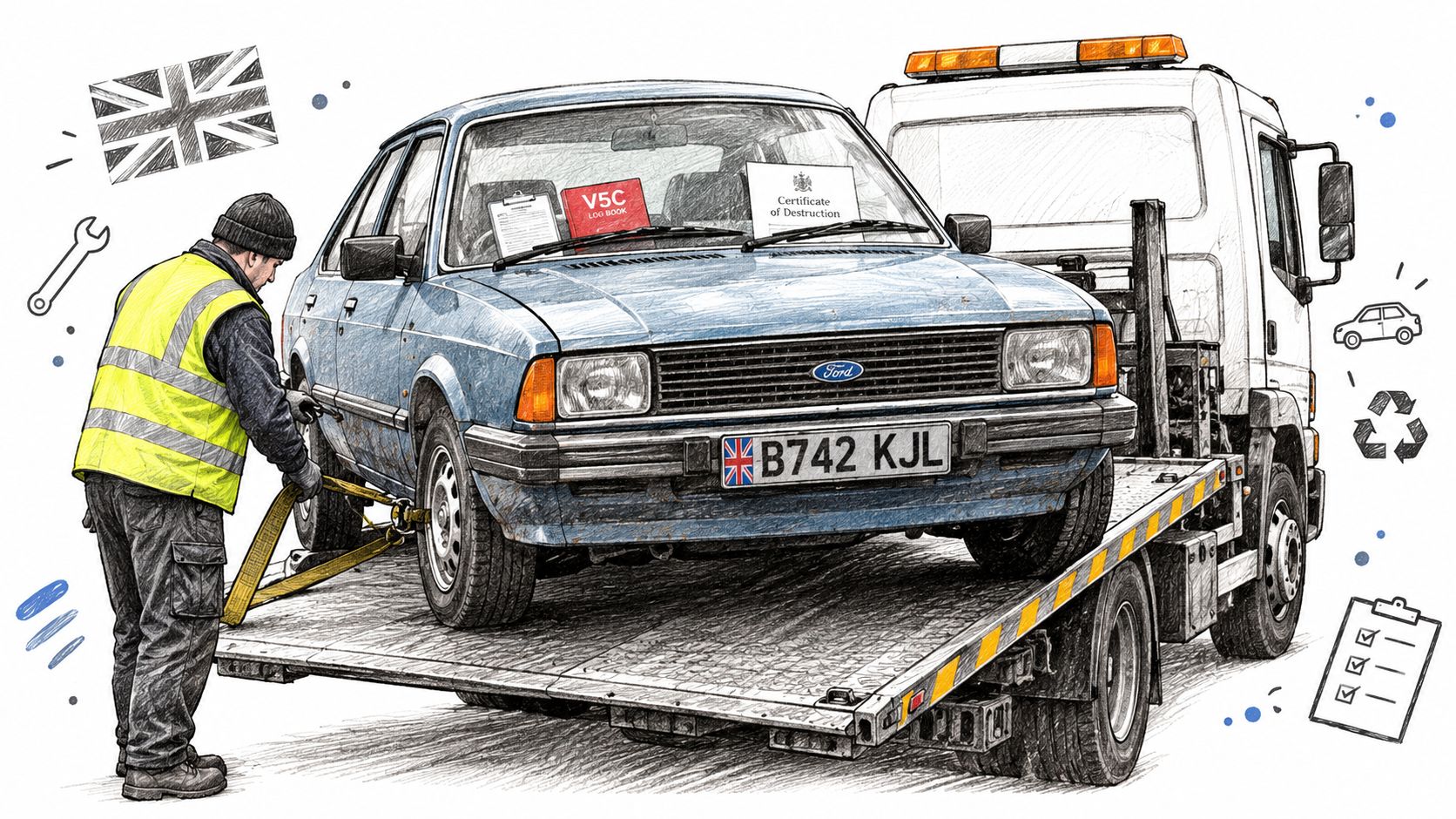
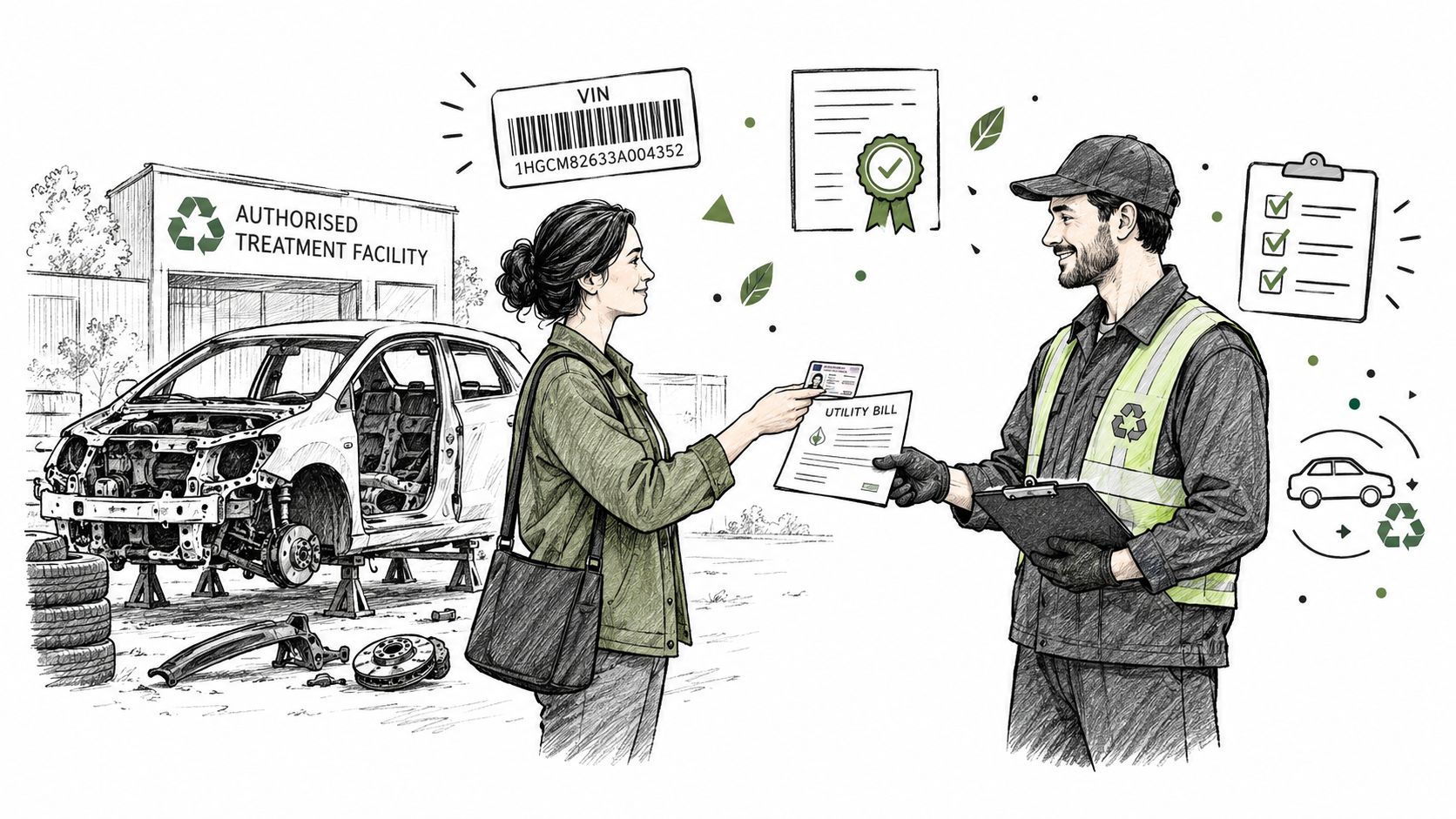
Legitimate end-of-life transactions also follow the authorised route. A vehicle being scrapped should go through an Authorised Treatment Facility, because ATFs are the permitted sites that depollute and dismantle ELVs and issue the Certificate of Destruction, after which the DVLA removes the vehicle from the registration database through the official ATF dataset route referenced here.
If you’re comparing services, one option for a registration-based quote and collection booking is this UK car selling route.
Turnaround and payment timing
Speed depends mostly on how quickly the owner responds and how complete the information is. Where engagement is good and images are supplied quickly, a very fast turnaround is realistic. Industry guidance around end-of-life collection and payment also reflects that some buyers work on rapid collection and same-day payment mechanics, supporting a practical turnaround of around 24 to 48 hours from offer to payment when everything lines up as described in this damaged-car collection example.
The working benchmark I’d use is this:
With customer engagement and images we are often able to purchase a vehicle and pay for in within 48 hours, we even offer roadside payments to pay the customer before the vehicle leaves.
What to have ready on the day
Don’t overcomplicate collection day. Just have the right things in reach.
- Keys available: Even for non-runners, keys matter.
- V5C details ready: It helps handover and DVLA notification.
- Vehicle accessible: Tell the buyer in advance if it’s blocked in, has flat tyres, or won’t steer.
- Bank details confirmed: Payment should be checked before the vehicle departs.
- Any added parts or paperwork: Service records, receipts, or spare items should be handed over if they formed part of the agreed value.
If the offer was built on honest details, the driver visit is usually a condition check, not a renegotiation exercise.
Proven Ways to Maximise Your Damaged Car Offer
Owners often think “tidy it up and say as little as possible.” That’s the wrong instinct. The cars that hold their money best are the ones backed by information.
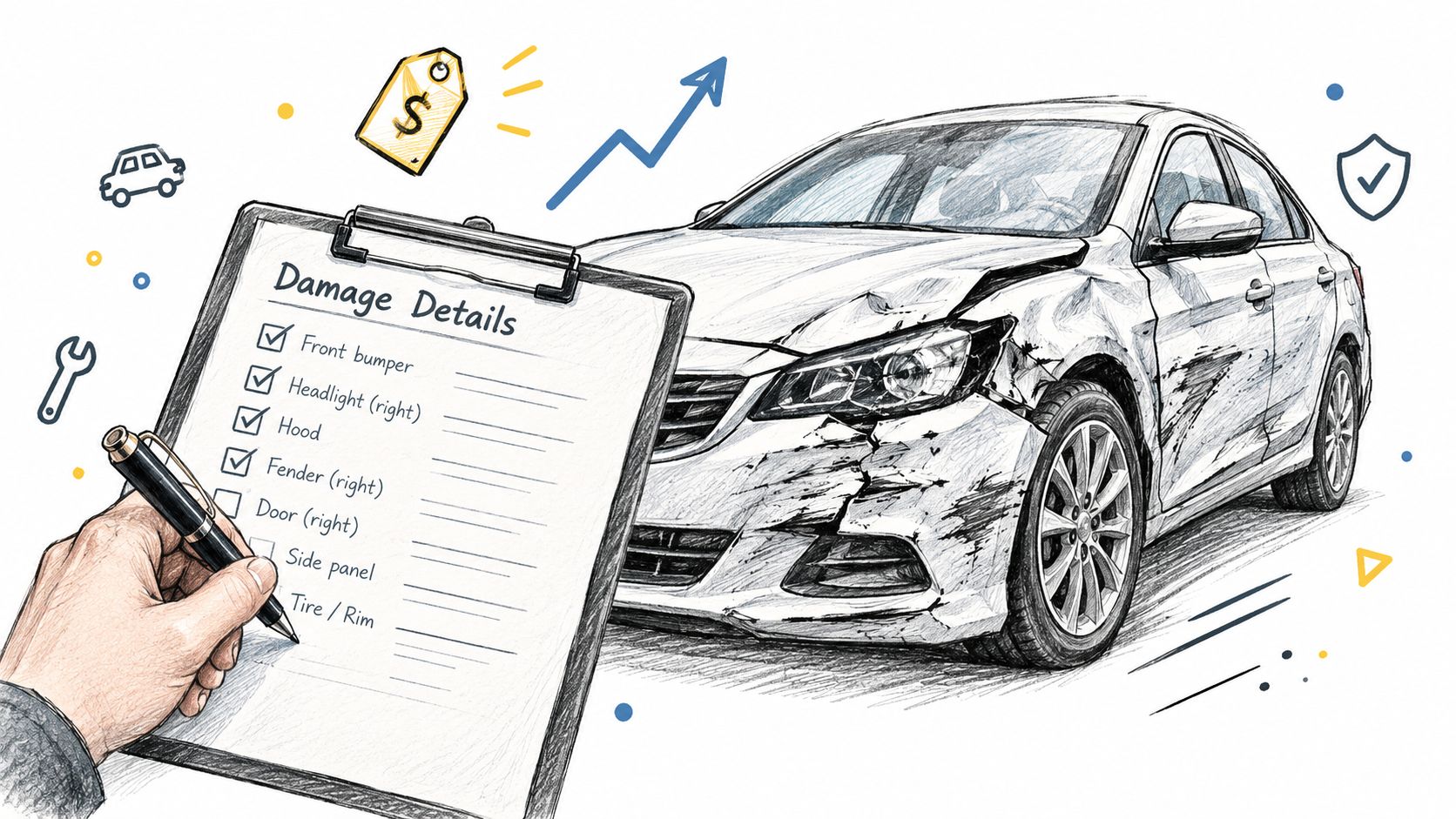
A buyer prices risk. Every fact you confirm removes some of that risk. Every omission adds it back in.
What lifts confidence and usually helps value
Some details matter more than owners realise.
- Recent repairs count: If the car has had a clutch, turbo, gearbox, tyres, or suspension work recently, say so and show the invoice if you have it.
- New parts should be listed: A newly fitted battery, catalytic converter, DPF, alloy, or headlamp can change a dismantler’s view of the car.
- Be honest about non-runner status: If it cranks but won’t fire, say that. If it starts on a jump pack, say that too. Accuracy protects the price.
- Tell buyers about service history: A documented car is easier to place into the right channel than one with no supporting history.
A heavily damaged car can still price well
This catches sellers out regularly with hybrids and EVs. A car can look awful externally and still have serious salvage appeal if the right components remain desirable.
A good example is a damaged Tesla or hybrid with strong powertrain demand. Batteries in hybrids or EVs often have second-use potential in other industries, and the battery pack also contains valuable copper and aluminium. That’s why some vehicles achieve a favourable price even when the body shell is clearly into write-off territory. The value isn’t just in the panels. It’s in the drivetrain, battery system, modules, and recoverable materials.
If you own a hybrid or EV, mention battery status, charging status, warning lights, and whether the car powers up. Don’t make the buyer guess.
What doesn’t work
Some owners accidentally talk their price down.
| Mistake | What happens instead |
|---|---|
| “Minor damage” with no photos | Buyer assumes there’s more to find |
| Hiding warning lights | Confidence drops immediately at collection |
| Forgetting to mention recent parts | You lose value that could have been recognised |
| Describing a non-runner as “just needs a battery” | It sounds like guesswork unless supported |
| Sending old photos | Creates distrust when the driver sees the car |
The number-one tip is still the simplest one. Give the buyer as much information as possible about the condition, any recent repairs, and any new parts fitted. That helps the vehicle get priced accurately. In practice, accurate pricing often means a stronger offer because the buyer doesn’t have to build in as much uncertainty.
Final Checks Paperwork and Avoiding Costly Mistakes
The sale can still go wrong in the last ten minutes.
A driver arrives, the car is loaded, then the buyer starts querying the missing V5C, asks whether the hybrid battery is still fitted, or says the shell has to go through an ATF after all. That is how agreed prices get cut and how owners end up chasing paperwork later. A few checks before collection prevent most of it.
If the car is going for scrap, use the correct legal route. GOV.UK states that scrapped vehicles should go through an Authorised Treatment Facility, and the keeper must deal with the V5C and notify the DVLA properly under the government’s scrapped and written-off vehicle guidance. That is what closes off future liability. If the vehicle is being broken for parts or sold as salvage rather than destroyed, the process is different, which is why the buyer needs to be clear about the route before collection.
What paperwork matters most
The documents that delay damaged car sales most often are simple ones.
- V5C: Have it ready if you have it. If it is missing, say so before the car is priced.
- DVLA notification: Make sure the transfer or scrappage is recorded correctly. Do not assume collection alone covers it.
- Certificate of Destruction: Ask about this only where the vehicle is being scrapped through an ATF. You would not expect one for every damaged car sale.
- ID and payment details: Names must match the bank account receiving funds. Mismatches slow same-day payment.
- Write-off and battery details: If the car is Cat S, Cat N, hybrid or EV, declare that early. It affects whether the buyer values it as repairable salvage, dismantling stock, or end-of-life scrap.
That last point matters more than many owners expect. A Cat N car with light panel damage may still be worth more sold as salvage than sent straight for destruction. A burnt EV, a flood-damaged hybrid, or a shell with the battery already removed is a different calculation. Battery status, converter presence, alloy wheels, and whether the car must go through depollution all change the offer.
Mistakes that cost owners money
The biggest losses usually come from mismatched descriptions.
If the price was based on “complete car, rolls freely, battery present, no major fire damage” and the collector finds seized brakes, missing catalytic converter, or a stripped interior, the buyer will revalue it on the spot. The same applies if the car was described as scrap but turns out to be a repairable Cat N. Owners sometimes send usable cars down the wrong route and leave money behind.
Another common mistake is sending poor evidence. To hold a guaranteed price before collection, send clear photos of all four corners, both sides, the front, the rear, the VIN plate or reg, the odometer, interior, dashboard warning lights, engine bay, and the exact damage area. For hybrids and EVs, include a shot showing whether the car powers up and mention any battery warnings or charging faults. For scrap vehicles, say if the catalytic converter, wheels, and battery are still fitted. Metal and component values are part of the offer.
Use a buyer who can explain whether the vehicle is being bought for salvage, dismantling, or ATF destruction. If they cannot tell you which route applies, stop there.
Confirm the route, confirm the paperwork, and confirm what is included with the car before it leaves your driveway.
A careful final review is short. Check the buyer’s status, make sure the V5C handover is being handled correctly, keep a record of the transaction, and release the vehicle only once payment is confirmed.
If you want a straightforward route to sell a damaged car in the UK, Scrap A Vehicle provides instant online valuations, free nationwide collection, same-day bank payment, and ATF processing where the car is going for scrap. If your vehicle is accident-damaged, a non-runner, or at the end of the road, it’s a practical way to get the price, collection, and paperwork handled in one process.