562,185 vehicles were written off in the UK in 2024, roughly one vehicle every minute. That’s not a niche corner of the market, it’s a deep, steady supply of accident damaged cars for sale UK buyers can either profit from or get burned by.
If you’re staring at a tempting listing with a sharp price and a few vague photos, the key question isn’t whether it’s cheap. It’s whether the damage is limited, repairable, and priced with honesty, or whether you’re being sold someone else’s headache with a shiny advert.
Table of Contents
- Understanding Accident Damaged Cars for Sale UK Market
- UK Insurance Damage Classifications Explained
- How Valuation Differs Between Structural and Cosmetic Damage
- Three Red Flags Every Buyer Must Check First
- How to Verify Repair History and Accident Severity
- When to Buy or Sell Accident Damaged Cars UK
Understanding Accident Damaged Cars for Sale UK Market
You can spot a clean-looking car from across the forecourt, see a price far below retail, and still be staring at a bad deal. The money in accident damaged cars sits in the parts, the shell, the trim, and the repair history. The traps sit in bent structure, poor paperwork, and insurance values that missed what the car was truly worth.
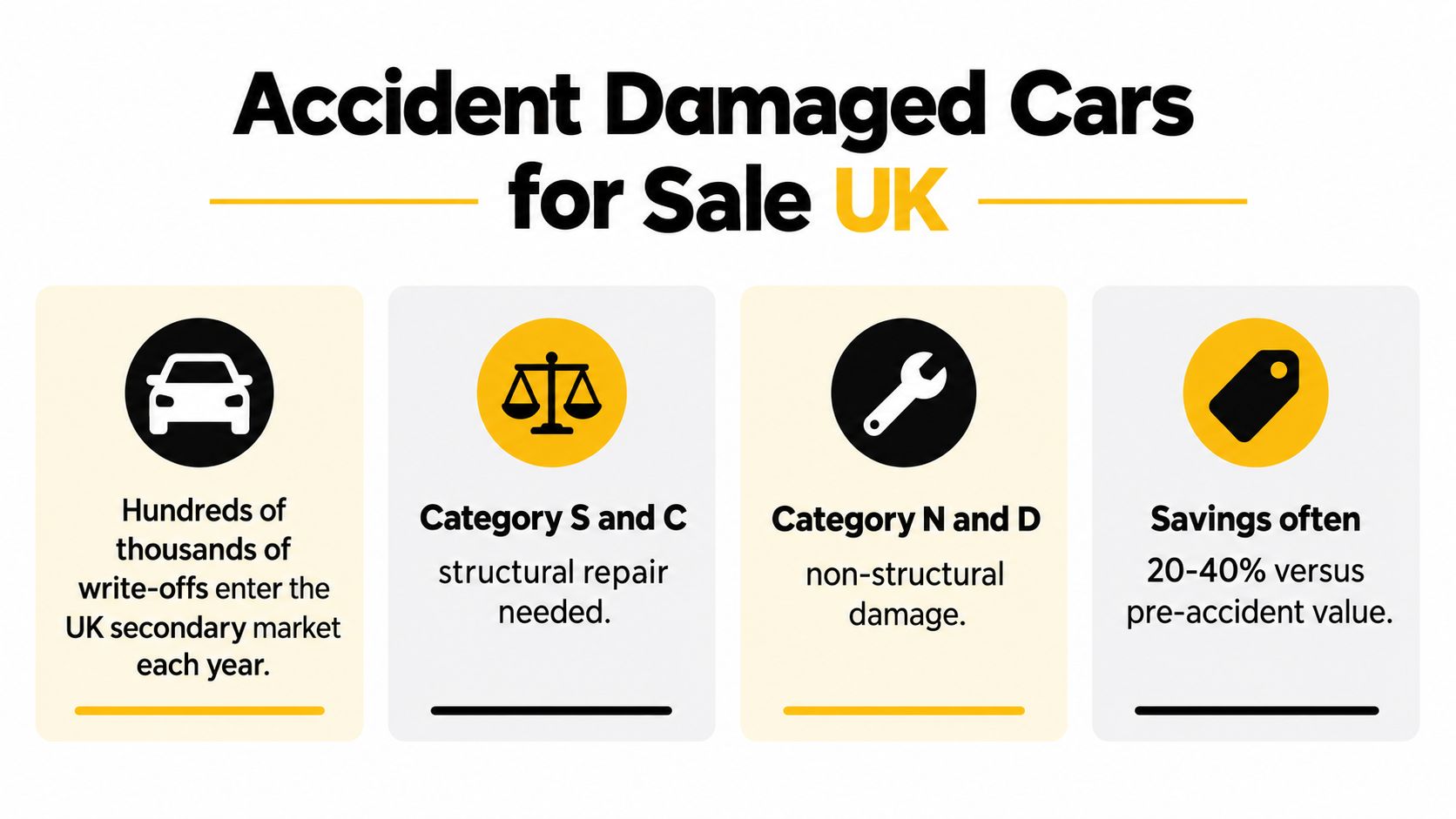
The market stays busy because insurers keep pushing more cars into write-off channels. Legal Futures reports that annual write-offs ranged from 414,593 to 562,185 between 2019 and 2024, with 2024 at 562,185 and the 2023 peak at 559,870. That steady supply keeps accident damaged cars for sale UK listings flowing through salvage yards, repair shops, exporters, and dismantlers. Legal Futures write-off data
What keeps the market busy
Repair bills keep climbing, and that changes the numbers fast. Legal Futures also reports that the average repair cost moved from £4,162 in 2019 to £5,191 in 2025 year to date, while the total-loss rate rose from 58.3% to 66.5%, with a peak of 73.6% in 2023. That is why more damaged cars get sold on rather than repaired for a private owner. Legal Futures repair economics
For a trader, the opportunity is simple. A car with cosmetic damage can still carry strong value in the drivetrain, interior, wheels, or glass. A structurally damaged car can still be worth buying if the shell is straight enough, the repair path is clear, and the discount leaves room for labour, parts, and a margin. Classic cars need extra care here, because insurers often undervalue them when they compare them to ordinary used stock instead of real collector demand.
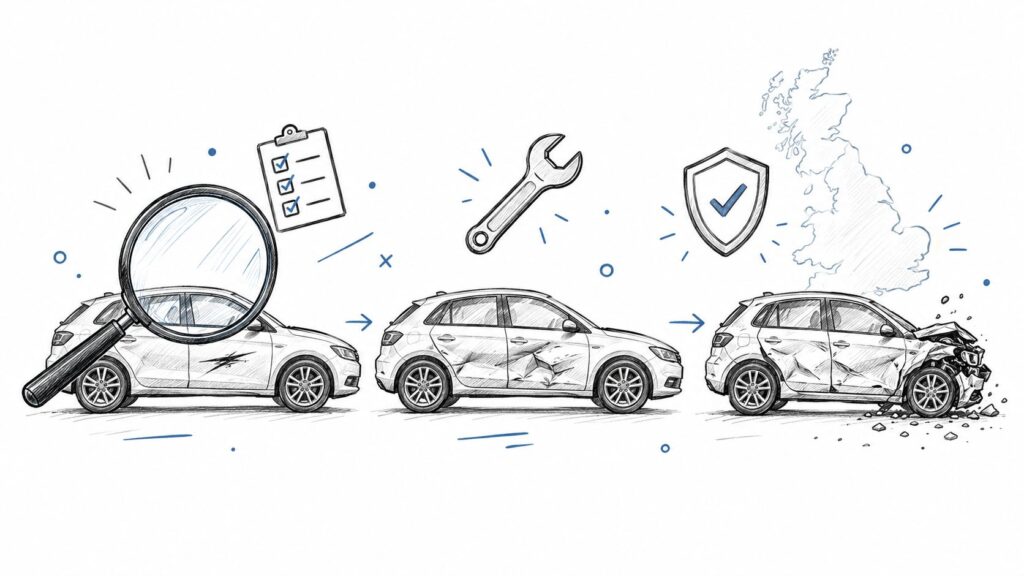
A sharp buyer looks at the damage type first. Scratched panels, bumper covers, and broken lights are one pricing bucket. Bent rails, airbags, suspension pick-up points, and distorted shell work are another. The first can leave room for profit. The second can turn a cheap listing into a money pit.
Practical rule: treat every damaged listing as a parts-and-paperwork job first, and a bargain second. If the numbers only work with hope, walk away.
| UK Vehicle Write-Off Scale and Repair Cost Trend | |
|---|---|
| Metric | Value |
| Vehicles written off in 2024 | 562,185 |
| Approximate pace in 2024 | Roughly one vehicle every minute |
| Annual write-offs in 2019 to 2024 | 414,593 to 562,185 |
| Peak annual write-offs in 2023 | 559,870 |
| Average repair cost in 2019 | £4,162 |
| Average repair cost in 2025 year to date | £5,191 |
| Repair cost increase | 24.7% |
| Total-loss rate in 2019 | 58.3% |
| Total-loss rate in 2025 year to date | 66.5% |
| Peak total-loss rate in 2023 | 73.6% |
UK Insurance Damage Classifications Explained
The category on the paperwork tells you more than the advert title ever will. If you ignore it, you’re guessing. In salvage, guessing is expensive.
What each category really means
UK insurers use four main write-off categories. Category A vehicles cannot be repaired and must be crushed. Category B vehicles can’t return to the road, but some parts may be removed and reused. Category S vehicles have structural damage but can be repaired to a roadworthy condition. Category N vehicles have non-structural damage and can also be repaired to roadworthy condition. GOV.UK sets that out clearly in its write-off guidance. GOV.UK insurance write-offs
That split matters because the same headline phrase, “accident damaged”, covers very different economics. A Cat A or Cat B car is basically a parts or scrap decision. A Cat S or Cat N car can still have real resale value if the repair is properly done and the price reflects the work still needed. For buyers, the first job is to stop treating all write-offs as the same thing.
Why the category changes the deal
A Cat N car often looks tempting because the damage sounds lighter, but that doesn’t automatically make it a bargain. The category tells you the insurer’s view of the damage, not your final ownership cost. If the repair paperwork is weak, the previous write-off history is murky, or the car has already been written off before, the discount can disappear fast once you add labour, parts, and the risk of future insurance friction.
A clean-looking panel is not proof of a clean repair. The category and the paperwork decide whether you’re buying a runner, a rebuild, or a liability.
The core point is simple. Cat A and B units are mainly end-of-line recovery. Cat S and N units are the ones that still move through the secondary market as repairable salvage, but only if the buyer understands what the marker means and what it doesn’t.
| Valuation Focus by Damage Type | |||
|---|---|---|---|
| Damage Type | Primary Value Drivers | Typical Buyers | Risk Level |
| Structural damage | Remaining usable components, repair cost, body integrity | Salvage traders, rebuilders, dismantlers | High |
| Cosmetic damage | Panels, interior, electronics, serviceability | Retail buyers, small dealers, repair specialists | Moderate |
| Parts-only recovery | Engine, gearbox, battery, trim, panels | Dismantlers, breakers, exporters | High but contained |
How Valuation Differs Between Structural and Cosmetic Damage
A trader does not price two damaged cars the same way just because both have a dent and an ugly advert photo. Structural damage and cosmetic damage sit in different worlds. One is a repair problem. The other is often a value problem.
Cosmetic damage still leaves the car intact
If the damage is mostly cosmetic, the vehicle often keeps most of its usable value. Panels, trim, glass, electronics, drivetrain, and sometimes even the original market appeal are still there. That’s why a car with scrapes, broken bumpers, or localised non-structural damage can still make sense for a professional repair and resale plan.
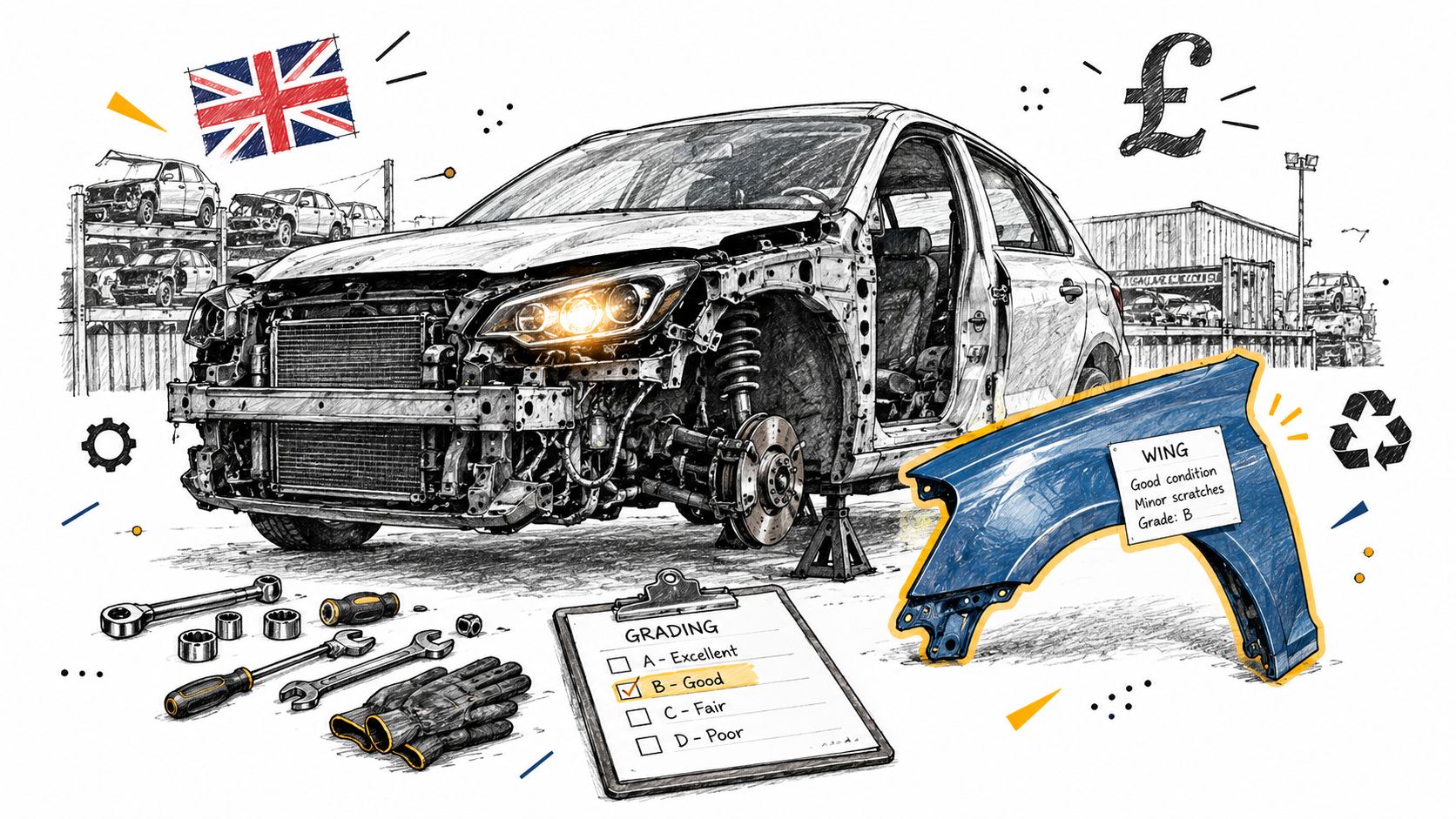
The moment the damage is structural, the valuation changes. Now you’re no longer pricing a complete car. You’re pricing what survives, which may be the engine, gearbox, electric battery, and selected panels or interior parts. That’s exactly how experienced buyers think when they appraise accident damaged cars for sale UK traders see every week. They’re not asking, “Can this look nice again?”. They’re asking, “What can I recover, and what will it cost to make safe?”
Classic cars are the exception insurers miss
One vehicle recently collected by the business owner was valued low by insurers, yet it was a classic now. That’s the danger of leaning only on databases for valuation. Automated figures often miss rarity, provenance, enthusiast demand, and the fact that some old cars don’t behave like ordinary used cars in the market.
Dealer rule: if a rare or classic car is priced only by generic database logic, assume the insurer may have under-read it.
That’s why the valuation lens has to change with the damage type. Cosmetic damage points to repair economics. Structural damage points to parts recovery and risk. A classic or rare car can sit outside both models if the database fails to capture collectability. In practice, the better the car’s story, the more dangerous it is to trust a blunt automated value.
| Damage Type | Primary Value Drivers | Typical Buyers | Risk Level |
|---|---|---|---|
| Structural damage | Engine, gearbox, battery, panels, salvageable parts | Traders, dismantlers, export buyers | High |
| Cosmetic damage | Repairability, paintwork, time to fix, resale potential | Retail buyers, small garages | Moderate |
| Classic or rare vehicle | Collectability, rarity, provenance, parts demand | Enthusiasts, specialists, collectors | Variable |
Three Red Flags Every Buyer Must Check First
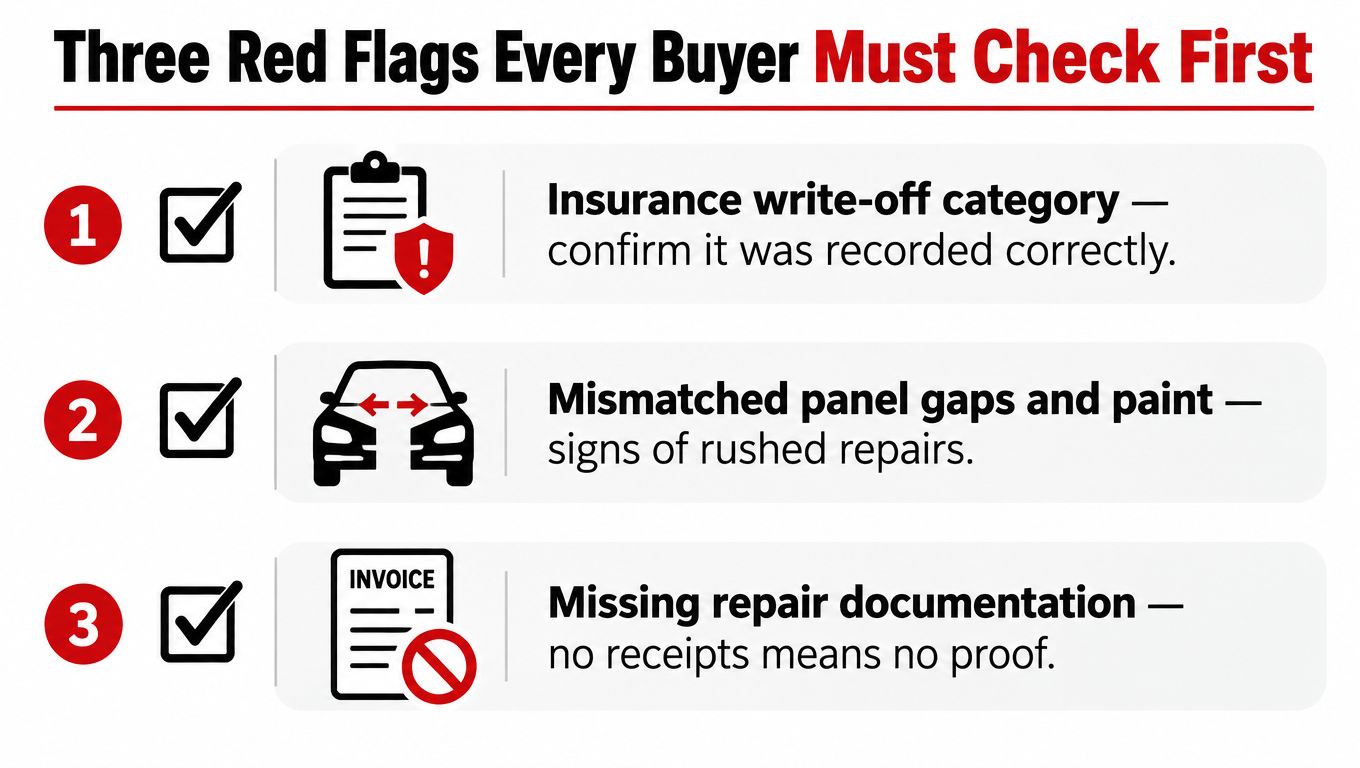
The cheapest damaged car in the advert feed is rarely the cheapest car to own. I’d check three things before I even think about money changing hands, because these are the mistakes that turn a bargain into a mess.
Start with the category and the history
First, confirm the insurance damage classification. Don’t rely on the seller’s wording. Check exactly what the insurer or assessor recorded, because the category tells you how severe the damage was and what the car can legally become again. A Cat N car and a Cat S car might both look tidy in pictures, but they are not the same risk.
Second, check whether the vehicle has been classified before. Some cars are written off more than once, and repeated loss history usually means repeated problems, patch repairs, or a story the listing isn’t telling you. Third, insist on proof that the vehicle has been professionally repaired by a reliable, reputable garage. No proper repair record usually means you’re being asked to trust a finish you can’t verify.
What to ask before you pay
Ask for the repair invoice, the garage name, and any photos taken during the repair. Look for mismatch in panel gaps, overspray, and any reason the seller avoids simple questions about the damage path. If the seller hesitates when you ask who repaired it, that’s not a minor detail. It’s the deal.
Missing paperwork is not a paperwork problem. It’s a value problem.
How to Verify Repair History and Accident Severity
A clean advert doesn’t prove a clean car. I’ve seen plenty of tidy-looking vehicles that hid bad underbody repairs, poor alignment, or a history the seller hoped you wouldn’t check. The safest approach is to build the picture from the outside in.
Use images, inspection, and underside checks together
Start with photos. Look for pre-repair images, auction shots, insurance pictures, or any record of how the car looked before the cosmetic work. Then do a proper walk-around inspection in daylight, not under a forecourt’s flattering lighting. If you suspect undercarriage damage, get the car on a ramp and inspect the suspension mounting points, floor area, and any signs of prior impact.
Service history matters too. Old invoices, alignment reports, and repair notes can reveal whether the car had panel work, suspension work, or hidden structural attention in the past. A DVLA and insurance database check adds another layer, but don’t treat it as the full answer. It’s one tool, not the whole truth. MOT history check tool
The dangerous mistake buyers keep making
A database can undervalue a car that the market sees differently. One recently collected vehicle was judged low by insurers, yet it had become a classic, which is exactly why manual review still matters. If you only trust a screen, you can miss the upside in a rare car, or the downside in one that’s been cosmetically polished over bad repairs.
When I’m pricing a vehicle, I care about what still works and what still counts. If the drivetrain is healthy, the battery is usable, or the engine and gearbox survive a hit, there may be strong value left. If the structure took the blow, the car needs much deeper inspection before anyone calls it a deal.
When to Buy or Sell Accident Damaged Cars UK
Buy when the category is clear, the repair story is documented, and the remaining value is obvious. Sell when the damage is too deep for a sensible private repair, or when the buyer pool is naturally specialist and speed matters more than squeezing out one more offer. That’s the line the market rewards.
For owners who want out quickly, accident-damaged cars can be sold through services that provide instant online valuations, free nationwide collection, and same-day bank payment through licensed Authorised Treatment Facilities. Scrap A Vehicle is one option in that space, and it handles damaged and non-running cars through ATF processing, with the paperwork tied off properly. That matters because a badly handled write-off can create admin trouble long after the car leaves your drive.
For buyers, the best move is patience. Check the category, check the repair evidence, and price the car as a repair job or a parts job, not as a normal used car with a discount badge on it. The UK salvage market pays for knowledge, not optimism.
If you’re selling a damaged car, a failed MOT car, or a vehicle that’s no longer worth repairing, use Scrap A Vehicle to get a proper valuation and a compliant collection process. If you’re buying salvage, use the same discipline the trade uses, clear category checks, repair evidence, and no guesswork on value.