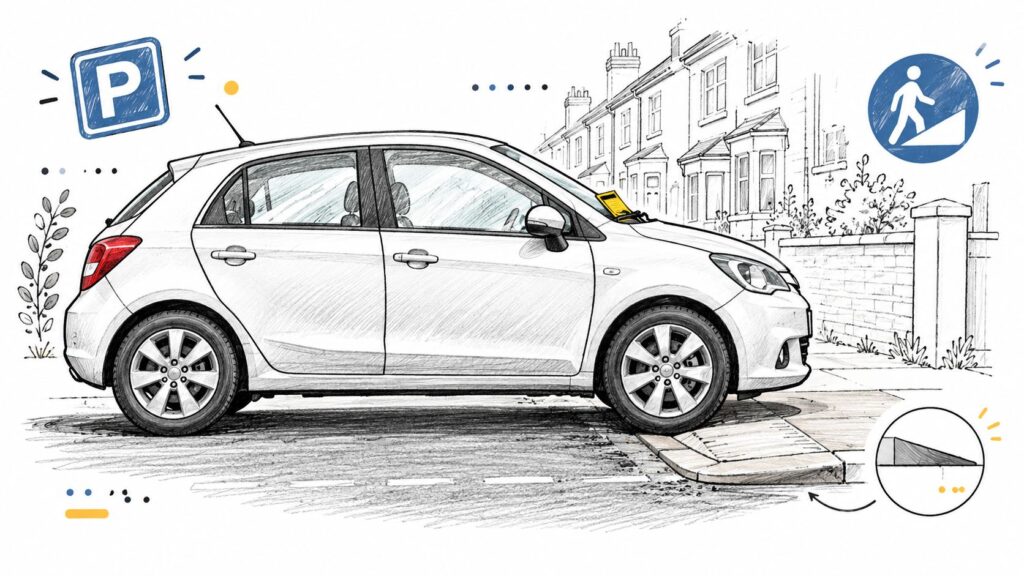
A parking charge for this can be £70, and in many areas it drops to £35 if paid within 14 days. Councils often enforce it automatically under Section 86 of the Traffic Management Act 2004, so a car left across the wrong part of a lowered kerb can turn into a notice very quickly.
You might come back to your car after a short stop and only then realise the front wheels were a little too close to a driveway, a pedestrian ramp, or the lowered section outside someone’s home. That mistake happens because a drop kerb can look like ordinary pavement shaping when you’re focused on finding a space. The legal test is stricter than most drivers expect, and the exact kerb type matters.
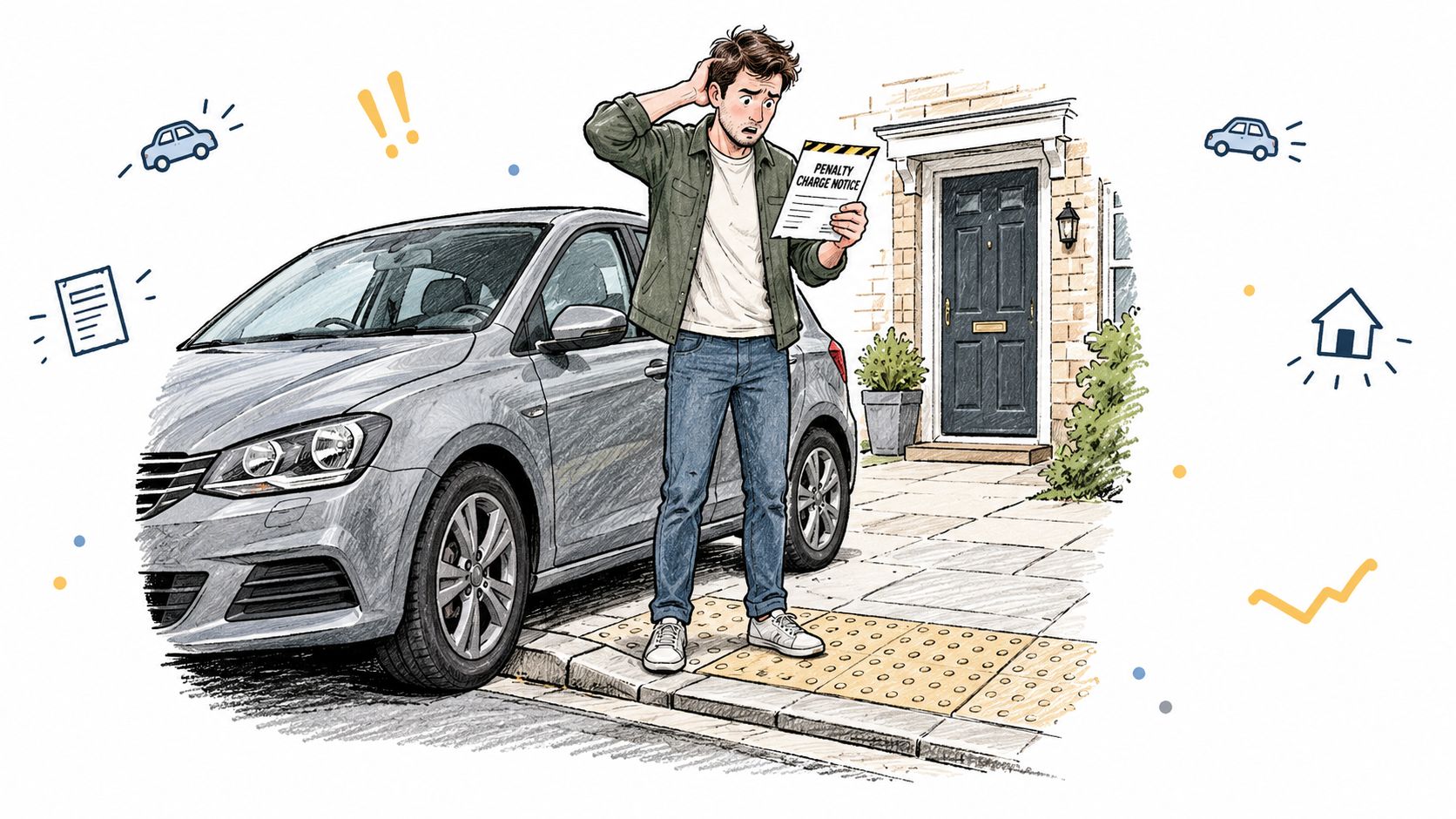
Table of Contents
- The Real Risk of Parking at a Drop Kerb
- Understanding the Legal Basis for Drop Kerb Enforcement
- Shared, Residential and Pedestrian Drop Kerbs Compared
- How Councils Measure a Contravention
- Penalties, Discounts and Repeat Offences
- Legitimate Exceptions and Temporary Access Options
The Real Risk of Parking at a Drop Kerb
A driver sees an open stretch of road, pulls in neatly, and thinks the car is clear. Then a notice arrives because the vehicle was sitting across the lowered section that gives someone access to a driveway or crossing. That’s the trap with parking in front of a drop kerb, the danger isn’t always obvious from inside the car.
The problem is that people judge by the empty space around the vehicle, while enforcement looks at the exact kerb position. A small overlap can be enough, and the rear of the car can be more important than the front if it crosses the lowered access point. Drivers also assume that if there’s no painted restriction, the space is safe, but that’s not how this rule works in many councils.
Practical rule: if the lowered kerb is there to let people or vehicles cross the footway, treat it as an access point, not a parking space.
A lot of confusion comes from the fact that the road can look wide enough for everybody. In practice, the issue is not whether your car can fit. It’s whether the vehicle blocks the access that the lowered kerb was built to serve.
Understanding the Legal Basis for Drop Kerb Enforcement
Section 86 and why councils can act
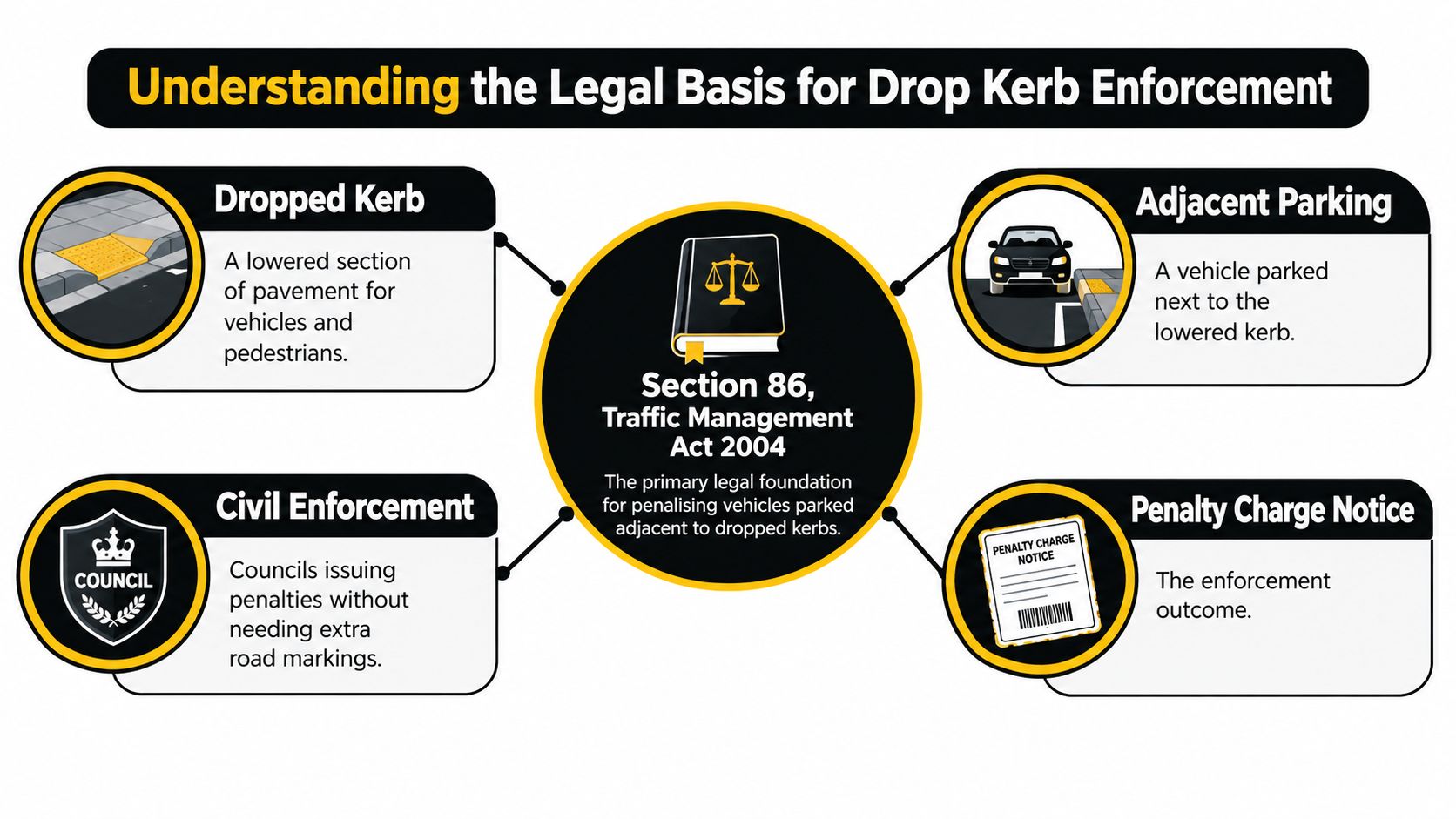
The modern legal foundation is Section 86 of the Traffic Management Act 2004. It generally prohibits parking adjacent to the lowered section of kerb used for pedestrian, cyclist, or vehicle access, and local authorities can enforce that without needing road signs or yellow lines in many cases. That matters because the offence is not just about inconvenience, it is a civil parking contravention with formal consequences.
The Gateshead Council explanation of dropped kerb enforcement shows how this rule has become a recognised part of parking control across England and Wales. Councils can therefore treat blocked access as more than a neighbour dispute. They can issue enforcement action when the legal conditions are met.
The Highway Code backs up the rule
The same framework is reflected in Rule 243 of the Highway Code, which tells drivers not to stop or park where the kerb has been lowered for wheelchair users and powered mobility vehicles, or in front of an entrance to a property. That makes the guidance easy to understand in theory, even if drivers still struggle with the exact boundary in practice.
The important point is that the Highway Code and the legislation point in the same direction. One sets the driving standard, the other gives councils the enforcement route. So this is not a vague courtesy rule that depends on whether someone complains loudly enough.
Key takeaway: the law treats a lowered kerb as a protected access point, and councils do not need to rely on extra signs before they can act.
That’s why a driver can’t safely assume, “I didn’t see a restriction, so I’m fine.” The restriction is built into the kerb itself, and local enforcement policy decides how that becomes a notice on the windscreen or through the post.
Shared, Residential and Pedestrian Drop Kerbs Compared
The biggest source of confusion is that not every lowered kerb is treated the same way. A shared crossover, a residential driveway access, and a pedestrian crossing point all look similar from the street, but councils can handle them differently. That’s why two drivers can park in what feels like the same situation and get very different outcomes.
How the common kerb types differ
| Kerb Type | Typical Enforcement Trigger |
|---|---|
| Shared vehicle crossover | Often enforced routinely when the access is obstructed |
| Residential driveway kerb | Often enforced on report, or when the occupier asks for action |
| Pedestrian drop kerb | Often enforced routinely because it supports footway access |
The clearest distinction is between routine enforcement and complaint-based enforcement. Richmond’s dropped kerb enforcement guidance shows that a single-property dropped kerb may need a resident report before a PCN is issued, while Bromley says shared or pedestrian dropped kerbs can be enforced routinely and residential ones only on report from the occupier. That’s a real policy difference, not just wording.
So if a driver parks across a residential driveway in one borough, they may get a notice only after the occupant reports it. In another borough, the same behaviour could be ticketed more quickly if the kerb is treated as a shared or pedestrian access point. The difference comes from the kerb’s function and the council’s policy, not from luck.
That’s why it helps to stop thinking of every lowered kerb as one single category. The legal risk changes with the access it serves, and the enforcement trigger follows that classification.
How Councils Measure a Contravention
The level section is the key
Councils usually look at the level crossing section where the lowered footway meets the carriageway. That’s the part that matters, not just the sloped taper leading into it. Havering’s dropped kerb guidance makes this distinction clear, and it explains why a vehicle can be ticketed even when it only partly blocks the access point.
That means the test is not, “Is the car close to the driveway?” The test is, “Does any wheel or any part of the vehicle overlap the enforceable lowered section?” If the answer is yes, a contravention may be recorded.
A simple street-level example
A driver parks with the front of the car just beyond the sloped approach, thinking the car is clear. The rear bumper, however, sits over the flat lowered section that lines up with the driveway entrance. In that situation, the vehicle can still be treated as obstructing the access point because the overlap happens where the kerb meets the road.
The practical lesson is simple. Don’t use the sloping edges as your guide. Use the full width of the lowered section itself, and remember that a partial overlap can still count.
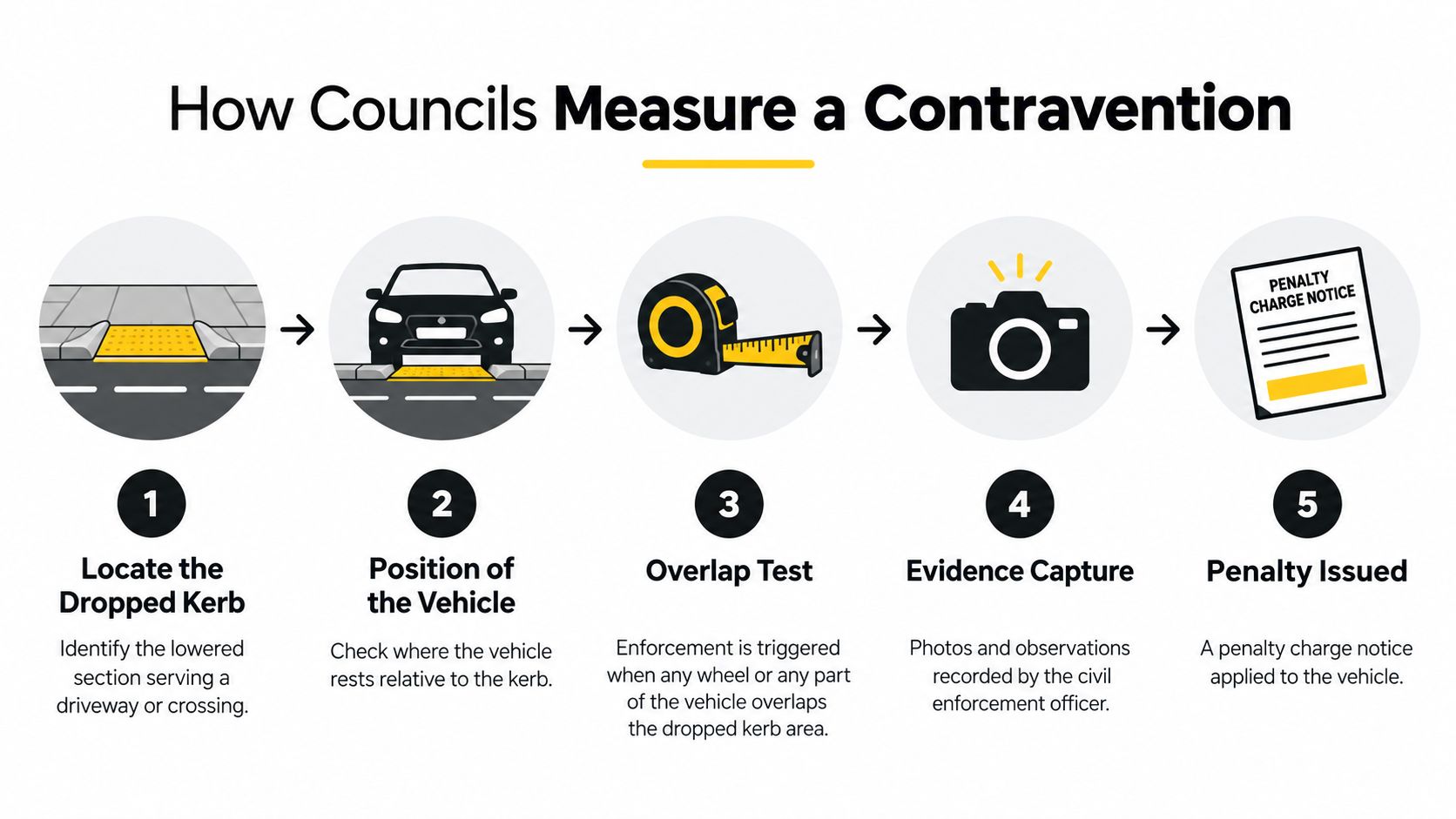
A car doesn’t have to sit fully across the access point to trigger enforcement. A partial overlap can be enough if it reaches the lowered section.
Penalties, Discounts and Repeat Offences
The financial side is easy to understand once you know councils treat this as a parking contravention. A common penalty level is £70, and that figure appears in guidance from multiple UK local authorities. Bournemouth, Christchurch and Poole Council’s dropped kerb page also shows the usual early payment reduction, with payment within 14 days lowering the charge to £35.
That discount changes the practical risk. A driver who treats the notice casually can miss the lower payment window and end up paying the full amount. The early payment option exists because councils want quick resolution, not prolonged argument over a blocked access point.
When repeat obstruction gets tighter control
Some councils go further when the problem keeps happening. Bexley allows residential dropped kerbs to be formally registered for routine enforcement, after which any vehicle parked across the area can be ticketed, including the resident’s own vehicle or a visitor’s car. That shifts the issue from occasional complaint to a repeatable enforcement process.
Practical rule: one blocked driveway may be a one-off mistake, but a registered dropped kerb can turn every new obstruction into a fresh penalty risk.
This is why repeated parking in the same spot can become a much bigger problem than a single bad judgement. Once a kerb is in an active enforcement scheme, the council doesn’t have to treat each incident as a separate debate about access. It becomes a standard parking control matter.
Legitimate Exceptions and Temporary Access Options
Not every stop near a dropped kerb ends with a penalty. East Suffolk says enforcement may not happen if the vehicle is in a designated bay, is engaged in continuous loading or unloading for no longer than 20 minutes, or has the property owner’s consent for a residential dropped kerb. East Suffolk’s dropped kerb enforcement guidance is one of the clearest examples of how outcomes in practice can differ from the broad Highway Code rule.
That nuance matters because drivers often think only in terms of “blocked” or “not blocked.” In practice, councils also consider the activity taking place and whether the access is residential or part of a different parking layout. Consent can change the picture, but only when the local authority accepts it under its own guidance.
A simple checklist for short-term stopping
- Check the kerb’s function: If it serves a driveway, a pedestrian crossing, or another access route, treat it as sensitive space.
- Look for a designated bay: A marked bay can override the normal fear of a PCN in some situations.
- Keep loading continuously active: Stopping briefly, disappearing, and coming back later is not the same as active loading.
- Ask for consent where appropriate: If it’s a residential access and you have the owner’s permission, that can matter.
- Verify the council policy: Local rules decide how the same kerb is enforced.
If you’re arranging a collection, helping a disabled passenger, or loading a vehicle before removal, don’t rely on guesswork. Read the council’s own dropped kerb page and compare it with the physical access point outside the property. For a practical overview of the risks involved, see this guide on parking over a dropped kerb.
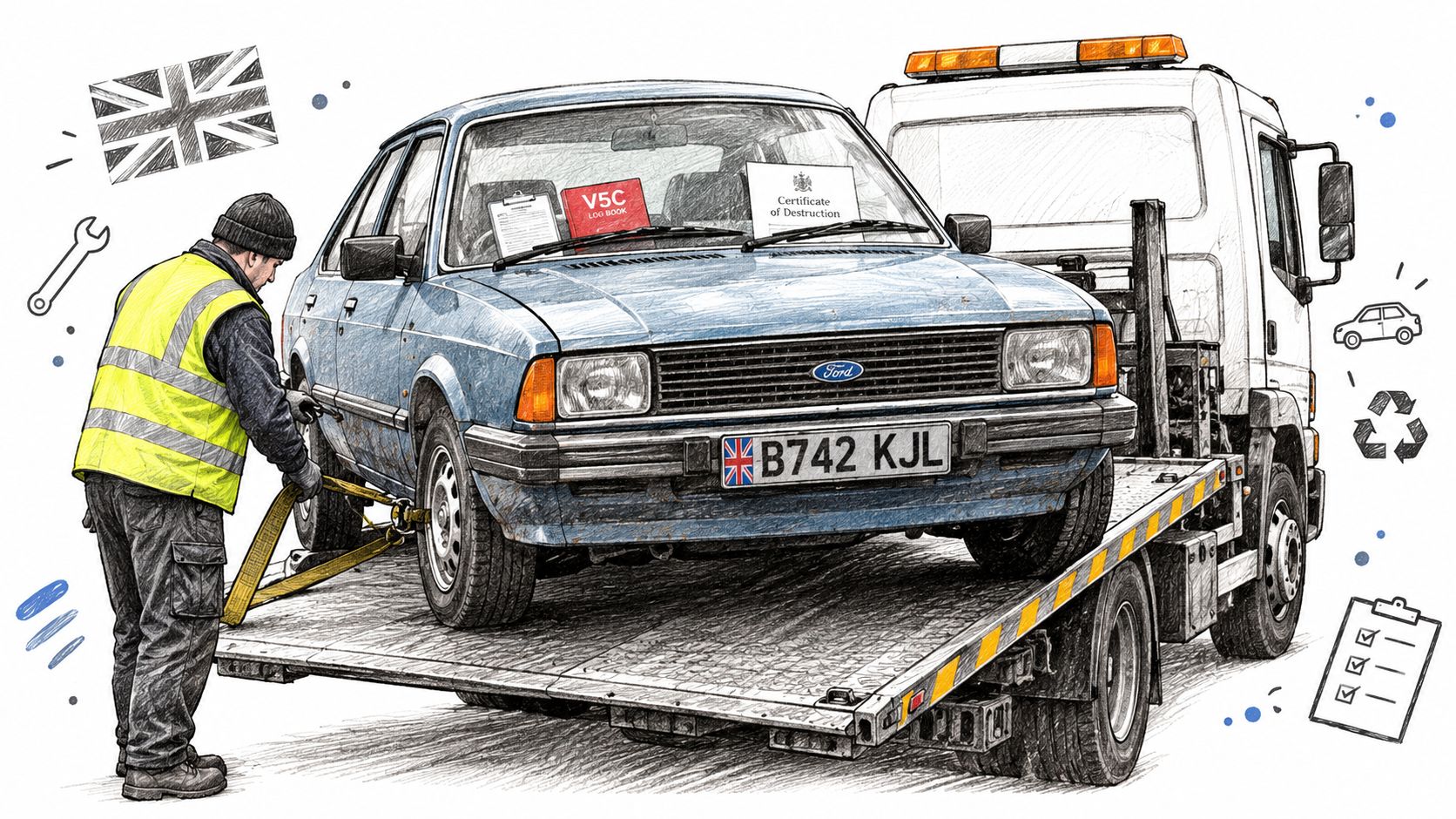
If you need to clear a vehicle that’s making parking stressful or you’ve got an end-of-life car sitting in the wrong place, Scrap A Vehicle can help with a quick, lawful disposal route. Visit Scrap A Vehicle for an instant valuation, free collection, and a straightforward way to move on from the problem without turning a parking issue into a bigger headache.