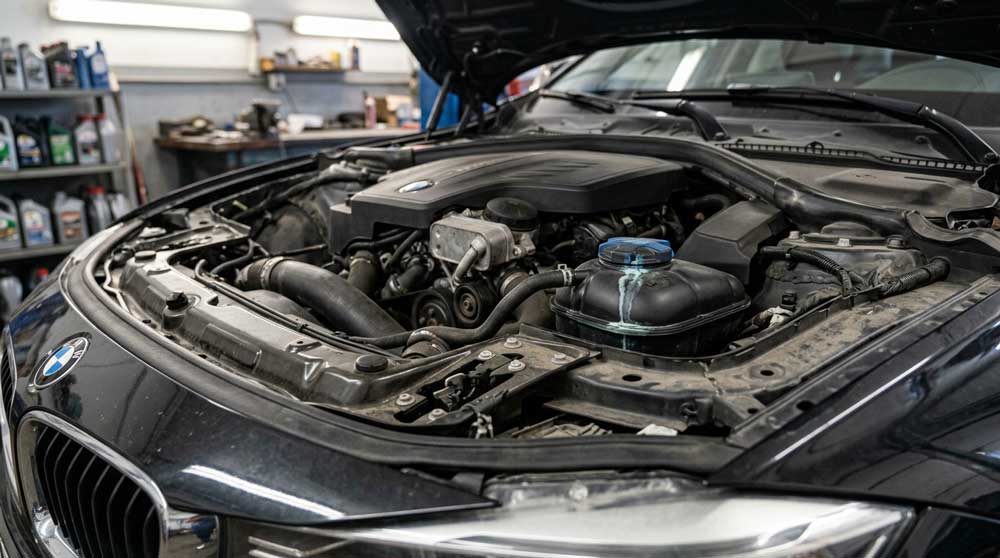
A puddle under the front of the car, a sweet smell after a drive, or that low-coolant warning on the dash. A BMW coolant leak usually starts small, but the repair bill behind it can range from pocket money to more than the car’s worth. Knowing which failure you’re looking at tells you whether to fix it or let it go.
What causes a BMW coolant leak?
Most leaks trace back to a handful of parts that wear out with age and heat. The plastic expansion tank, also called the header tank, is the classic BMW weak point and cracks once the plastic goes brittle. Water pumps are another common culprit, since many BMWs use an electric pump that fails as the miles climb.
Beyond those two, the thermostat housing, radiator, hoses and clamps all perish over time and start to weep. At the serious end sit two expensive problems, a leaking head gasket and, on certain V8 engines, an internal coolant transfer pipe. Both can lose coolant with little showing on the driveway.
How do you know your BMW is losing coolant?
Your dashboard usually warns you first, with a low-coolant light or a rising temperature gauge. A sweet, syrupy smell is another giveaway, and you might spot pink or orange residue around the front of the engine or a stain on the ground where you park.
Some leaks hide well. If the level keeps dropping but nothing shows underneath, the coolant may be leaking internally through a head gasket or a transfer pipe, or burning away through the engine. White smoke from the exhaust or a mayonnaise-like film under the oil cap points that way, and it’s worth acting quickly before the engine overheats.
Which BMW engines and models are worst affected?

The cooling parts that fail vary by engine, and a few have a reputation for it. The N62 V8, fitted to cars like the 545i, 550i, 645i, 650i, X5 and 7 Series, suffers a notorious coolant transfer pipe leak deep inside the engine valley. That pipe weeps near the water pump and it’s awkward to reach.
Cracked expansion tanks turn up across the range, and owners of the E46 3 Series and E90 generation report them often. Smaller engines like the N47 diesel and the petrol four-cylinders tend to leak from hoses, the thermostat housing or the pump rather than anything internal, which usually keeps repairs cheaper.
How much does a BMW coolant leak cost to repair?
What you pay swings hugely depending on what’s leaking. A loose hose or clamp is quick and cheap, while a water pump or thermostat housing costs more in parts and labour. A head gasket or an N62 transfer pipe sits at the top, because the labour alone runs into double-digit hours. The typical UK figures look like the table below.
| Repair | Typical UK cost |
|---|---|
| Hose or clamp | £100 to £250 |
| Expansion tank | £150 to £350 |
| Thermostat housing | £300 to £600 |
| Radiator | £300 to £700 |
| Water pump | £400 to £800 |
| Head gasket | £1,000 to £3,000 |
| N62 coolant transfer pipe | £2,000 to £4,000+ |
These are guide prices, and the real quote depends on your model, your garage and where you live. A specialist or independent BMW garage will often beat a main dealer, especially on the bigger jobs. For more on the parts involved, the RAC’s coolant and antifreeze guide is a useful read, and you can compare typical figures on repair-cost estimates before you book.
When is it cheaper to scrap than fix?
Here the maths is simple once you know the repair cost and the car’s value. A cracked expansion tank on a tidy BMW worth several thousand pounds is an easy fix and well worth doing. The picture changes when an older, high-mileage car needs a head gasket or a transfer pipe.
If the bill lands near or above what the car would sell for, pouring money in rarely makes sense, especially when other tired parts are likely to follow. At that point scrapping turns a leaking liability into cash. You can check what your BMW is worth for free, and if scrapping beats fixing we offer free collection nationwide and an instant online quote. A persistent coolant leak can also be the kind of fault that tips an older car past being worth repairing in the first place.
Frequently asked questions about BMW coolant leaks
Can you drive a BMW with a coolant leak?
Only for the shortest distance, and never if the temperature gauge is climbing. Running a BMW low on coolant risks overheating, which can warp the head or crack the block and turn a cheap repair into a ruinous one. Top it up, watch the gauge, and get it looked at quickly.
Why does my BMW lose coolant with no visible leak?
A leak you can’t see usually means coolant is escaping internally rather than onto the ground. A failing head gasket or, on V8s, the coolant transfer pipe lets it burn or seep inside the engine. White exhaust smoke or a creamy film under the oil cap are common signs.
Is a BMW coolant leak expensive to fix?
It depends entirely on the source. A hose or expansion tank is a few hundred pounds at most, while a head gasket or an N62 transfer pipe can run into the thousands once labour is added. Getting the leak diagnosed first tells you which camp you’re in.
How long can you leave a coolant leak?
Not long. Even a slow leak drops the level over time, and a BMW that overheats can suffer serious engine damage fast. If you can’t fix it promptly, keep the coolant topped up and avoid long or fast journeys until it’s sorted.
Is it worth fixing an old BMW’s coolant leak?
If the repair’s minor and the car’s otherwise sound, yes. If it needs a head gasket or transfer pipe and the car is old with high miles, the cost can outstrip its value, and scrapping is often the smarter move. Weigh the quote against a free valuation before deciding.