For most cars over 3 years old, you can’t tax the vehicle unless it has a valid MOT when the tax starts. The main exceptions are new vehicles under 3 years old and historic vehicles that are formally MOT-exempt.
That’s the point where many drivers get stuck. Your MOT has just expired, or the car has failed, and the tax renewal reminder lands at exactly the wrong time. You try the DVLA service, assume tax and MOT are separate jobs, then hit a block in the process.
The confusion usually comes from treating tax as a payment issue and MOT as a garage issue. In practice, the DVLA treats them more like linked gates. If one gate is shut, the other often won’t open. That’s why people ask, can I tax a car without MOT, when what they’re really facing is a chain of decisions about road use, storage, repair, or disposal.
A few common situations bring people here:
- Your MOT expired before you renewed tax
- The car failed its MOT and you need to decide what next
- The vehicle is a non-runner and you’re wondering whether to SORN it or scrap it
- You own an older classic and aren’t sure whether MOT exemption changes the tax rule
The answer depends less on what condition the car is in and more on how the vehicle sits in the DVLA system. That distinction matters. A broken car isn’t automatically untaxable. An MOT-exempt car isn’t automatically road-legal either. The system looks for the right status, at the right time, with the right evidence.
Plain-English rule: for most everyday cars, no current MOT means no tax. If the vehicle is legally exempt from MOT, that exemption can satisfy the DVLA check instead.
Table of Contents
- Introduction Can You Tax a Car Without an MOT
- How UK Car Tax and MOT Work Together
- When You Can Legally Tax Without an MOT
- What Happens If Your MOT Has Expired or Failed
- Practical Steps to Take for Non Runners and MOT Failures
- Common Misconceptions About Tax MOT and Insurance
- Myth one insurance lets me tax the car anyway
- Myth two there’s a grace period after the MOT expires
- Myth three SORN means the car can stay parked on the street
- A simple video explanation helps
- Myth four an older or classic car is outside the system
- Myth five if the car failed its MOT, I can tax it first and fix it later
- Making the Right Decision for Your Vehicle
Introduction Can You Tax a Car Without an MOT
Your tax reminder arrives. The car is sitting on the drive. Then you remember the MOT ran out, or the test ended with a fail sheet in your hand.
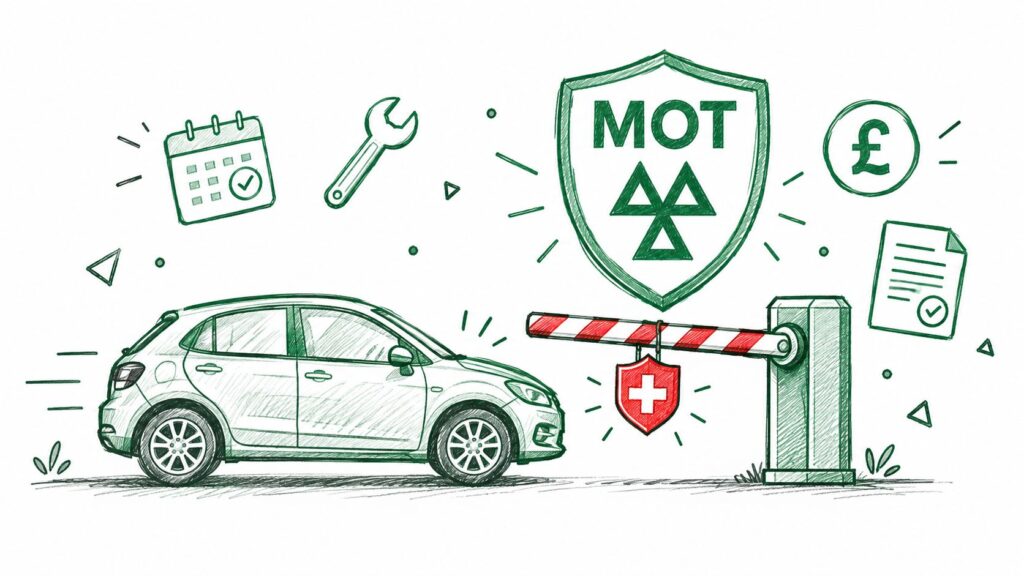
That moment catches a lot of drivers out because tax and MOT feel like two separate jobs. One looks like a payment. The other looks like a garage check. In practice, the DVLA treats them more like two linked gates. For most cars, if the MOT gate is shut, the tax gate stays shut too.
As noted earlier in the GOV.UK guidance, the system checks whether the vehicle needs an MOT before tax can start. If the vehicle does need one, the MOT usually has to be current at the point the tax begins. If the vehicle is legally exempt from MOT, that exemption can satisfy the check instead.
That distinction matters more than the car’s condition. A non-runner is not automatically untaxable. An MOT-exempt vehicle is not automatically ready for the road. What matters first is the vehicle’s status in the DVLA system, then what you plan to do with it next.
People usually ask this question in three situations:
- The MOT has expired and they want to renew tax or keep the car legal.
- The MOT has failed and they need to choose between repair, storage, or disposal.
- The vehicle may be exempt and they are unsure whether tax can still be arranged.
Each one leads to a different decision.
If the car is a failed MOT case or a non-runner, the question is often wider than “can I pay the tax?” It is whether the car should go back on the road at all. Sometimes the sensible route is repair and retest. Sometimes it is SORN. Sometimes, if the repair bill is hard to justify, scrapping the car is the cleaner financial choice.
A good rule to keep in mind is simple. For most everyday cars, no current MOT means no tax. The main exception is a vehicle that does not legally need an MOT in the first place.
How UK Car Tax and MOT Work Together
Think of the DVLA system as a gate with checks built into it. Tax is one part of road legality, but it isn’t processed in isolation. The system looks at the vehicle’s record before letting the tax start.
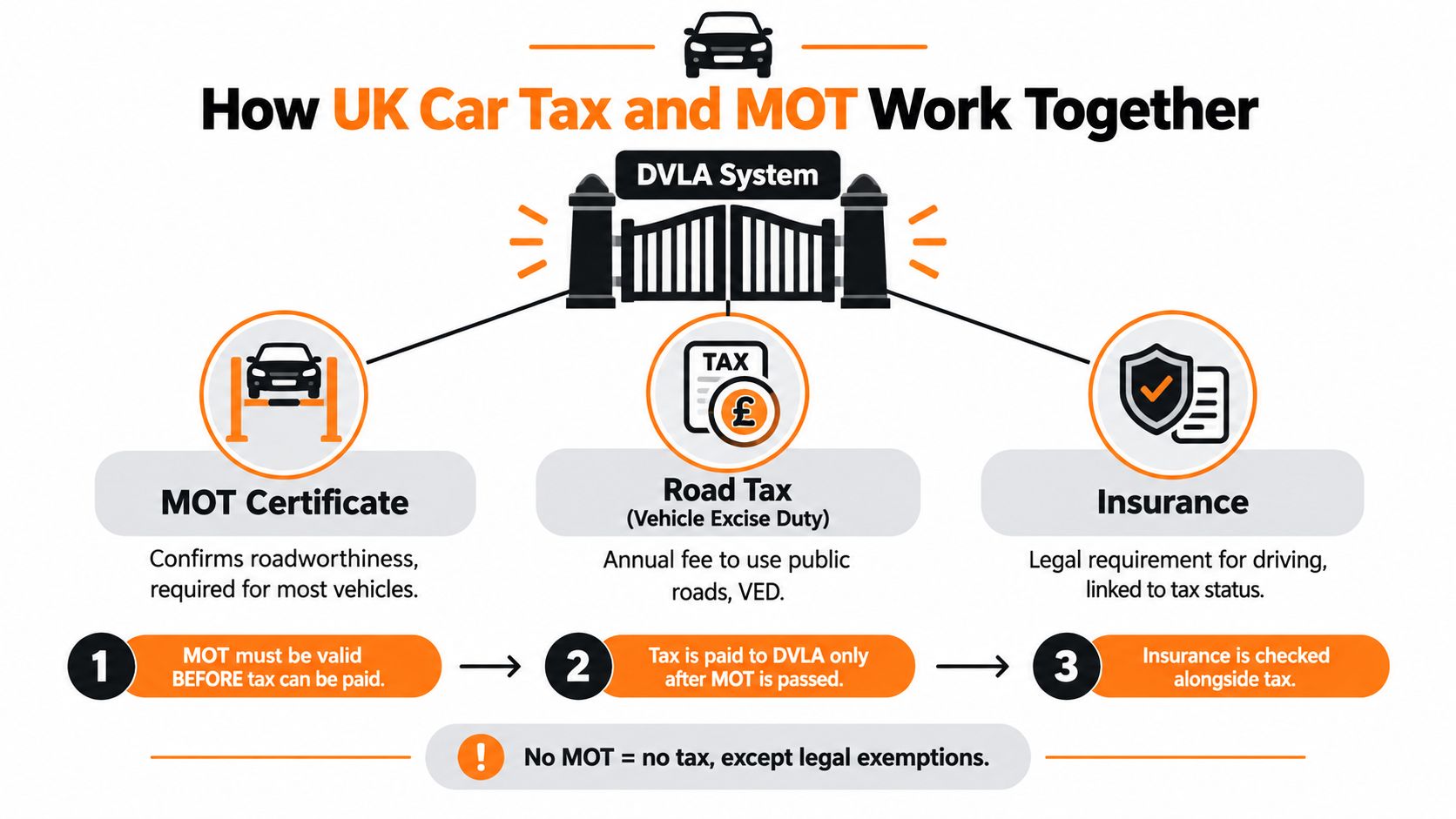
The gatekeeper idea
Most drivers think in a straight line:
- pay tax
- insure the car
- drive it
The DVLA logic is closer to this:
- Check whether the vehicle needs an MOT
- Check whether the MOT is valid when tax starts
- If valid, allow tax to begin
- If not valid, stop the application unless an exemption applies
That’s why taxing a car without MOT isn’t usually about finding a workaround. It’s about whether the system sees you as eligible at that moment.
Why the timing matters
The point is not “did this car have an MOT recently?” The point is whether the MOT is valid at the moment the tax starts. That wording matters because drivers sometimes assume they can renew tax first and sort the MOT later the same week.
You generally can’t do that. The record needs to line up at the start point.
A simple example helps. If your tax is due today and your MOT expired yesterday, the DVLA system is likely to stop the tax application because the gatekeeper check fails. If your MOT is still current today, you can usually complete the tax and then deal with the next MOT before that certificate expires.
The tax system doesn’t judge how tidy your plans are. It checks whether the legal condition is met when the tax begins.
Why non-runners get caught here
Owners of broken-down vehicles often assume the car’s condition is the main issue. It usually isn’t. A car can be mechanically rough but still pass the tax gate if its MOT status is current or exempt. A perfectly clean-looking car can fail the tax gate if the MOT record isn’t valid.
That’s why the question for a non-runner is rarely “Can I just tax it anyway?” More often, the useful questions are:
- Will it be repaired and retested soon?
- Will it stay off the road under SORN?
- Has it reached the point where disposal makes more sense?
Insurance is linked, but not a replacement
Drivers also mix up insurance and MOT. Insurance matters for lawful road use, but it doesn’t replace the MOT requirement for taxing a vehicle. Having a policy in place doesn’t persuade the DVLA to ignore an expired MOT record.
So the easiest way to remember the system is this:
| Check | What it does |
|---|---|
| MOT status | Shows whether the vehicle meets the test requirement or has an exemption |
| Tax application | Starts only if the MOT gate is satisfied |
| Insurance | Remains a separate legal requirement for road use |
If you remember that order, most of the confusion disappears.
When You Can Legally Tax Without an MOT
You can tax a car without an MOT in only a few narrow situations. The simplest way to read the rules is as a gatekeeper system. The tax gate opens only if the MOT side is already satisfied, either because the vehicle does not need an MOT yet or because it qualifies for a recognised exemption.
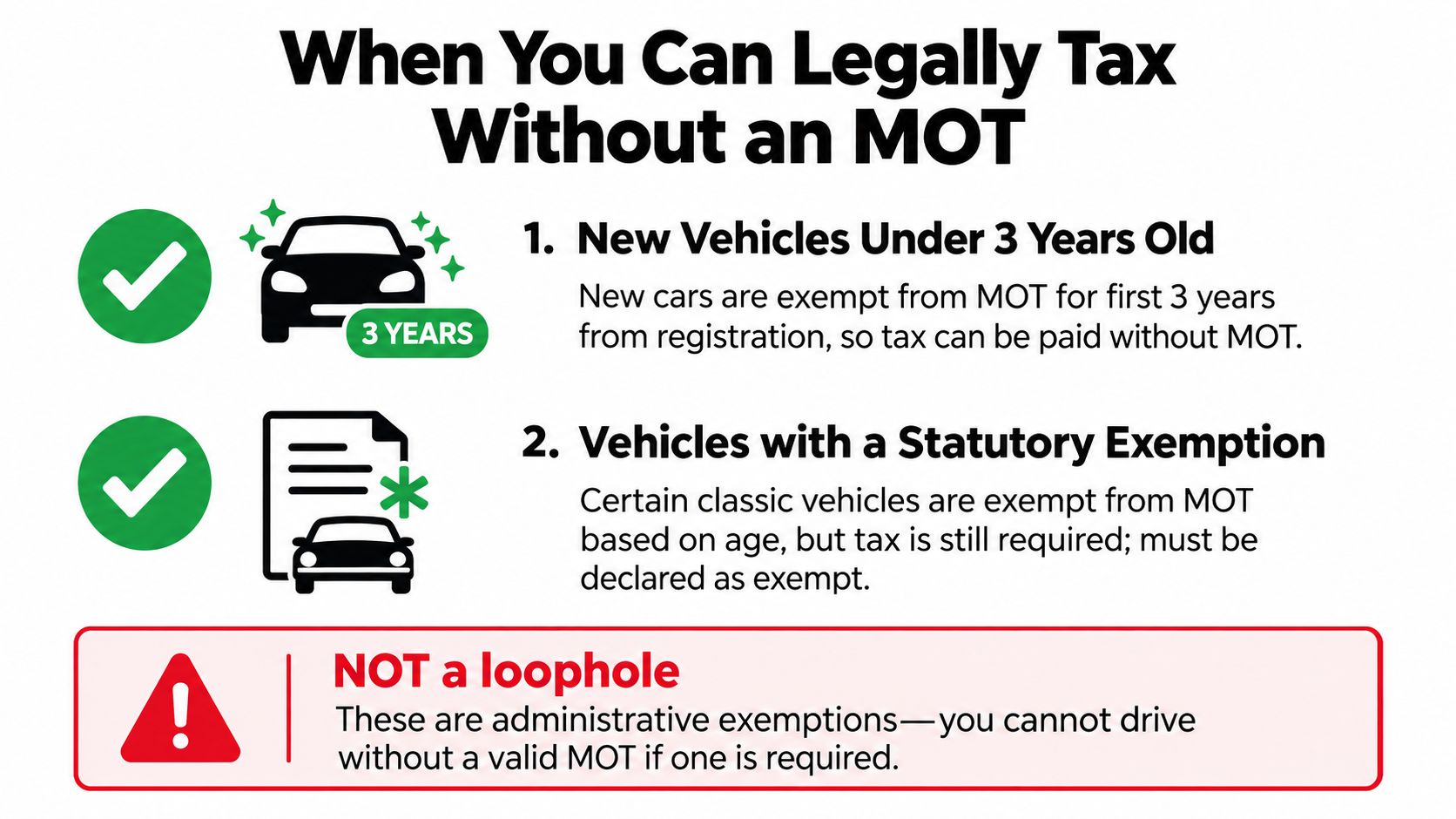
New vehicles under 3 years old
A brand-new car sits outside the MOT system for its first few years. So if the vehicle is under 3 years old, the missing MOT is not a problem. There is no test record because no test is due yet.
That is why a newer car can usually be taxed even though no MOT history appears online. The MOT gate is treated as satisfied because the vehicle has not reached that stage.
Historic vehicles with a valid exemption
Older vehicles can be different, but only where the exemption rules apply. Some historic vehicles do not need a current MOT, and in those cases the exemption takes the place of the certificate for tax purposes.
The key point is paperwork. Age alone does not move a car through the tax gate. The vehicle must fall within the exemption rules, and the keeper must declare that status properly. GOV.UK historic vehicle guidance explains the process and where form V112 may be needed: https://www.gov.uk/historic-vehicles/apply-for-vehicle-tax-exemption
Some classic owners still work from the older assumption that every older vehicle needs a live MOT before it can be taxed. That is not always true now. What matters is whether the vehicle qualifies for exemption and whether the exemption has been recorded in the right way.
Important distinction: MOT-exempt does not mean roadworthy by default. The vehicle still has to be safe for the road.
What form V112 does
Form V112 is the declaration used for certain MOT exemption categories. It works like a label on the file saying, “this vehicle meets an exemption route, so there is no normal MOT record to check.”
That matters for barn finds, long-stored classics, and other non-runners that owners assume are exempt just because they are old. A dusty car does not pass the gate on appearance or age alone. Its legal status has to fit the exemption rules.
The decision tree in plain English
If you want the short version, ask these questions in order:
- Is the car under 3 years old? If yes, you can usually tax it without an MOT.
- If not, does it have a current MOT? If yes, the normal tax route is open.
- If not, does it qualify for a recognised MOT exemption, such as an eligible historic vehicle declared correctly? If yes, you may still be able to tax it.
- If the answer is no, the tax process usually stops.
For non-runners, that last step matters most. If the car is off the road, has no valid MOT, and does not qualify for exemption, taxing it is usually the wrong question. The choice is whether to repair it, keep it on SORN, or cut losses if the repair bill is likely to outrun the car’s value.
What Happens If Your MOT Has Expired or Failed
Once the MOT is no longer valid, the question changes from “Can I tax it?” to “What’s the least risky and most sensible next step?”
The answer depends on whether you want to keep the car, repair it soon, or stop using it altogether.
Your three main routes
If the MOT has expired or the car has failed, most owners end up choosing one of these:
- Repair and retest, then tax once the MOT position is sorted
- Declare SORN and keep the vehicle off the public road
- Sell or scrap the vehicle if repair no longer makes sense
That last option deserves more attention than it usually gets. For a tired non-runner, chasing a pass can become a money sink. If the vehicle’s value is low and the faults are serious, disposal may be the cleaner outcome.
Options When Your Car Has No Valid MOT
| Option | Can You Tax | Can You Drive | Key Requirement |
|---|---|---|---|
| Repair and retest | Usually not until MOT is valid again, unless exemption applies | Only in limited lawful circumstances such as travelling to a pre-booked MOT test | Book repairs and get a pass or valid exemption |
| Declare SORN | No need to tax while off-road | No, it must stay off the public road | Keep the car on private land |
| Sell or scrap | Usually unnecessary if you’re disposing of it | No routine road use before disposal | Transfer or dispose of the vehicle properly |
The pre-booked MOT test exception
One area causes constant confusion. A vehicle can usually be driven to a pre-booked MOT test in limited circumstances, but that is not the same thing as being free to use the car normally.
You can’t treat a test booking as a general permit to drive around untaxed or with no valid MOT for errands, commuting, or shopping. The exception is narrow and practical. It exists so you can get the car to the test.
Check the history before spending on repairs
Before approving a long repair list, it helps to review the car’s past test pattern. Repeated corrosion advisories, recurring emissions problems, or a run of major defects can signal that the vehicle is nearing the end of the road financially.
A UK MOT history check can help you spot whether this is a one-off failure or part of a longer decline.
If a car keeps failing for the same family of issues, the MOT isn’t the problem. The car’s overall condition is.
When scrapping becomes the smarter move
If the vehicle is a non-runner, needs towing, or has failed on multiple expensive items, the practical question becomes simple. Will the repair bill give you a dependable car back, or only buy a short spell of use before the next big failure?
For some owners, the answer is obvious once they step back. A car that can’t be taxed, can’t be used, and isn’t worth repairing isn’t really in limbo. It’s waiting for a decision.
Practical Steps to Take for Non Runners and MOT Failures
When a car has failed its MOT or won’t start, people often rush into the wrong task first. They look at tax before deciding whether the vehicle is staying on the road.
The better order is to secure the legal position, assess the repair path, then choose whether to recommission or dispose of it.
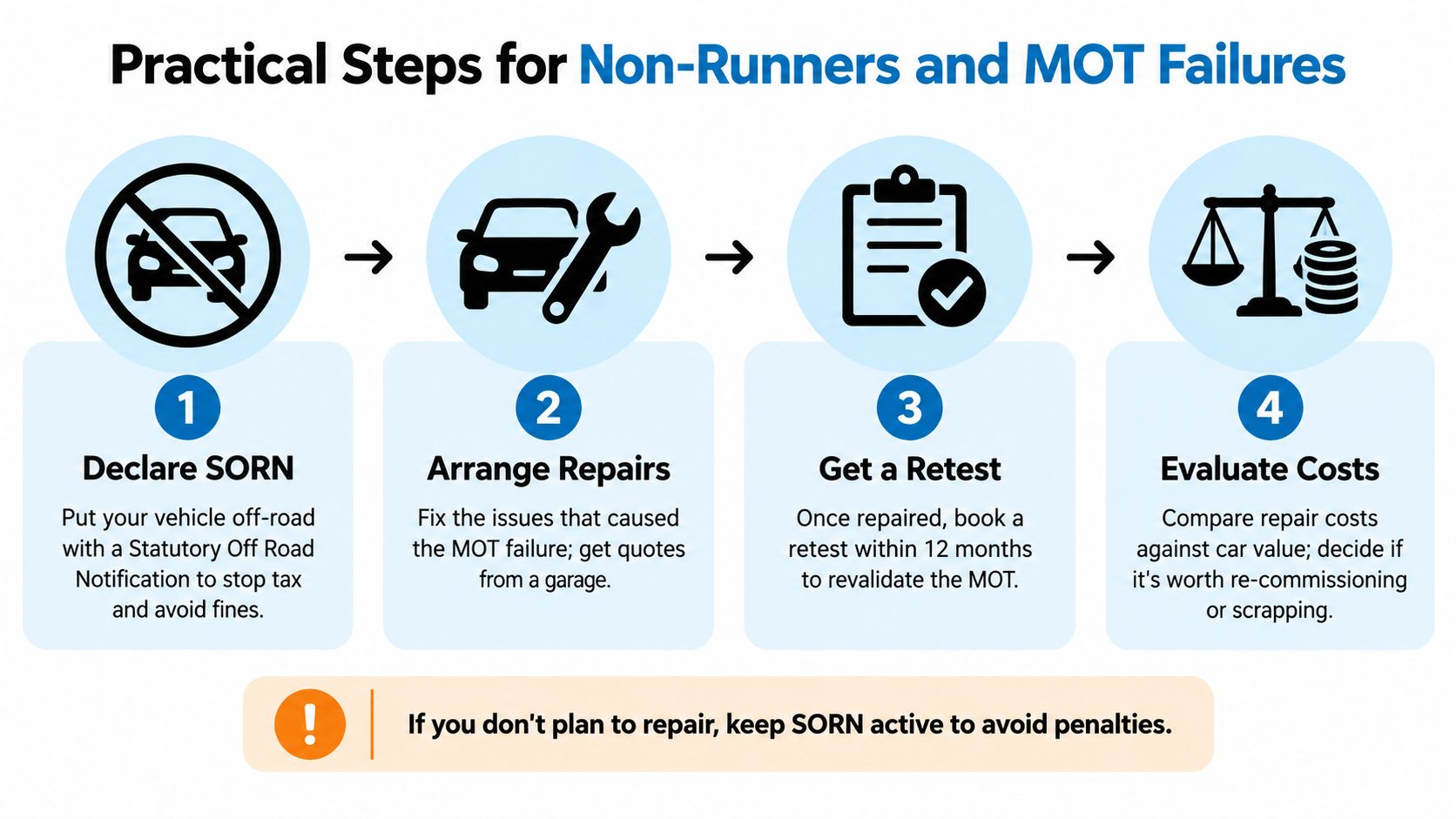
Step one off-road means off-road
If the vehicle won’t be used straight away, declare SORN and keep it on private land. That takes the pressure off while you decide what to do. It also stops you drifting into accidental road use with a car that isn’t ready.
A driveway, garage, or other private space is the key point. If the car is off-road in name only but still left on a public road, you haven’t really solved the problem.
Step two get the failure sheet translated into decisions
An MOT failure notice can look intimidating because it mixes safety items, wear-and-tear faults, and sometimes issues that make the repair uneconomical. Don’t read it as one giant “yes or no”. Break it into categories.
Ask the garage:
- Which defects must be repaired before any lawful road use?
- Which faults suggest wider decline rather than a single fix?
- Whether the car can be made reliable, not just passable
That last question matters. A pass isn’t the same as a sensible vehicle to keep.
Step three compare repair cost with likely outcome
Many owners focus only on whether they can afford the first repair bill. A better test is whether the total spend still makes sense after the car goes back on the road.
Use a simple checklist:
- Condition overall. Is the MOT failure part of a wider pattern?
- Use case. Do you need a dependable daily car or an occasional runabout?
- Storage. Can you keep it off-road while deciding?
- Resale reality. Would the repaired car still be worth keeping?
Practical rule: if the repair feels like rescuing the car for sentimental reasons alone, be honest about that before you spend the money.
Step four choose recommissioning or compliant disposal
If the repairs are reasonable, book the work, arrange the retest, and only return to tax once the vehicle is ready for legal road use again.
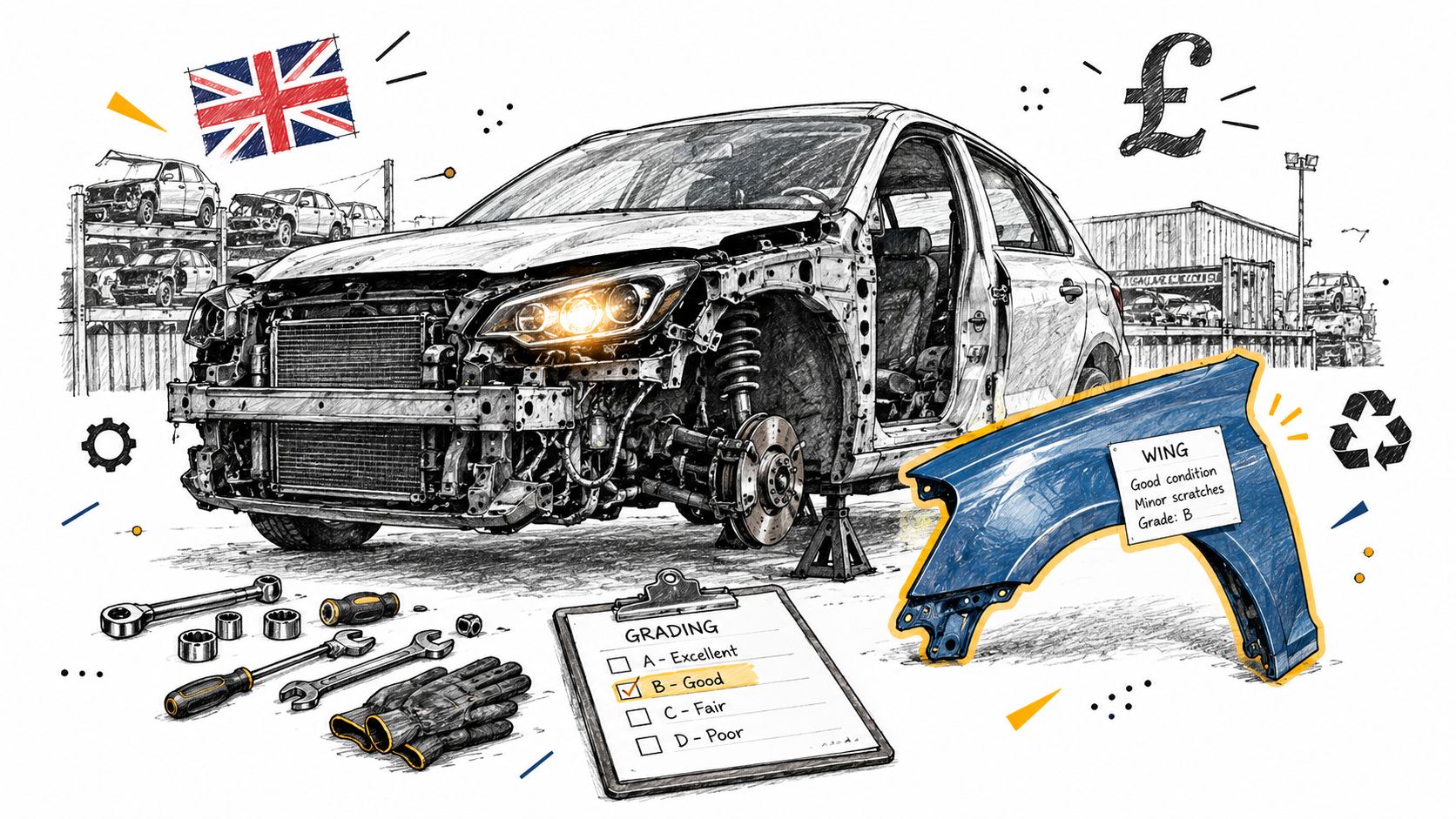
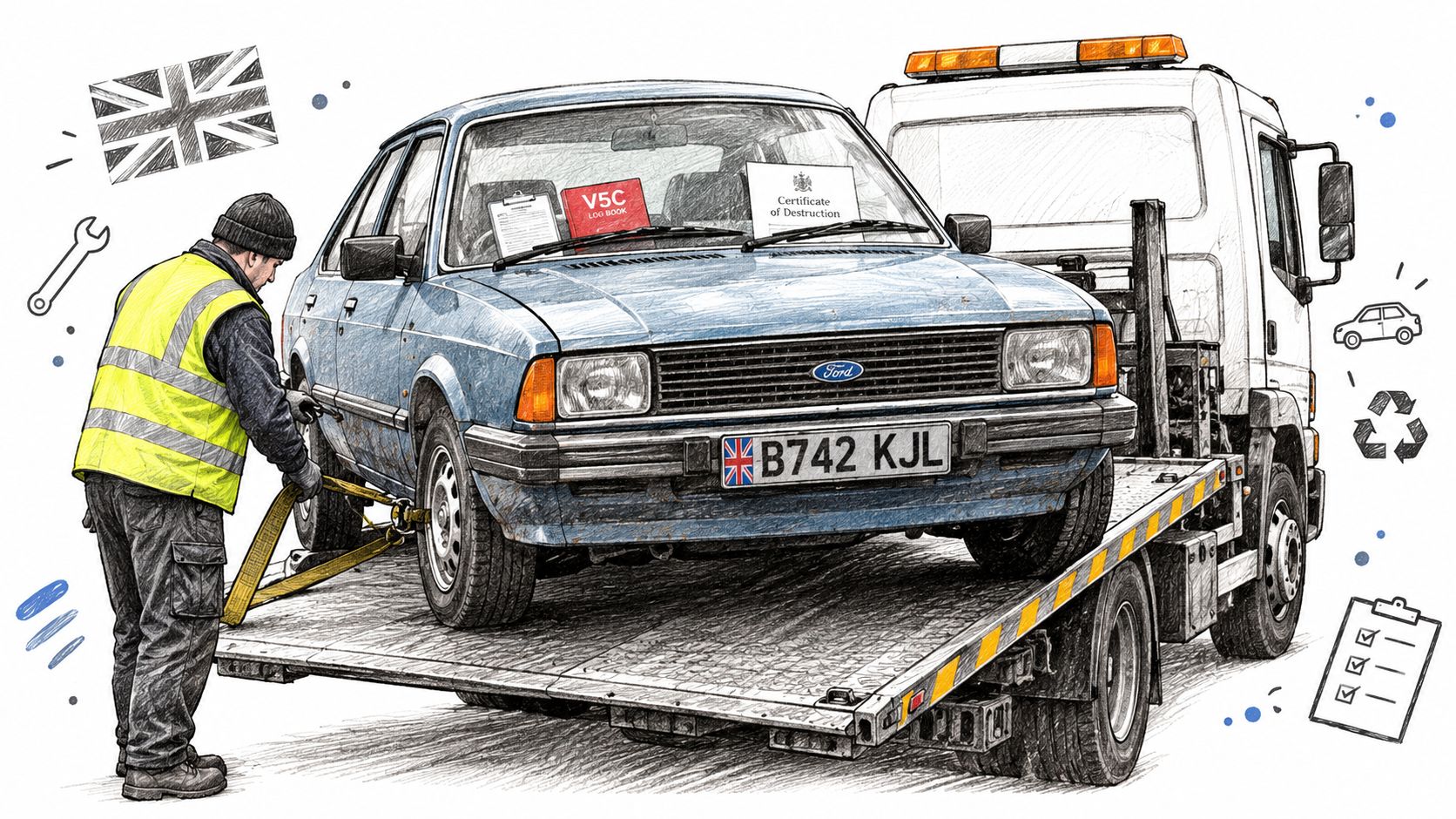
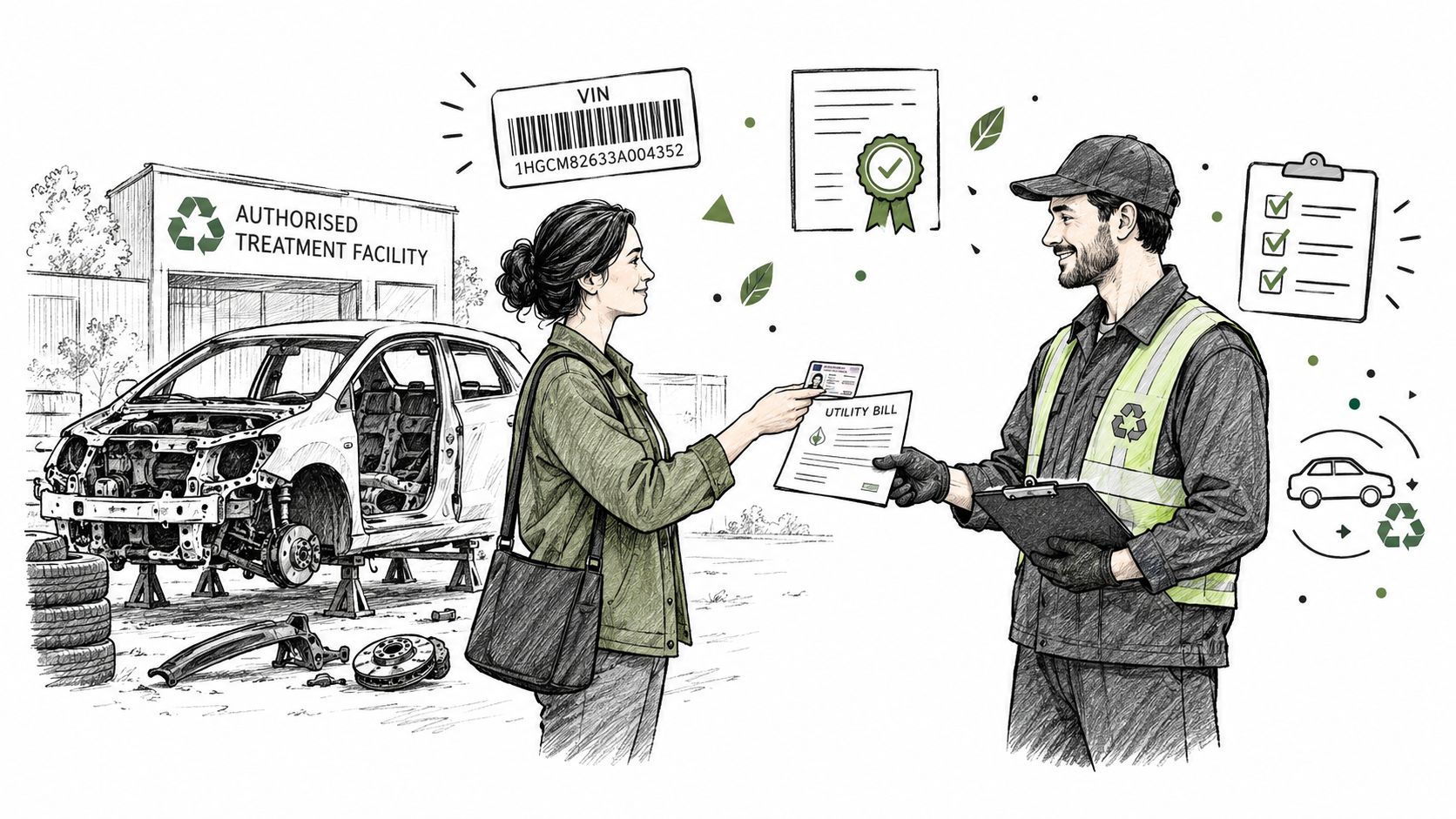
If the numbers don’t stack up, disposal is often simpler than owners expect. Licensed treatment routes can collect non-runners, handle DVLA paperwork, and issue the proper destruction paperwork where relevant. That removes the risk of the vehicle hanging around uninsured, untaxed, and deteriorating further.
A rough decision guide helps:
| Situation | Usually the sensible next move |
|---|---|
| Minor fail, otherwise sound car | Repair and retest |
| Non-runner with uncertain faults | Get a firm diagnosis before spending more |
| Repeated failures or major structural issues | Consider sale for salvage or scrappage |
| No plan to use it soon | Keep SORN in place while deciding |
For a lot of MOT failures, clarity saves more money than speed.
Common Misconceptions About Tax MOT and Insurance
DVLA guidance and owner discussions about MOT failures tend to reveal the same misunderstandings again and again. The confusion usually starts when drivers treat tax, MOT and insurance as separate jobs, when they work more like linked gates. If one gate stays shut, the car does not become road-legal just because another one is open.
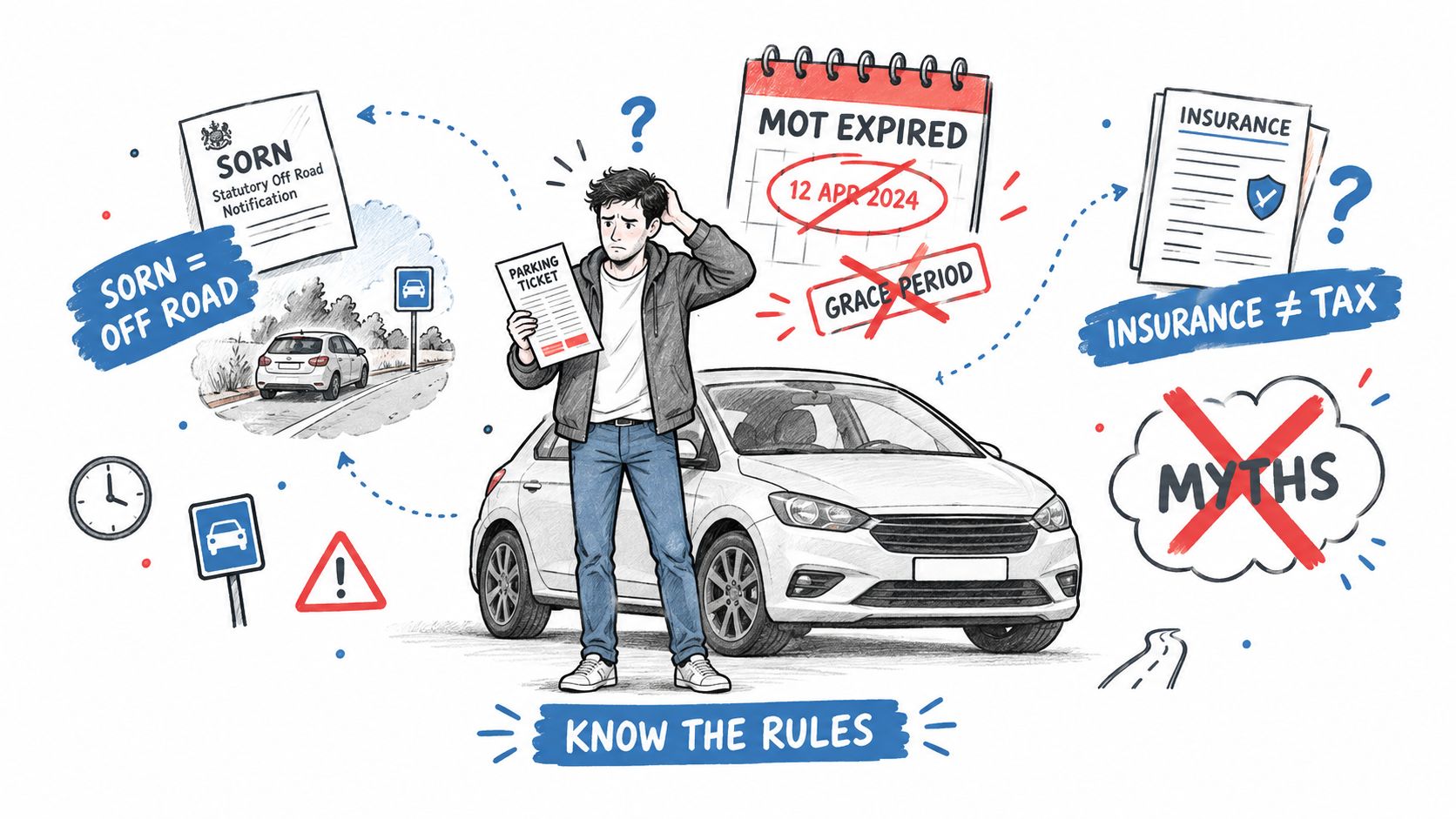
Myth one insurance lets me tax the car anyway
Insurance covers risk. It does not replace the MOT requirement.
That distinction trips people up because insurance feels like the serious part. But the DVLA system checks a different question when you tax a car. Is this vehicle allowed through the MOT gate, either by having a valid MOT or by falling into a genuine exemption? If the answer is no, having insurance in place does not solve it.
Myth two there’s a grace period after the MOT expires
An MOT expiry is more like a pass running out than a reminder letter being ignored for a few days. Once the expiry date has passed, the vehicle no longer sits in the same legal position for normal road use.
The usual point of confusion is the trip to a pre-booked MOT. That is a narrow exception, not a general grace period for carrying on as normal.
An expired MOT changes the car’s status straight away.
Myth three SORN means the car can stay parked on the street
SORN only works if the vehicle is kept off the public road. A car outside your house on a public street is still in the road system, even if it has not moved for weeks.
The gatekeeper idea helps. SORN is the off-road route. Tax is the on-road route. You cannot mix them by leaving an untaxed or failed-MOT car on the road while you decide what to do.
A simple video explanation helps
If you want a visual walk-through of the rule and the common mistakes people make, this short video is a helpful companion.
Myth four an older or classic car is outside the system
Some older vehicles can be MOT exempt, but exempt does not mean ignored. The keeper still needs the vehicle to sit in the right category, and any tax class or exemption status still has to be correct.
A useful way to read it is this. Age can change which gate applies. It does not remove the gates altogether.
Myth five if the car failed its MOT, I can tax it first and fix it later
In practice, the order usually runs the other way round. A failed MOT means the road-use gate has not been cleared, so taxing the car is rarely the next step unless the vehicle is exempt.
This is often the moment to make a money decision, not just a paperwork decision. If the car is a non-runner, has repeated failures, or needs expensive repairs, scrapping or selling for salvage may be more sensible than paying for tax, insurance and repair work on a vehicle that still may not return to reliable use.
A simple decision tree helps:
- Valid MOT or genuine exemption: tax may be possible if the vehicle is returning to the road
- Expired or failed MOT, repair worthwhile: repair first, then retest, then sort tax
- Expired or failed MOT, no short-term plan to use it: keep it off-road under SORN
- Major faults or poor value after repair: compare repair costs with sale or scrappage before spending more
That is the part many drivers miss. Tax, MOT and insurance are linked checks, not three separate boxes to tick in any order.
Making the Right Decision for Your Vehicle
By the time drivers ask can I tax a car without MOT, they’re really deciding between three futures for the vehicle. Put it back on the road, store it legally off-road, or let it go.
The right answer depends on the car’s condition, not just the tax reminder date.
A practical decision checklist
Use this checklist before you spend money or make applications:
- Check whether the vehicle needs an MOT. Newer cars and some historic vehicles sit in a different category.
- Confirm whether the car is returning to road use soon. If not, keep your focus on off-road compliance first.
- Look at the MOT failure in context. A single repairable issue is different from a pattern of decline.
- Decide whether the car still fits your life. A cheap fix can still be the wrong choice if the vehicle is unreliable.
- Choose a clean end point. Repair, SORN, sale, or scrappage. Don’t leave the car stuck in limbo.
When repair still makes sense
Repair is usually the sensible route when the car is otherwise sound, the failure is limited, and you expect to keep using it. In that case, the path is straightforward. Fix the faults, retest, then put the road-use side back in order.
When SORN is the calmer answer
If you’re undecided, SORN often gives you breathing room. It stops the panic of trying to solve tax, testing, repairs, and logistics all at once. That matters for households with a second car, inherited vehicles, or a project that clearly won’t be back on the road soon.
When disposal is the honest choice
Sometimes the most responsible decision is to stop treating the vehicle as if it’s about to return to service. If it’s been sitting, failing, draining money, or turning into a storage problem, scrapping or salvage sale can be the practical finish.
That isn’t giving up on the car. It’s recognising when the gatekeeper system is telling you the vehicle no longer fits normal road use without disproportionate effort.
A calm final rule helps. If the car is viable, fix it properly and bring it back legally. If it isn’t viable, move it on cleanly instead of chasing tax on a vehicle that has already reached its end point.
If your car has failed its MOT, won’t start, or isn’t worth putting back on the road, Scrap A Vehicle can help you dispose of it through licensed ATFs with collection and DVLA paperwork support. You can get a quote for runners, non-runners, and end-of-life vehicles, then decide whether scrapping is the smarter option for your situation at Scrap A Vehicle.