You’ve got an ageing car that still starts every morning, but the last MOT turned up a failure, the garage has quoted repair work you weren’t expecting, and the question keeps coming back. Do you fix it again, or is it time to let it go?
That decision is rarely about pride. It’s about whether the car still makes sense as a tool you rely on, the same way you might keep repairing a washing machine until the next breakdown costs more than replacing it. A car can look usable and still be close to its economic end, especially once faults start stacking up.
This guide keeps the decision simple. It shows how to judge when to scrap a car using safety, MOT history, corrosion, and value, then explains the legal route for scrapping it properly in the UK. If you’re staring at a failed MOT, a rust patch, or a repair estimate that feels too high for an old car, you’re in the right place.
Table of Contents
- Understanding What End of Life Really Means for a Car
- Key Signs It Is Time to Scrap Your Car
- Repair Sell Salvage or Scrap Comparing Your Options
- Financial and Legal Essentials Before You Scrap
- Your Practical Decision Checklist and Next Steps
- Conclusion Making a Confident and Compliant Choice
Understanding What End of Life Really Means for a Car
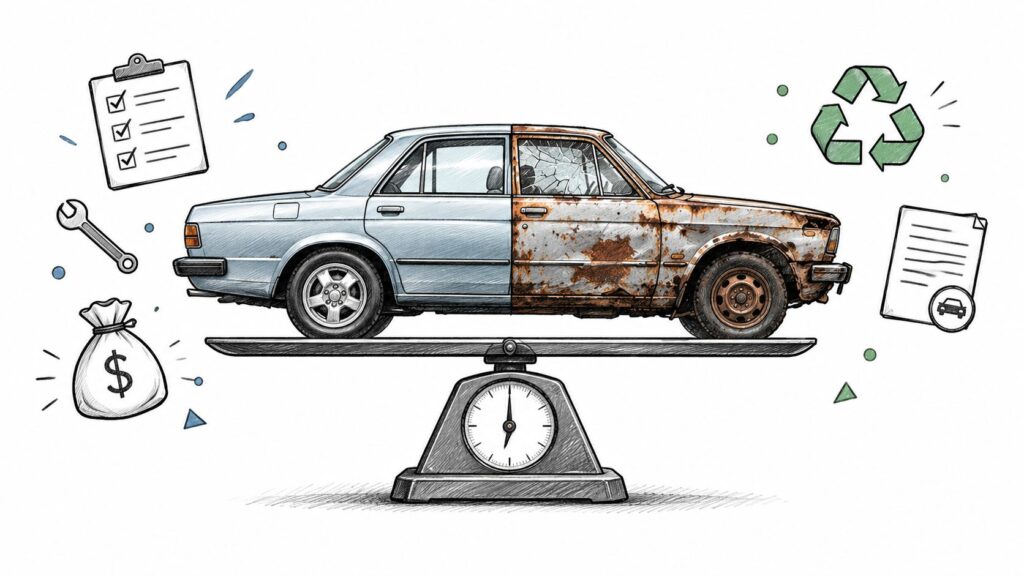
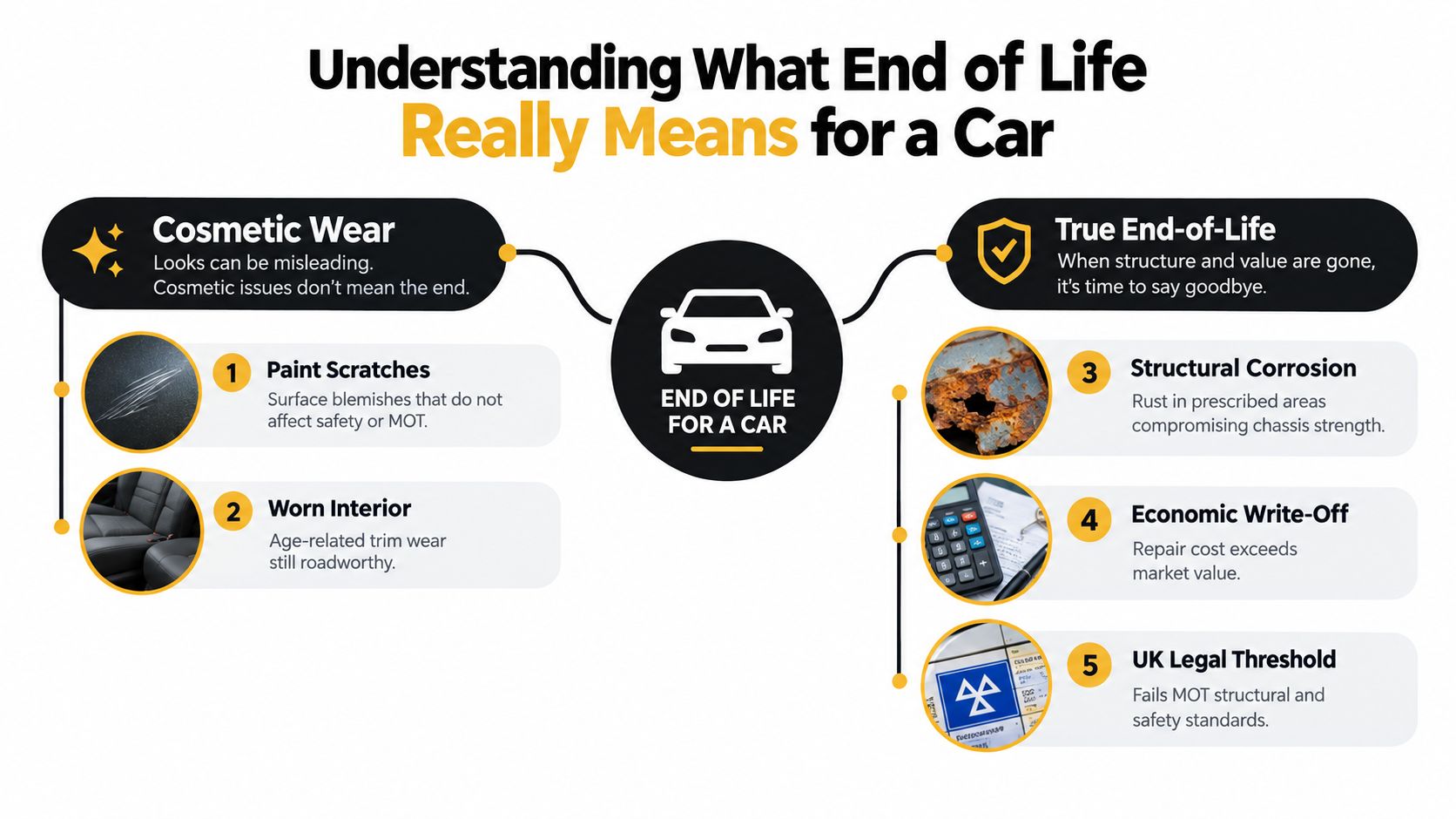
A car reaches end of life in two different ways. One is economic end-of-life, where keeping it on the road no longer makes financial sense. The other is structural end-of-life, where the body or load-bearing parts have deteriorated to the point that safety and compliance are compromised.
That difference matters because a car can still start, drive, and even pass for “fine” on the outside while hidden weaknesses are already deciding its future. The simplest analogy is a house with cracked paint versus a house with a failing foundation. Paint is cosmetic, but a weak foundation changes everything.
The UK scrappage pattern shows why age matters without becoming a hard rule. The most common age for vehicles being scrapped is 19 years, with 213,351 records, followed by 18-year-old vehicles at 193,049 and 20-year-old vehicles at 181,102 (Car.co.uk scrap data). The same dataset says the average end-of-life vehicle is 16.6 years old, with the main scrappage bracket sitting between 15 and 20 years (Car.co.uk scrap data).
Age tells part of the story, MOT history tells the rest
MOT failure curves make the pattern clearer. Across 57,663,348 DVSA test records, 21.7% of vehicles failed an MOT at least once, and pass rates fall from 89.3% at age 3 to 77.2% by age 10 and 69.5% by age 15 (MOT data analysis). That doesn’t mean every older car should be scrapped. It does mean the odds of repeated trouble rise as cars age.
There’s also a longer-term shift in disposal age. Separate UK reporting found the average scrapped car was 17.5 years old in 2025 with about 125,000 miles, while earlier reporting put the average scrappage age at 13.7 years in 2014 and 14.5 years in 2017 (MOT data analysis). The point is not to chase a magical number. It’s to recognise that old cars tend to move from “worth fixing” to “not worth the next repair” in stages.
Practical rule: once the car needs repeated money to stay legal and reliable, it’s no longer just an MOT issue, it’s an end-of-life decision.
Key Signs It Is Time to Scrap Your Car
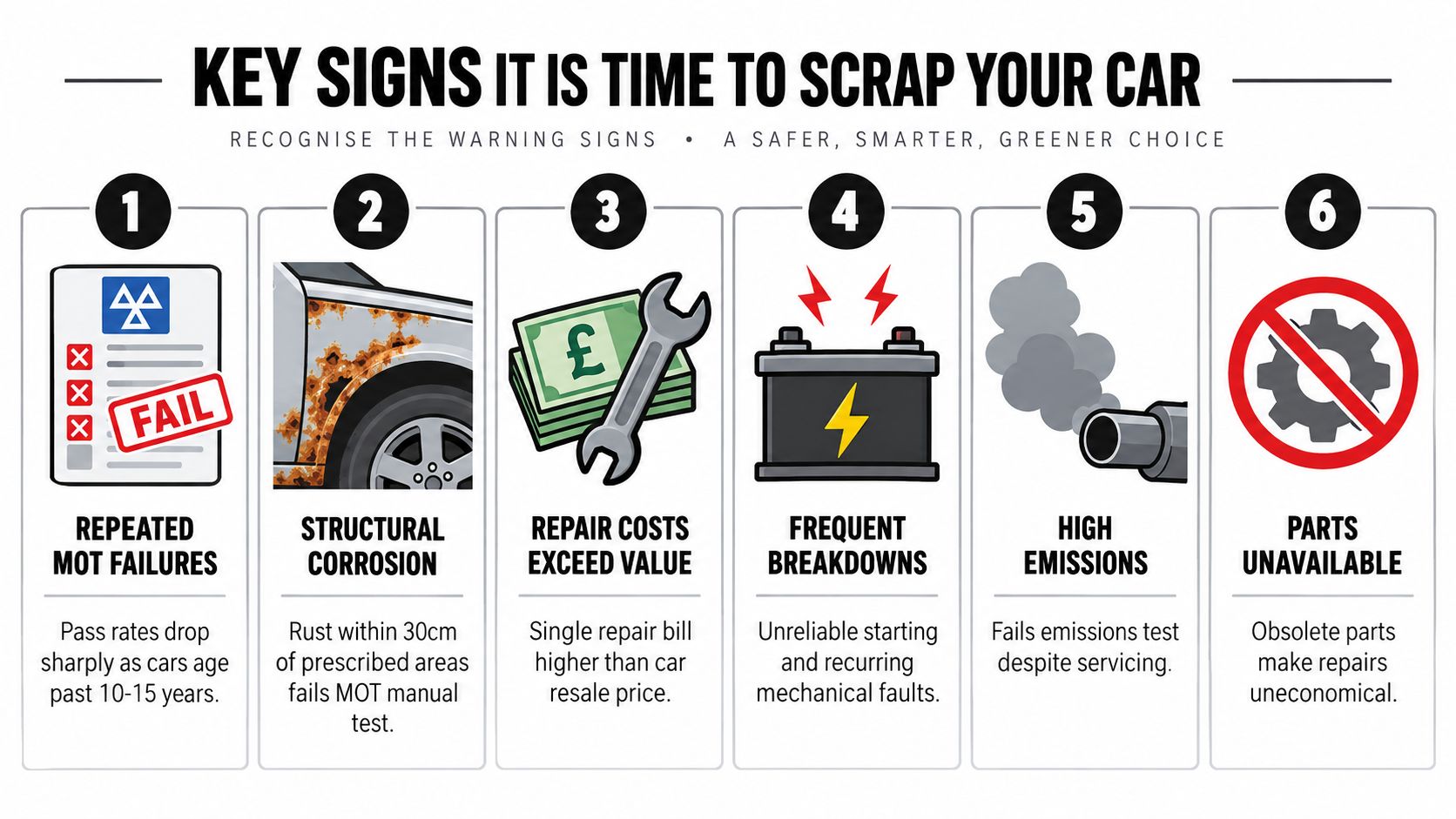
The signs usually arrive together. One fault is annoying. Two or three faults, plus a weak MOT record, is when the decision starts to tilt.
Repeated MOT failures and age-related decline
A car that keeps failing the MOT isn’t just unlucky. The data shows that pass rates fall as vehicles get older, which is why older cars often land in the same conversation as scrappage and replacement (MOT data analysis). If your car has a growing list of advisories and the same repairs keep returning, that’s a warning sign.
Look at the pattern, not just the latest test. One small repair may be manageable. A cycle of failures across brakes, suspension, corrosion, and emissions usually means the car is ageing into expensive ownership.
Structural corrosion in prescribed areas
Rust becomes serious when it affects safety-critical structure. The DVSA MOT manual says vehicles should fail for corrosion in prescribed areas when the structure is significantly weakened, including cases where corrosion has created a hole or the area no longer feels firm, and it defines corrosion that significantly reduces rigidity as a major defect (DVSA MOT manual).
Check by hand, not just by eye: if a sill, floor edge, or mounting point feels soft, perforated, or has had repeated weld repairs, the car is moving from cosmetic rust to structural concern.
Repair cost versus market value
This is the financial tipping point. If one repair bill is close to, or higher than, what the car is worth, the case for repair weakens fast. Public guidance says scrapping makes sense when a vehicle is no longer safe or economically viable, and that includes cars that are repeated MOT failures, badly rusted, accident damaged, or too costly to keep (GOV.UK scrapped and written-off vehicles).
Reliability that keeps failing you
A car that struggles to start, keeps overheating, or throws recurring faults can become a time drain as much as a money drain. Even if it passes an MOT today, the next breakdown can land quickly. If you’re planning journeys around the car’s moods, the vehicle is already costing you more than fuel and insurance.
Insurance write-off status
Write-off status changes the equation because the car’s repair path has already been judged uneconomic or unsuitable by an insurer. That doesn’t automatically mean every write-off must be scrapped immediately, but it does mean the car’s residual value and legal route need careful checking before any decision is made (GOV.UK scrapped and written-off vehicles).
Repair Sell Salvage or Scrap Comparing Your Options
Not every tired car belongs in the crusher. Some cars still have enough value to justify repair, sale, or salvage. The right choice depends on condition, paperwork, and how quickly you need the problem solved.
| Option | Best For | Payout Potential | Effort and Time |
|---|---|---|---|
| Repair | A car with one clear fault and strong residual value | None upfront, but may preserve value | High, because you need diagnosis, parts, and a return visit |
| Sell privately | Roadworthy cars with decent demand | Usually the highest if the car is clean and presentable | High, because you handle listing, calls, viewings, and negotiation |
| Salvage or parts sale | Cars with usable parts, niche models, or strong component demand | Can beat basic scrap value if major parts are sought after | Medium to high, depending on how the car is dismantled |
| Scrap via ATF | Cars that are unsafe, uneconomic, or legally at end of life | Lower than a strong private sale, but predictable and compliant | Low, especially when collection and paperwork are handled |
Repair only works when the numbers still breathe
If a repair restores many more months or years of dependable use, fixing can make sense. If the same car will likely need another major bill soon after, you’re patching a sinking hull. That’s when repair becomes maintenance theatre rather than practical ownership.
Sell if the car is still genuinely roadworthy
A roadworthy car with decent bodywork and a clean history can still attract a private buyer or part-exchange offer. The catch is time. If the car is already failing MOTs or has visible corrosion, the selling pool gets smaller and the price usually follows.
Salvage sits between value and hassle
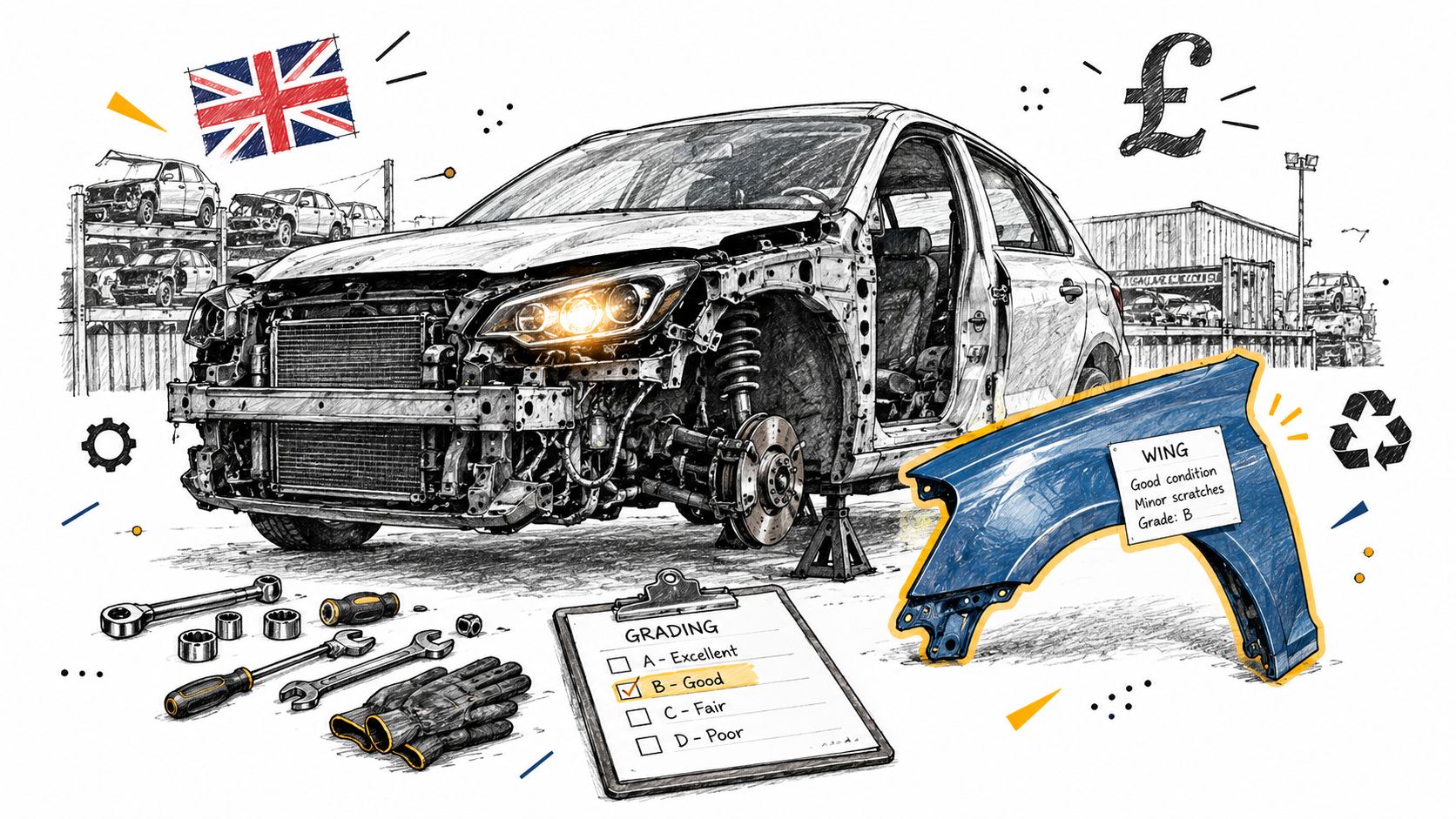
Salvage can beat scrap when the vehicle has desirable components, but it takes more effort. Parts, trim, wheels, catalytic converter status, and model demand all affect whether dismantling is worth the delay. If the car is heavily damaged or missing key parts, that route loses appeal fast.
Scrap becomes the cleanest answer when compliance matters
Scrapping is the right move when the car is no longer safe, no longer economical, or no longer worth the repair gamble. It also becomes the only sensible route when the vehicle is effectively at end of life and needs to go through the proper regulated channel.
Financial and Legal Essentials Before You Scrap
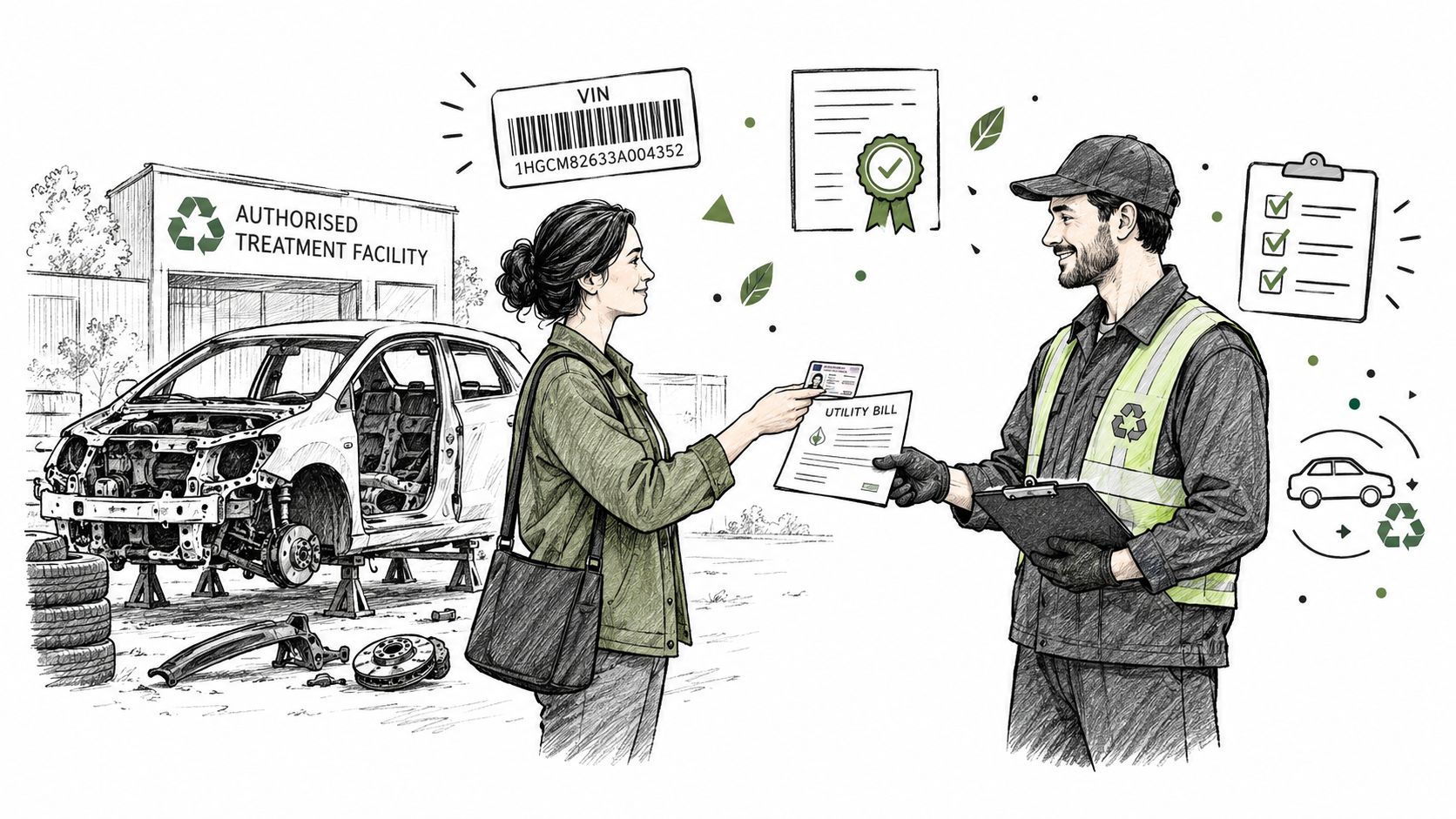
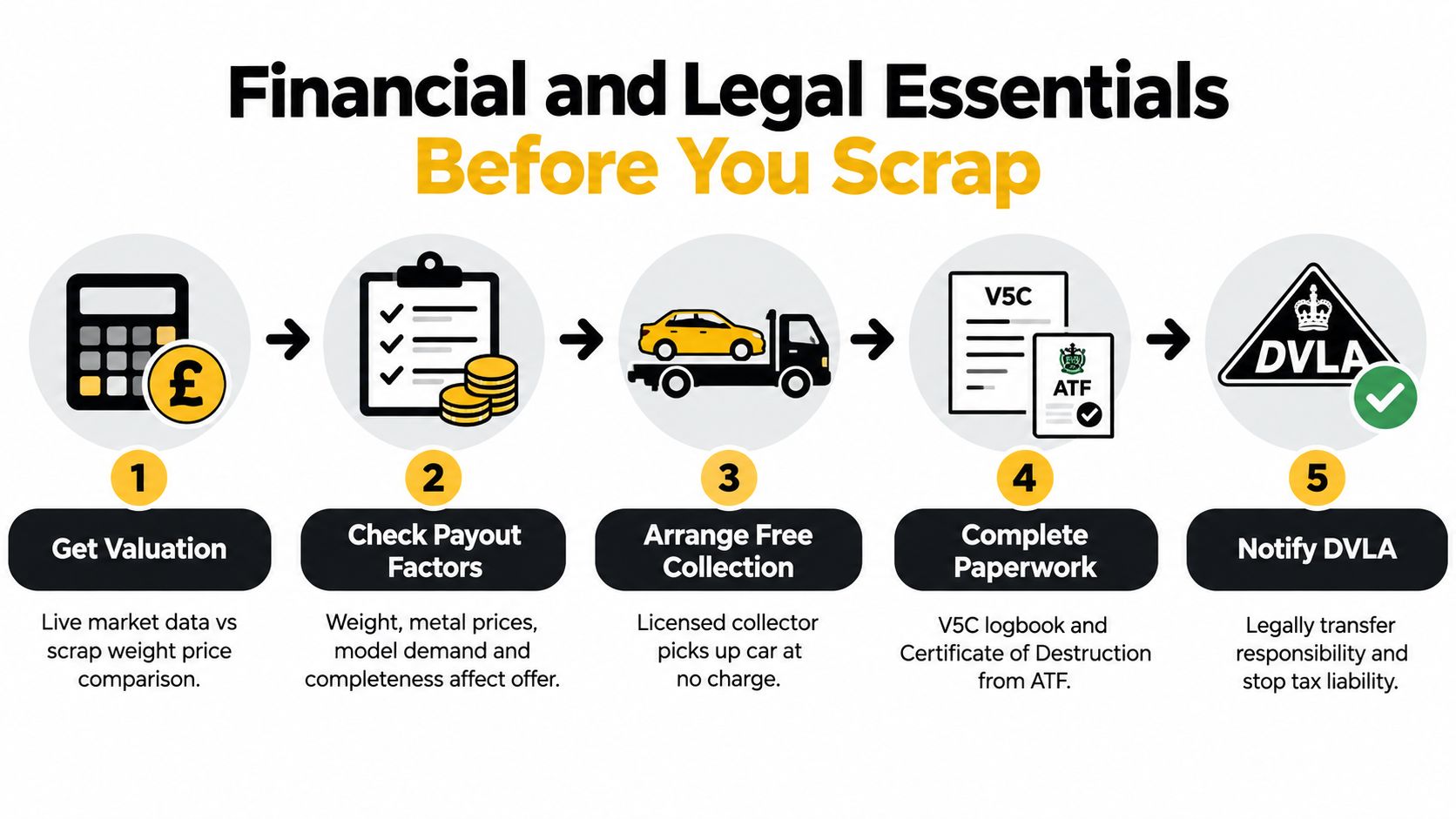
The UK doesn’t treat scrapping as an informal handover. Once a vehicle has reached the end of its usefulness, it should go to an Authorised Treatment Facility, or ATF, and scrapping it anywhere else is illegal (GOV.UK scrapped and written-off vehicles). That legal step matters because it protects you from future liability and gives the car a proper end-of-life record.
Money comes first, paperwork comes second
A sensible quote should reflect more than scrap metal weight. Live market demand, model popularity, completeness, and the car’s reusable parts all affect value. A car with salvageable components can be worth more than one that is only being valued as metal.
That’s why the first offer you hear shouldn’t be the last one you check. If your car still has intact panels, wheels, catalyst components, or parts in demand, it may be worth more than a bare minimum scrap figure.
Collection and payment should be clear before handover
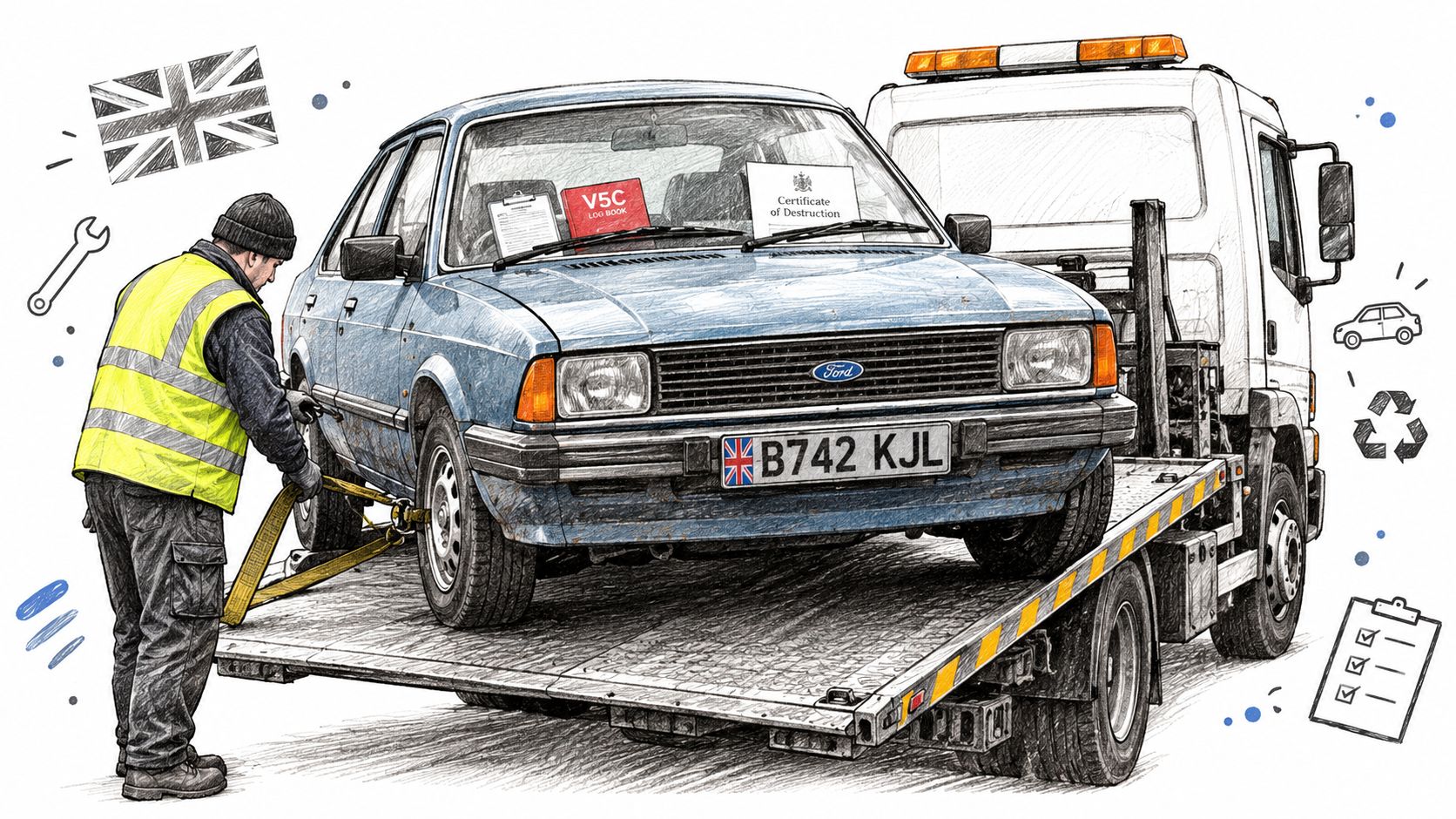
Many UK scrapping services arrange collection at no charge and pay by bank transfer when the vehicle is collected. Make sure the payment method is confirmed before the driver leaves. That keeps the handover clean and avoids confusion over what happens after the keys change hands.
V5C and Certificate of Destruction matter
The keeper should give the ATF the V5C logbook, then notify DVLA. The ATF should issue a Certificate of Destruction, which is the proof that the vehicle has been processed through the correct route (GOV.UK scrapped and written-off vehicles). Keep that record. It is your evidence that the car is no longer your responsibility.
For a practical route through the paperwork and collection process, Scrap A Vehicle’s car disposal guide lays out the same basic steps in a simple order.
Compliance is part of the value
An ATF route gives the car a documented finish, not just a removal. That means depollution, regulated dismantling, and a proper audit trail. If you’re choosing between a quick unofficial offer and a licensed route, the licensed route gives you the cleaner legal exit.
Your Practical Decision Checklist and Next Steps
Run this check before you spend another pound. If the answer leans one way on most points, the decision usually follows.
Ten-minute checklist
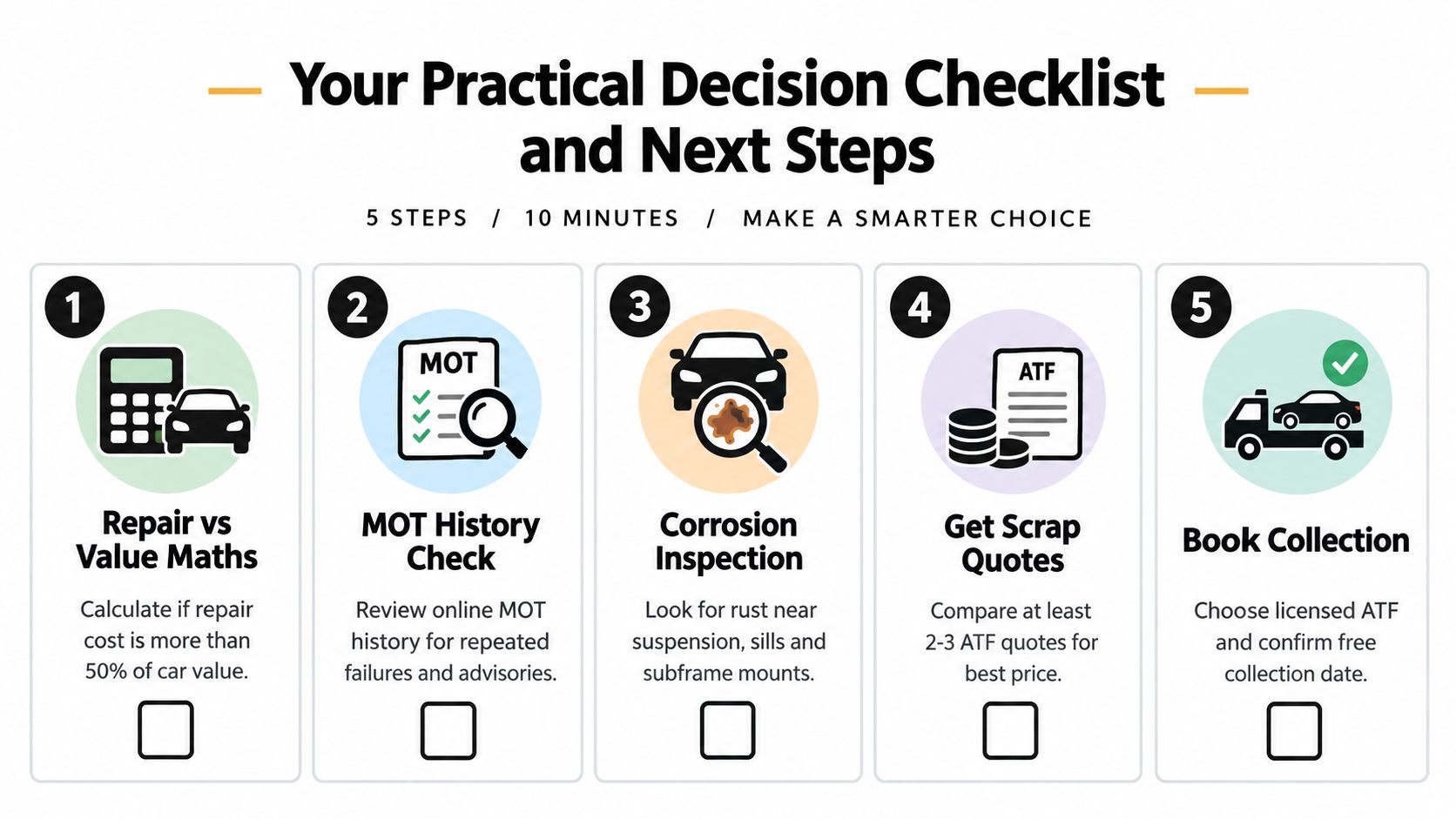
- Compare repair cost to value. If the repair bill is close to the car’s worth, the car is already on the edge.
- Look at the MOT pattern. Repeated failures and a growing list of advisories usually point to a tired vehicle.
- Inspect the rusty areas properly. Sills, floor edges, suspension mounts, and seatbelt anchor zones deserve a close look.
- Think about future reliability. If you’re already expecting the next fault, that matters as much as the current one.
- Check the legal route. If the car is effectively finished, it should go through a licensed ATF, not an informal buyer.
What to do next if the car has reached that point
If the car is beyond sensible repair, get a valuation based on its registration and postcode, then compare a few offers before you agree to anything. A proper scrapping service should be able to collect the vehicle, handle the DVLA paperwork, and give you a clean handover without extra stress.
If the car is still roadworthy but you’re unsure, treat the decision as a pause rather than a failure. A short inspection, an honest value check, and one or two quotes usually reveal whether the car still earns its keep.
Conclusion Making a Confident and Compliant Choice
The answer to when to scrap a car is not a single age or mileage number. It’s the point where MOT risk, structural corrosion, and repair-versus-value maths all point in the same direction. Once the car becomes unsafe, unreliable, or uneconomic, scrapping stops being a defeat and starts being the sensible next step.
The legal part matters just as much as the financial part. An ATF route gives you the proper paperwork, the correct disposal trail, and the reassurance that the car has been handled within UK rules. That protects you and closes the chapter cleanly.
If you’re looking at a tired car and still feel unsure, don’t guess. A quick valuation and a proper collection route can turn a messy decision into a straightforward one, and that usually brings more relief than another round of repairs ever will.
If you want a simple, compliant way to move on from an end-of-life car, Scrap A Vehicle provides instant valuations, free collection, and DVLA paperwork handling through licensed ATFs. It’s a practical route when you want the car gone without sorting the legal steps yourself, and it can help you see whether repair or scrappage makes more sense before you commit.