You handed the keys over for a routine MOT and got the call nobody wants. It’s failed, and the reason is emissions. It’s one of the more worrying fails, because the cost can swing from a £10 bottle of additive to a four-figure catalytic converter. If your car failed MOT on emissions, the next right step depends entirely on why it failed and what the car is worth.
This guide walks through what an emissions failure actually means, the usual causes, whether you can drive the car, what repairs tend to cost, and the point where scrapping makes more sense than fixing.
What does it mean if your car failed MOT on emissions?
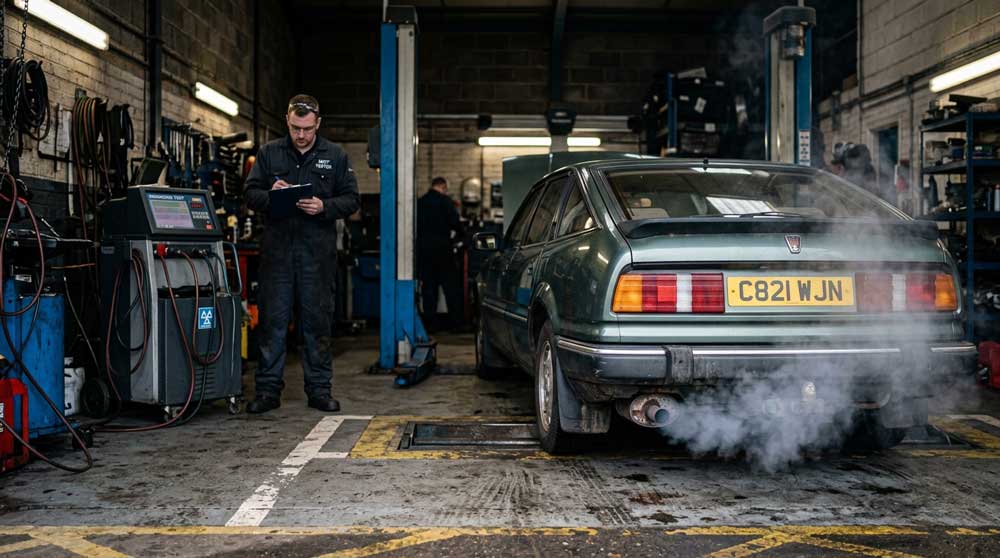
An emissions failure means your exhaust is putting out more pollutants than the legal limit allows, so the car fails its overall MOT. The tester checks the gases coming out of the tailpipe against the standard for your vehicle’s age and fuel type.
Testing runs in stages. There’s a quick initial reading, and if that’s clearly within limits you’re done. If it’s borderline or over, the car goes through to a fuller test that involves revving the engine and can take a few minutes. Fail that and the result stands. The emissions section has failed, so the whole MOT has failed, and you get a printout listing the fault.
Why do cars fail the MOT emissions test?
Cars usually fail on emissions because something in the fuel, ignition or exhaust system is no longer burning or filtering properly. Most failures come down to wear, a fault, or simply a neglected service.
The usual causes are below.
- A failing catalytic converter, which stops scrubbing the exhaust gases effectively.
- A blocked or removed diesel particulate filter (DPF), which is an automatic fail on a diesel built to need one.
- A worn lambda (oxygen) sensor, which throws off the fuel mixture.
- Old spark plugs or a faulty EGR valve on petrol and diesel engines respectively.
- Dirty engine oil or a long-overdue service, which hurts combustion.
- Lots of short, cold journeys, which let carbon build up instead of burning off.
You can often see the warning signs before test day. Check the free GOV.UK MOT history for past emissions advisories, and watch for heavy exhaust smoke, a lit engine-management light, or poor fuel economy.
Can you drive a car that has failed its MOT on emissions?
Usually no. Once your MOT has run out, or the car has failed on a major defect like emissions, it’s illegal to drive on public roads, except to a pre-booked repair or retest appointment.
If your previous MOT is somehow still valid and the failure was not logged as dangerous, you may technically be allowed to drive it, but that’s an unusual position to be in. Driving without a valid MOT can bring a fine of up to £1,000, so the safe course is to leave the car put and book the repair or retest first.
How do you get your car to pass the emissions retest?
To pass the retest, you fix the underlying fault, then book the car back in. For a marginal failure, a few simple steps can tip a borderline car back under the limit before any major spend.
If the fail was close, try a long motorway run at higher revs to burn off carbon, a fuel-system cleaner, and a fresh oil change, then make sure the engine is fully warm when you arrive. For a genuine fault, you’ll need the specific repair, whether that’s a new sensor, a cleaned or replaced DPF, or a new catalytic converter. On the retest itself, you only get a free partial retest if the same centre does the repair and you return within a short window, and emissions work often falls outside that, so expect to pay for a full retest at the standard MOT fee.
How much does it cost to fix an emissions failure?
Costs range from around £100 for a simple fix to well over £1,000 for a major part. What you pay depends entirely on the cause the tester identifies.
Here’s a rough guide for 2026.
| Repair | Typical cost |
|---|---|
| Fuel additive or air filter | £10–£50 |
| Lambda (oxygen) sensor | £50–£300 |
| EGR valve | £150–£500 |
| Catalytic converter | £500–£1,500 |
| Diesel particulate filter (DPF) | £1,000–£3,000 |
Those two big-ticket items, the catalytic converter and the DPF, are where the maths often stops adding up on an older car.
Petrol or diesel: what is different about emissions failures?
Petrol cars are tested mainly on carbon monoxide and hydrocarbons, while diesels are tested on smoke density. Diesels built from 2009 onward face much tighter limits because they’re expected to have a working particulate filter.
That makes a blocked or tampered DPF one of the most common and most expensive diesel failures. Petrol failures more often trace back to the catalytic converter, lambda sensor or spark plugs. Either way, the fix follows the fault the printout names.
What if your car is not worth repairing?
If the emissions repair costs more than the car is worth, scrapping is usually the sensible call. A £1,500 catalytic converter or a £2,500 DPF on a car worth a few hundred pounds rarely makes financial sense.
Before you commit to an expensive repair, it’s worth knowing what the car would fetch as scrap. You can find out what your car is worth with a free valuation, we offer free collection anywhere in the UK, and you can get an instant quote to weigh against the repair bill. A car that’s failed on emissions still has value in its metal and reusable parts.
Frequently asked questions about emissions MOT failures
Is an emissions failure a major or minor MOT fault?
It’s a major fault, which means the car fails its MOT outright. Minor faults let the car pass with an advisory, but exceeding the emissions limit is not one of them, so the vehicle cannot be driven on the road until it’s fixed and retested.
Will fuel additives help my car pass the emissions test?
They can help a borderline car, not a faulty one. A cleaner used over a tank or two, combined with a good motorway run, may lower mild readings. If a sensor, catalytic converter or DPF has actually failed, an additive won’t fix it and the repair is needed.
How long do I have to get my car retested after a fail?
A free partial retest is only available if the same test centre carries out the repair and you return within 10 working days. Emissions repairs often fall outside the free-retest list, so in most cases you’ll pay for a full retest at the standard fee.
Can a car fail just on emissions and nothing else?
Yes. Emissions is its own section of the MOT, so a car in otherwise good condition can fail purely because the exhaust readings are over the limit. The rest of the result still shows on the printout as passed or advisory.
Is it worth fixing an old diesel that failed on emissions?
It depends on the repair. A sensor is cheap, but a new DPF or catalytic converter can cost more than an older diesel is worth. Compare the repair quote against a scrap valuation before deciding, especially on high-mileage cars.