You’ve decided the car has to go, you’ve gone looking for the logbook, and it is nowhere. Before you panic about whether that ruins everything, here is the short answer. You can scrap a car without a V5C, it is completely legal, and yards deal with it every week. The logbook makes the job smoother, but losing it does not stop you scrapping the car or staying on the right side of the DVLA. This guide covers exactly what you’ll need instead, how to notify the DVLA without the slip, and the one thing that actually does cause problems.
Can you scrap a car without a V5C?
Yes. You do not need the V5C logbook to scrap a car in the UK, and you won’t be breaking any rules by doing it. Missing logbooks are far more common than people think, so an Authorised Treatment Facility, the licensed yard that handles scrapping, will have a process ready for exactly this situation. Yards see it constantly. It barely raises an eyebrow, and the steps to deal with it are well worn.
What the V5C does is speed things along. It carries the registration, make and model in one place, and it lets the yard transfer the car out of your name quickly. Without it, there’s a little more paperwork and a few extra checks, but it is far from a dealbreaker. The key requirement is simply that you can prove the car is yours, which we will come to in a moment. Get that part right and a missing logbook changes almost nothing about how the day goes.
Why scrapyards ask for the logbook
It helps to understand why the document matters to them, because it explains the checks you will face. A licensed yard asks for the V5C for two reasons. It protects them from unknowingly handling a stolen car, and it protects you from being linked to a vehicle you no longer own.
There is a harder rule underneath that. A licensed ATF cannot legally accept a vehicle where ownership cannot be established, and a facility that takes cars without proper checks risks losing its operating licence altogether. So when a yard asks you to prove who you are, that is not them being awkward. It is the sign of a legitimate operator doing the job properly, and it is exactly the kind of yard you want. A yard that asks no questions at all should worry you far more.
What you need instead of the V5C

With no logbook, the yard needs other evidence that you’re the registered keeper. The good news is that most of it is paperwork you already have around the house, so there is rarely anything to buy or chase. Tell the yard before collection day that you don’t have the V5C, so the driver brings the right forms.
The documents that carry the most weight are the following.
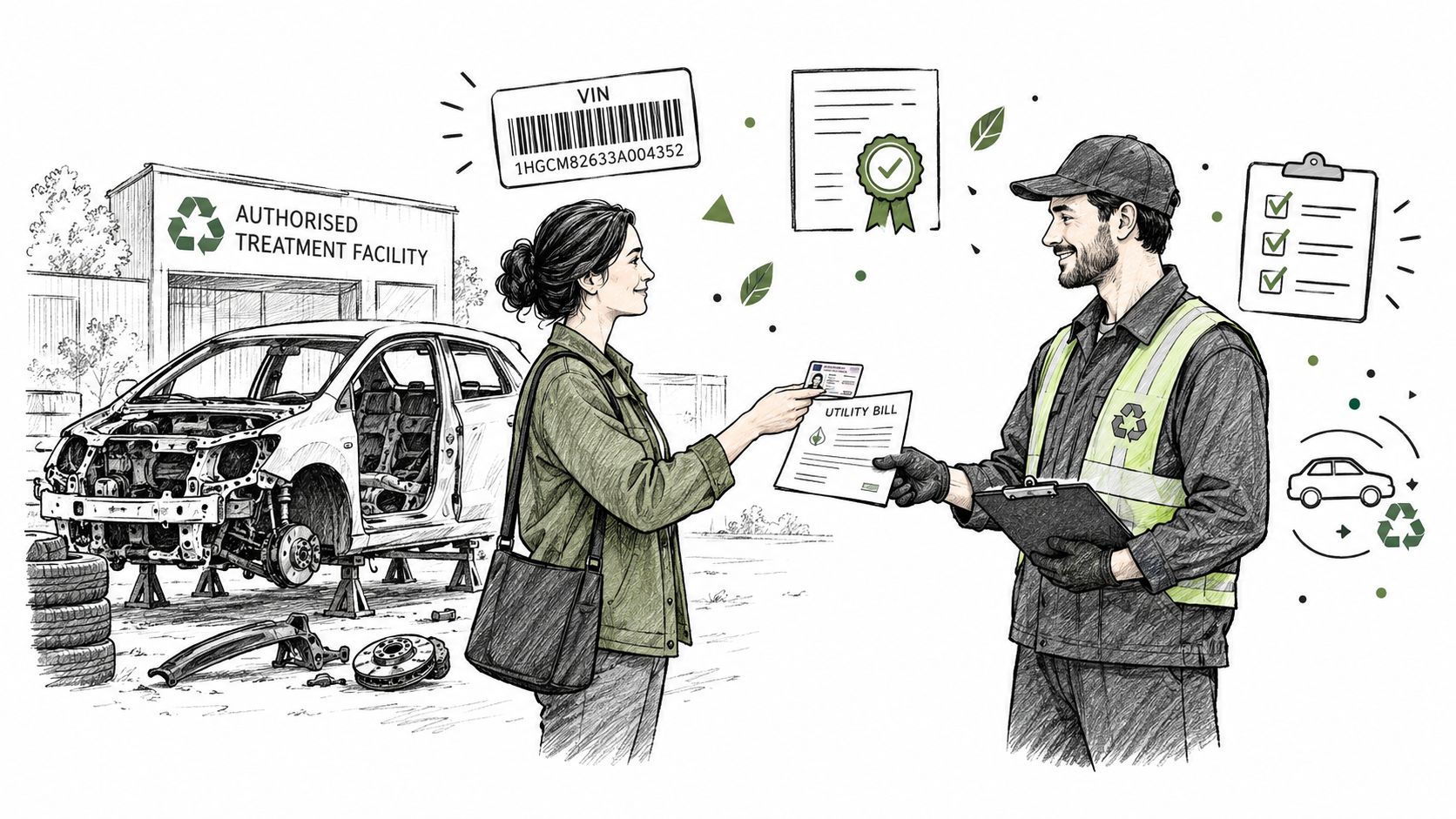
- Valid photo ID in your name, such as a current UK driving licence or a passport.
- Proof of address dated within the last three months, like a utility bill, council tax statement or bank statement.
- Supporting paperwork that links you to the car, such as an insurance document, a past MOT certificate, service history or the purchase receipt.
One detail trips people up, so it is worth stressing. The name and address on your documents must match the details held on the DVLA database for that vehicle. Many yards will also hand you a short declaration of ownership to sign on the day, confirming you’re the legal owner and authorising them to take the car. Get those pieces lined up and the rest runs smoothly. If you’re unsure whether what you have is enough, a quick call to the yard before the day settles it, and they’ll tell you straight whether your documents will do.
What if the car isn’t in your name?
Sometimes the logbook is missing because the car was never registered to you in the first place. Maybe you bought it cheaply with no paperwork, or you’re sorting out a relative’s vehicle after they have sadly died. You can still scrap it. You will just need to show how it came to be yours.
For a car you bought, a dated bill of sale or even a message trail with the seller, alongside your own photo ID, helps establish the chain of ownership. For a vehicle left by someone who has passed away, the yard may ask to see paperwork such as a grant of probate or a letter confirming you are dealing with the estate. Explain the situation when you book, because a licensed facility would far rather help you do it properly than turn away a genuine case. The same written notification to the DVLA still applies once the car has gone, so keep a note of the handover date and the yard details ready for your letter.
How to tell the DVLA when you have no V5C
Notifying the DVLA is the step you must not skip, because it ends your legal responsibility for the car. Normally you would do this through the yellow section of the V5C, or online using the eleven-digit reference from the logbook. With no V5C, neither of those is open to you, so you tell the DVLA in writing instead.
Post a letter to the DVLA in Swansea giving your full name and address, the vehicle’s registration number, its make and model, the exact date you handed it over, and the full name and address of the yard that took it. Keep a copy for your own records. If you’d like the precise address and a fuller walkthrough, our guide on how to notify the DVLA your car has been scrapped sets it all out. Skipping this can leave you on the hook for tax, insurance liability or enforcement on a car that no longer exists. It takes about ten minutes to write, and it closes the matter with the DVLA for good.
You still get a Certificate of Destruction
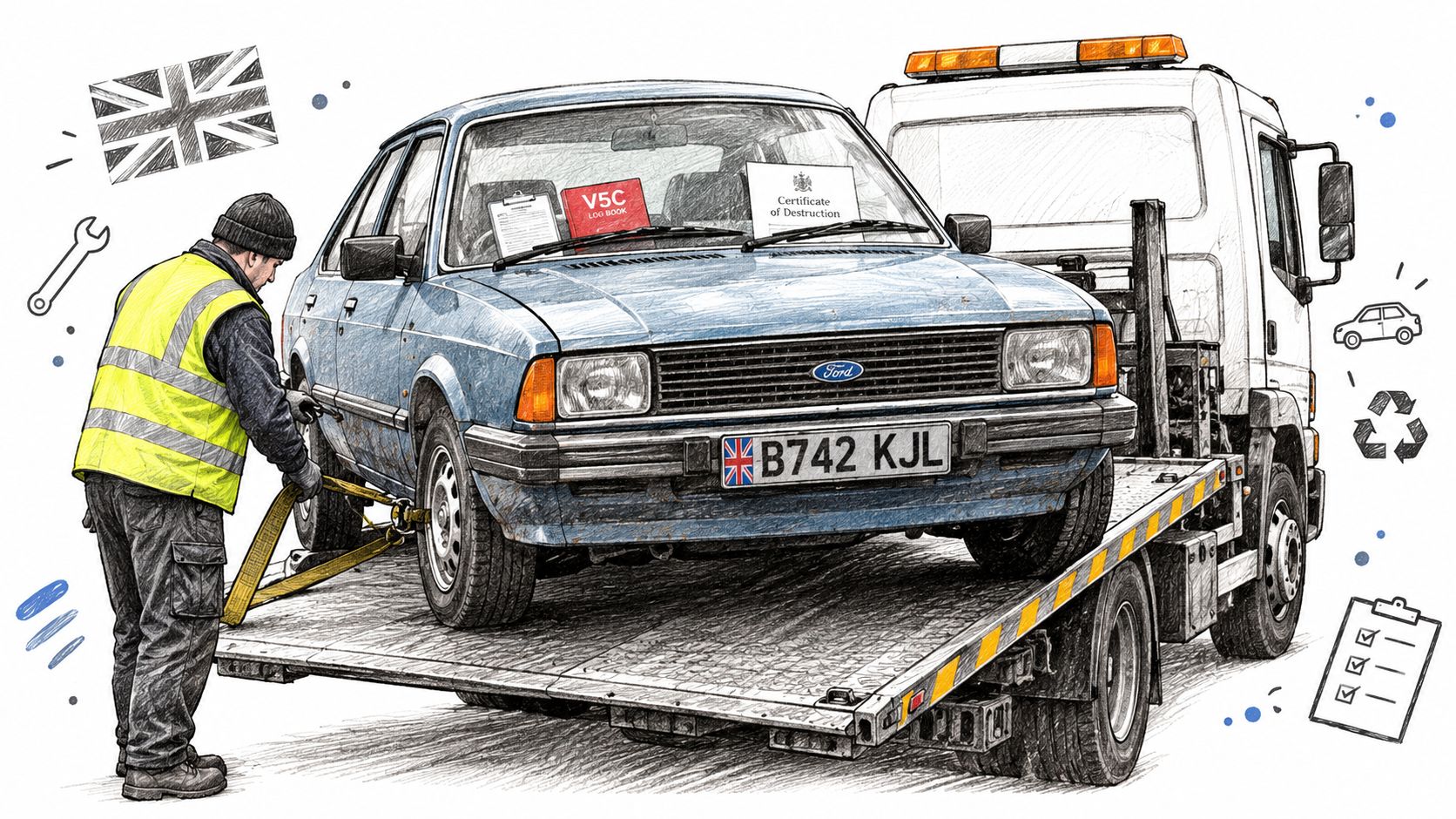
Losing the logbook does not cost you your proof of scrapping. When a car is completely scrapped through an ATF, the facility still issues a Certificate of Destruction, normally within seven days for cars, light vans and eligible three-wheelers. That certificate is your evidence the vehicle has been destroyed and is off the register for good. No logbook is needed for the yard to produce it.
Licensed facilities are also required to notify the DVLA through their own system when they issue that certificate, which adds a second layer of confirmation alongside your letter. Keep the CoD somewhere safe. If you ever want to confirm the record has updated, our guide on how to check if a car has been scrapped shows you how.
Should you get a replacement V5C first?
You can, but you rarely need to. If you’d prefer to have the logbook in hand, you can apply for a replacement V5C from the DVLA for £25, and it usually arrives within about five working days when you apply online as the registered keeper. A postal application using a V62 form takes longer, often four to six weeks.
For most people scrapping a car, waiting for a replacement is not worth the delay, since the ID-and-letter route works fine. It can be worth doing if you have no other proof of ownership at all, or if you want to be certain of claiming any road tax refund, which can be harder to sort without the document in hand. Our guide on the V5C logbook explains how the document works if you need a refresher.
Do you get less money scrapping without the logbook?
This worries people, but the answer is reassuring. The value of a scrap car comes from its weight in metal and any reusable parts, not from the logbook, so a reputable yard pays the same whether or not you’ve got the V5C. The document is pure admin, not value, and no honest yard will ever pretend otherwise.
There are two things to watch, though. A road tax refund from the DVLA is triggered by the notification, so without the V5C in hand it can take a little longer to come through. And a small number of less scrupulous yards may try to knock the price down by pointing at your missing paperwork. That’s a negotiating tactic rather than a genuine cost, so it pays to get more than one quote and walk away from anyone who treats a lost logbook as an excuse to pay you less.
The real risk is the wrong scrapyard, not the paperwork
Here is the part most guides skip. The missing logbook is not what gets drivers into trouble. The danger is picking the wrong yard, one that cuts corners, pays cash illegally, or fails to notify the DVLA properly after taking your car.
That’s how people end up still linked to a scrapped vehicle months later, chased for tax on a car that has already been crushed. Use a licensed ATF, insist on your Certificate of Destruction, and make sure the DVLA is told. Do those three things and scrapping without the V5C is no riskier than scrapping with it. A yard that waves away your paperwork and offers a wad of cash on the spot is the warning sign, not your empty glovebox. Trust the process and the paperwork, never the cash-in-hand shortcut that skips it.
Scrap your car without the logbook, the easy way
A good scrap service takes the worry out of all this. The right company tells you upfront which documents to bring, handles the DVLA side correctly, issues your Certificate of Destruction, collects the car for free even as a non-runner, and pays you by bank transfer. When you ask for a quote, just note that you have no V5C so the collection is planned around it.
When you’re ready, you can check what your car is worth in under a minute and get an instant online quote, then book free collection across England, Wales and Scotland. Our guide on how much you get for scrapping a car breaks down the figure, and if the payment matters most, our guide on how to scrap your car for cash explains how you get paid. You can also apply for a replacement logbook on GOV.UK or read the official scrap your vehicle guidance first.
Frequently asked questions
Can you scrap a car without a V5C logbook?
Yes. It is completely legal to scrap a car without a V5C in the UK, and licensed yards do it regularly. You just need to prove you are the owner with other documents and notify the DVLA in writing afterwards.
What do you need to scrap a car without the logbook?
You need valid photo ID, such as a driving licence or passport, and proof of address dated within the last three months. Supporting documents like insurance or a past MOT help, and the details must match the DVLA record for the vehicle.
How do you tell the DVLA a car is scrapped without a V5C?
Write to the DVLA in Swansea with your full name and address, the registration number, make and model, the date you handed the car over, and the name and address of the scrapyard. Keep a copy as proof you notified them.
Will you still get a Certificate of Destruction without the V5C?
Yes. The ATF still issues a Certificate of Destruction, normally within seven days, whether or not you had the logbook. Keep it safe, as it is your proof the car has been destroyed and removed from the register.
Do you need to get a replacement V5C before scrapping?
No, it is not required. The ID-and-letter route works without it. A replacement costs £25 and takes around five working days online, which is only worth the wait if you have no other proof of ownership or want to secure a tax refund.