You’ve handed over the keys, watched the car go onto the truck, and a small part of you wonders where it actually ends up. There’s a common picture of a scrap car being crushed into a cube and dumped, but that image is decades out of date. What happens to scrapped cars today is a tightly regulated recycling process, and roughly 95% of every vehicle is reused, recycled or recovered. This guide walks through each stage, from the moment your car arrives to the new products its metal becomes.
What an end-of-life vehicle actually is
Once a car reaches the end of its useful life and is set to be scrapped, it’s officially classed as an end-of-life vehicle, or ELV. That label matters, because it triggers a set of rules that govern exactly how the car must be handled. The framework comes from the End-of-Life Vehicles Directive, which was written into UK law and still applies here today.
Those rules cover cars and light vans up to 3.5 tonnes, though not motorbikes, lorries or buses. Only a licensed Authorised Treatment Facility, the formal name for an approved scrapyard, is allowed to take the car apart, and it must issue you a Certificate of Destruction once the job is done. That document is your proof. Without it, the car is not officially gone. Around 2.2 million vehicles go through this process in the UK every year. That really is a vast amount of metal and material to handle, which is exactly why the rules on what happens to scrapped cars are so strict.
Why scrapped cars are recycled and not dumped
It wasn’t always this careful. For decades, old cars were left to leak oil and fuel into the ground before being crushed whole and tipped into landfill, with little thought for what that did to the environment. Scrapped vehicles make up millions of tonnes of waste across Europe each year, so the damage from handling them badly was enormous.
The End-of-Life Vehicles Directive was created to change that. Its goal is simple, which is to recover and reuse as much of every car as possible while keeping hazardous substances out of the environment. It also pushes manufacturers to design cars with less lead, mercury and cadmium in the first place, so there is less to deal with at the end. That single change in approach is why your old car is now an asset to be recycled rather than a problem to be buried. The shift has been huge. A scrap car is raw material now, not rubbish.
First, the car is depolluted
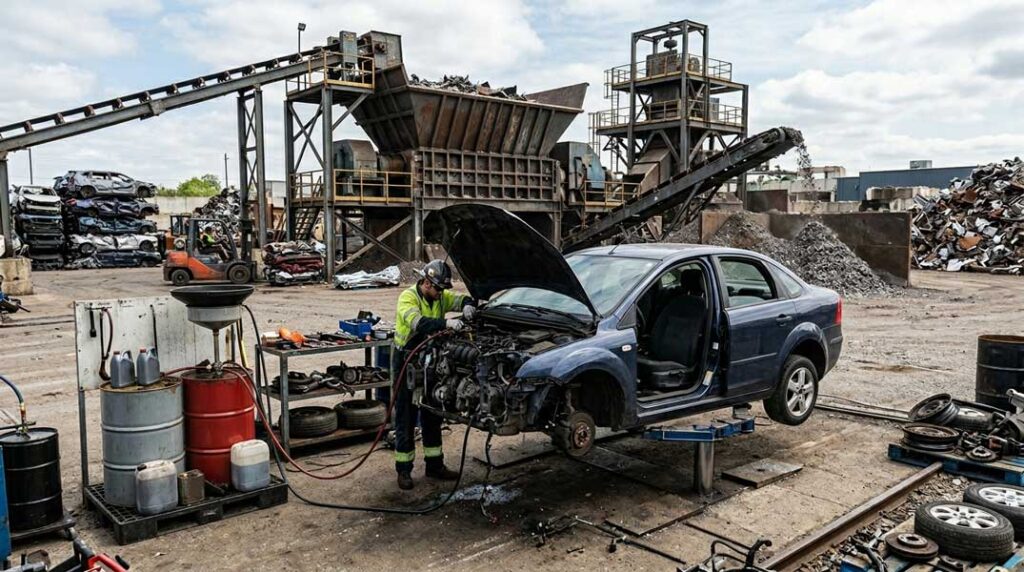
Nothing happens to the car until it’s been made safe. The first stage is depollution, which means stripping out every hazardous fluid and component before the vehicle goes any further. This is the step that stops toxins leaking into the soil, the water supply or the air. Skip it and a single car can poison a surprising amount of ground.
Several fluids are drained at this stage, including the following.
- Engine oil, gearbox and transmission oil, and any hydraulic fluid
- Coolant and antifreeze
- Brake fluid and power-steering fluid
- Fuel left in the tank
- Air-conditioning refrigerant gas and screen-wash
Alongside the fluids, the team removes the battery, the tyres, and the catalytic converter, and they make safe any airbags and remove the fuel tank. The lead-acid battery and the converter both hold real value and have their own recycling routes, which our guides on car battery scrap prices and catalytic converter scrap value cover in detail.
Next, the reusable parts are saved
With the car depolluted, the next job is to save anything that still has life in it. Skilled dismantlers strip out components that can be tested, cleaned and sold on as used spares. Engines, gearboxes, alternators, starter motors, body panels, lights and electronics regularly find a second home this way. It’s recycling in its purest form. Nothing is melted down if it can simply be reused.
This stage is where a lot of a car’s residual value sits, and it’s good for the environment too, since a reused part needs no energy to remanufacture. Demand for quality second-hand components is strong, which is why a complete car often fetches more than a stripped one. Buyers want working parts. A full car gives the yard more to sell. Those parts go on to keep other vehicles of the same model running for years. One scrapped car can supply dozens of working components.
Then the shell is shredded and separated
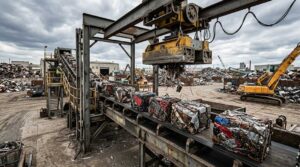
Once the useful parts are gone, the bare shell is ready for the heavy machinery. The car is fed into an industrial shredder that reduces it to fist-sized fragments in seconds. It’s a dramatic end to watch. From there, the mixed material runs through a separation line that sorts it by type.
Powerful magnets pull out the ferrous metals, which are mostly steel from the body and chassis. The non-ferrous metals, such as aluminium and copper, are separated using a different technique that repels them away from the rest. What remains after the metals are recovered is a lighter mix of plastic, glass, rubber and foam, known in the trade as shredder residue. That leftover fraction is the hardest part to deal with.
Finally, the metal and materials are recycled
Recovered metal is where most of the environmental benefit lies. Steel goes to electric arc furnace steelmakers, who melt it down and turn it into new products, using far less energy than making steel from raw iron ore. Some of the steel from your old car could be back on the road inside a new vehicle within a year or two. The loop is properly circular. Old cars quietly become the new ones on the forecourt.
Aluminium follows a similar path, and recycling it uses roughly 95% less energy than producing it fresh from bauxite ore. The other materials are handled too. Tyres are typically processed into crumb rubber for playground surfaces, sports flooring and road construction, while glass is cleaned and recycled wherever its composition allows, and even the foam from the seats can be recovered. The raw metal value behind all this is what our guide on scrap metal prices in the UK explains.
How much of a car can actually be recycled?
That headline figure is 95%. Under the rules, at least 95% of a vehicle’s weight must be reused, recycled or recovered, with a large share of that recycled outright. It’s a target the industry has met for years now. Put simply, almost nothing of your car is wasted.
Metal does most of the heavy lifting, since around three-quarters of a typical car by weight is steel and aluminium with well-established recycling routes. The trickier remainder, the mix of plastics and other materials, used to head to landfill, but modern post-shredder technology now recovers far more of it. The result is that only a small fraction of your old car cannot be reused in some form, a world away from the leaking, landfill-bound wrecks of the past, and the figure keeps creeping upward as the technology improves.
What happens to the number plate and registration?
The car’s identity is closed down as part of the process. When the ATF issues your Certificate of Destruction, the DVLA permanently retires that vehicle record, so the registration can never be used on the road again. The physical plates are destroyed along with the rest of the car, so they cannot be reused or sold on by anyone.
There’s one exception worth knowing. If the registration is a personalised one you’d like to keep, you have to take it off the car before it’s scrapped, not after. Once the vehicle is gone, the plate goes with it for good. Our guide on how to retain your number plate when scrapping explains how to save it in time.
Do you have to pay to scrap a car?
Usually the opposite is true. The law gives the last owner of a complete car the right to free disposal, so a scrapyard cannot charge you to take a roadworthy, intact vehicle off your hands. That right has been in place since 2007, backed by a network close enough that most drivers have a licensed facility within a short distance of home.
In practice, though, you’ll normally be paid rather than simply disposing of the car for nothing. Because the metal and parts have real value, a responsible service offers you a price for the vehicle and collects it at no cost. You only tend to face a charge if the car is incomplete, stripped of its valuable parts, or hard to collect. For most ordinary cars, money flows the other way.
What about electric and hybrid cars?
Electric and hybrid vehicles follow the same depollution and dismantling principles, with one major addition. The high-voltage battery has to be removed and handled by specialists, because it contains materials such as lithium and cobalt that need careful, dedicated treatment.
As more electric cars reach the end of their life, this part of the recycling system is growing quickly, with new facilities built to recover and reuse battery materials safely. The aim stays the same as it is for any car, which is to keep as much as possible out of landfill and back in use. It is the clearest sign of where the whole business of what happens to scrapped cars is heading next.
What the process means for you
From your side, none of this is something you have to manage. A licensed ATF takes care of the depollution, the dismantling and the recycling, and it issues the Certificate of Destruction that proves your car has been taken off the road for good. Use an unlicensed yard and you won’t get that certificate. That single document is why choosing a proper, licensed facility matters so much. None of the heavy lifting falls to you. You can confirm the record afterwards with our guide on how to check if a car has been scrapped, and our guide on how to notify the DVLA covers the paperwork.
Better still, your car’s materials are worth money, so a responsible service pays you for it rather than charging you. You can check what your car is worth in under a minute, get an instant online quote, and book free collection across England, Wales and Scotland. You can also read the official scrap your vehicle guidance on GOV.UK, or learn how the Environment Agency regulates the yards that do the work.
Frequently asked questions
What happens to a car when you scrap it?
It goes to a licensed Authorised Treatment Facility, where it is depolluted, stripped of reusable parts, then shredded and separated so the metal can be recycled. Around 95% of the vehicle is reused, recycled or recovered, and you receive a Certificate of Destruction.
How much of a car can be recycled?
At least 95% of a car’s weight must be reused, recycled or recovered under UK rules. Metal makes up around three-quarters of that, with modern shredder technology recovering much of the remaining plastic, glass and rubber that once went to landfill.
What is depollution?
Depollution is the first stage of scrapping, where all hazardous fluids and parts are removed before the car is dismantled. That includes oils, coolant, brake fluid, fuel, air-conditioning gas, the battery, the tyres and the catalytic converter, so nothing toxic is released.
Are scrapped cars still crushed?
Not before they are depolluted and stripped of useful parts. Modern facilities shred the bare shell rather than crushing whole cars to landfill, then separate the metal for recycling. The old image of cars crushed into cubes and dumped is long out of date.
What happens to the battery and tyres?
Both are removed during depollution and recycled separately. The lead-acid battery is processed to recover its lead and acid, while tyres are usually turned into crumb rubber for surfaces such as playgrounds, sports flooring and roads.