You’ve booked the repair, the replacement part should be straightforward, and then the garage tells you the vehicle may sit for weeks while a new component comes through. That delay can be more frustrating than the repair itself, particularly when the required part is a body panel, headlamp, bumper, door, or alternator that already exists on another vehicle in the UK.
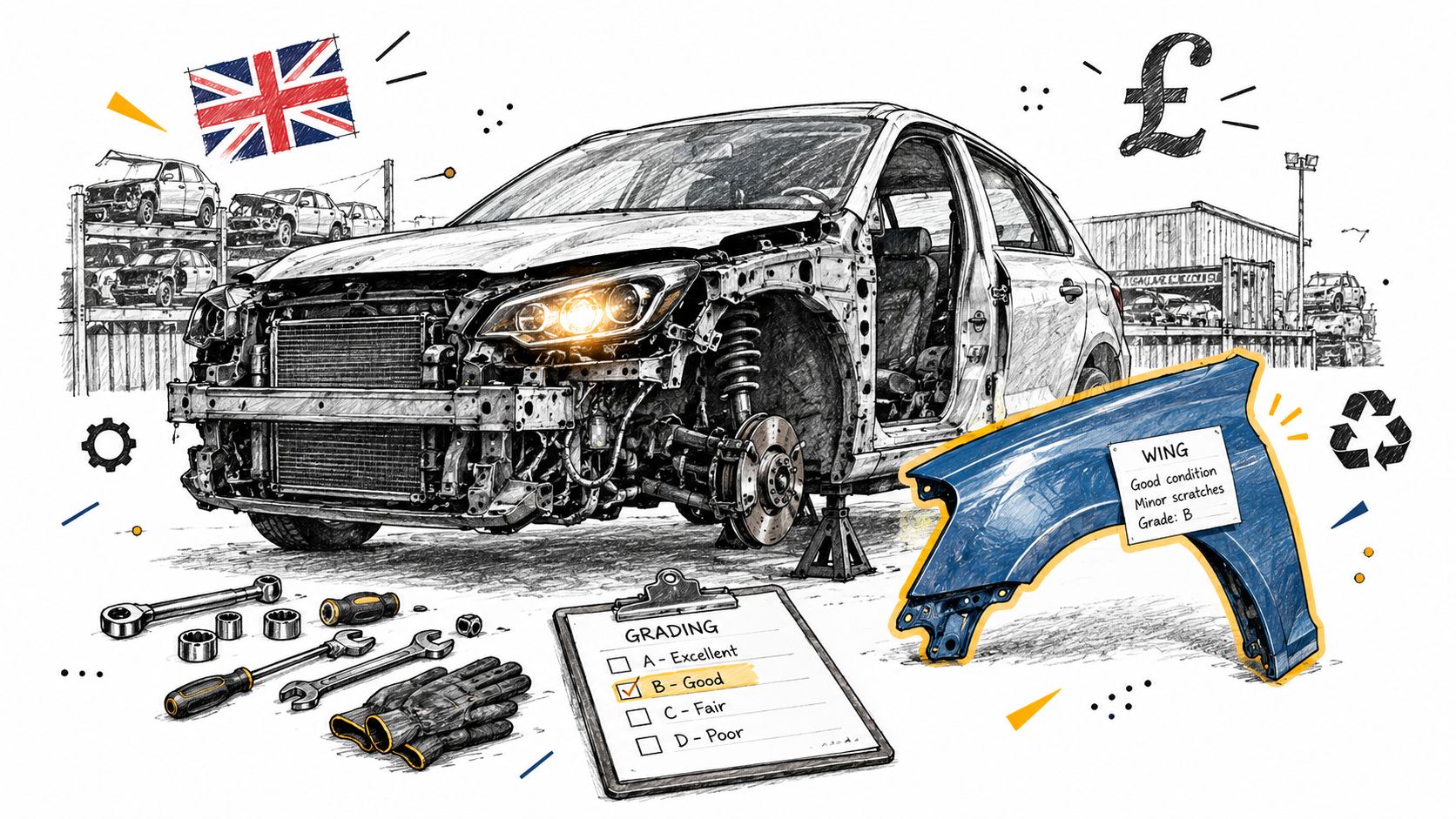
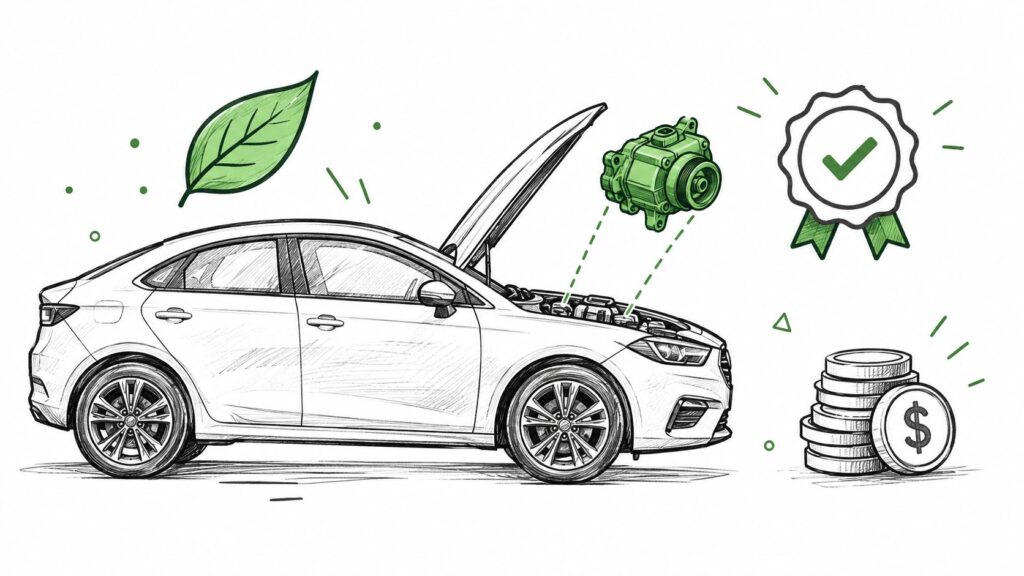
Green car parts offer a practical alternative. They’re original components recovered from end-of-life vehicles, then tested, cleaned, photographed, inspected, matched to vehicle data, and stored for resale. That’s very different from buying an unidentified component pulled from a yard and hoping it works.
The strongest case for them isn’t only price. A properly managed green-parts supply chain can help garages work around new OEM delays, reduce waste, and return vehicles to the road without treating every repair as a choice between an expensive new part and an uncertain used one.
Table of Contents
- Understanding Green Car Parts and the UK Repair Market
- Comparing the Cost of Green Parts Versus New OEM
- Environmental Benefits and UK Recycling Standards
- Quality Testing and Certification Processes
- Tracking Fitment Accuracy and Compatibility
- Using Parts Finder and Valuation Calculator Tools
- Making the Final Decision on Your Next Car Repair
Understanding Green Car Parts and the UK Repair Market
A typical delay starts with a damaged car waiting outside a bodyshop. The repair estimate has been approved, but the workshop can’t finish because a manufacturer’s panel or lighting unit isn’t available. The owner loses use of the car, the garage loses valuable space, and the insurer or fleet operator faces a longer repair cycle.
A green part may already be available through an authorised vehicle recycler. It has been removed from an end-of-life vehicle, checked for suitability, and listed with identifying information so a buyer can assess whether it’s the right replacement. You can browse examples through used car parts from Scrap A Vehicle, but the same buying principles apply across the UK market.
Recovered doesn’t mean unverified
There’s an important distinction between a professional recycled component and an unverified scrap-yard pull.
A controlled supplier should be able to explain:
-
Where the part came from: The donor vehicle should enter a compliant dismantling process rather than an unknown informal channel.
-
How it was checked: Mechanical and electrical parts need functional testing, while body parts require inspection for damage, corrosion, distortion, and finish.
-
How fitment was confirmed: Manufacturer part number data should identify the exact application rather than relying on a vague model description.
-
What you’ll receive: Clear images, condition information, and any available grading or warranty details reduce surprises at installation.
UK reporting shows that green parts are already part of ordinary repair activity. The latest industry report says 91% of bodyshops fit green parts, although they represent only 4.1% of total parts volume. The same report says 76% of repairers report that parts aren’t available within a reasonable timescale, highlighting the gap between adoption and supply depth. Read the UK industry analysis of green-parts availability and bodyshop demand for the underlying figures.
Practical rule: Treat a green part as a traceable replacement component, not as a bargain of unknown origin.
The market has moved beyond basic vehicle stripping. UK ELV rules support the identification and recovery of reusable components, while authorised treatment facilities provide the infrastructure for depollution, testing, storage, and dispatch. The operational question is no longer whether used parts belong in professional repairs. It’s whether the supplier can provide the right part quickly and with enough evidence to justify fitting it.
One useful difference with Scrap A Vehicle is its connection to the UK’s largest ATF network. That matters because recyclers within that network can factor in the potential resale value of reusable green parts when valuing an end-of-life vehicle. In practical terms, that can help owners receive a stronger price for their vehicle, rather than being paid only for scrap weight and basic commodity value.
If you want to source certified recycled parts directly, you can also browse Part Pro, a partner website that sells green parts from certified ATFs.
Comparing the Cost of Green Parts Versus New OEM
Price is often the first reason an owner asks about green parts, but the useful comparison is the complete repair cost, not just the number on the parts invoice. A cheaper component that arrives promptly may also prevent extra storage, transport, hire-car, or workshop scheduling costs. Those secondary costs vary by repair, so they should be discussed with the garage rather than assumed.
A Volkswagen Golf alternator illustrates the difference. UK retailer listings commonly show new Golf alternators at around £100 to £154, while a pre-owned VW Golf Mk6 alternator is listed at £51.99 on eBay UK. You can review the UK Volkswagen Golf alternator listings when checking the exact model and specification.
The content owner’s own working example uses a different quoted comparison, with a Volkswagen Golf alternator costing £300 new and £65 used. Prices vary with engine, year, supplier, warranty, and whether the part is new OEM, aftermarket, remanufactured, or recycled, so always compare like with like.
New OEM versus green part cost comparison
| Component Type | New OEM Cost | Green Part Cost | Typical Availability |
|---|---|---|---|
| Volkswagen Golf alternator, example listing | Around £100 to £154 | £51.99 for a pre-owned Golf Mk6 listing | Depends on exact engine and part number |
| Volkswagen Golf alternator, quoted workshop example | £300 | £65 | Used stock may avoid a manufacturer order delay |
| Body panel or cosmetic component | Varies by vehicle and panel | Varies by condition and colour | Often available from dismantled donor vehicles |
The table shows why a green part can make financial sense, but it doesn’t prove that every used component is the right purchase. A worn alternator pulley, damaged mounting point, mismatched headlamp, or heavily corroded panel can erase the apparent saving through additional labour.
Calculate the repair, not the headline price
Ask the garage to confirm four points before ordering:
-
Part price: Is the quotation for a tested green component, an aftermarket replacement, or a new OEM item?
-
Labour risk: Will the garage charge again if the part fails or doesn’t fit?
-
Delivery timing: Can the supplier dispatch immediately, or is the listing only an enquiry?
-
Return terms: What happens if the vehicle’s exact specification differs from the listing?
The best result comes when the part is correctly identified before dispatch and arrives while the vehicle is already in the repair schedule. That’s where green parts become a supply-chain tool, not just a cheaper substitute.
Environmental Benefits and UK Recycling Standards
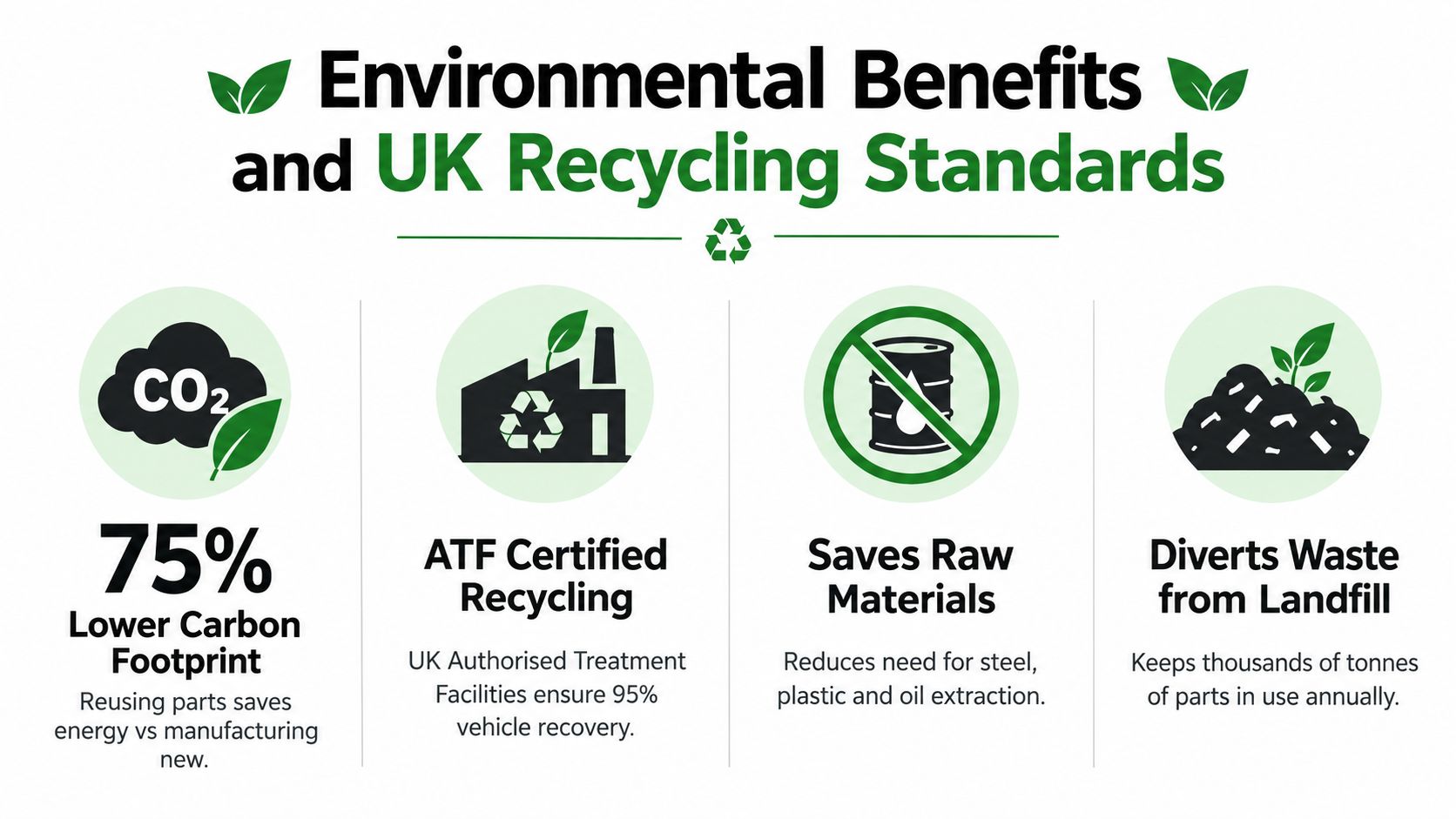
A green part avoids one stage of manufacturing because the component already exists. Reusing it can reduce demand for fresh steel, plastics, rubber, glass, energy, and transport associated with producing a replacement. The exact environmental benefit depends on the component, its condition, the distance transported, and what would otherwise have happened to the donor vehicle, but the principle is straightforward: extending the useful life of an existing part keeps more value in circulation.
The UK’s ELV framework places that activity inside a regulated recovery system. Vehicles and small vans must meet restrictions on hazardous materials, including cadmium, lead, mercury, and hexavalent chromium, unless a specific exemption applies. The same UK government guidance on end-of-life vehicles sets a 95% recovery target and an 85% recycling target by average vehicle weight.
Recovery is more than metal shredding
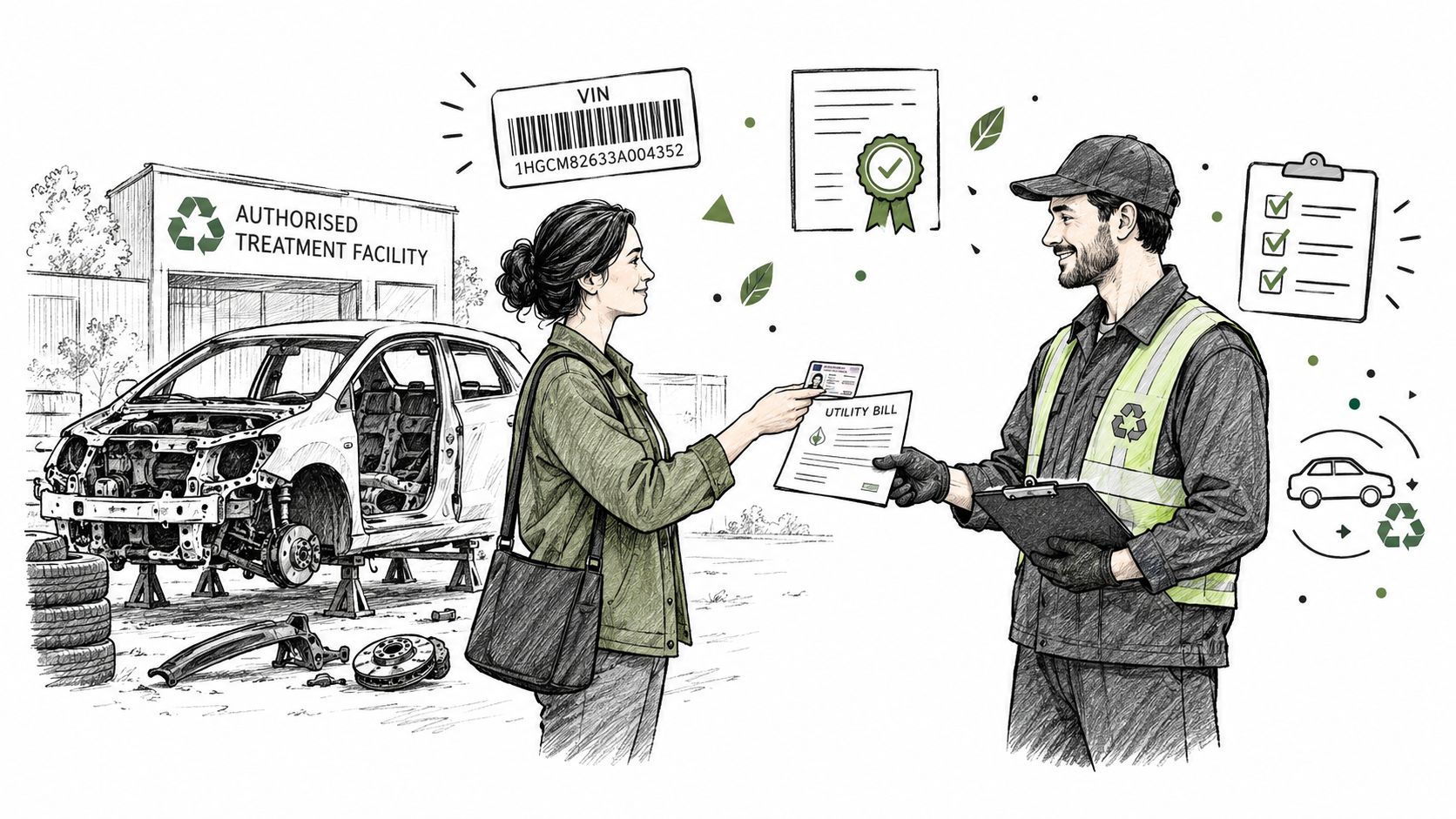
An authorised treatment facility depollutes the vehicle before dismantling. Fluids, hazardous materials, batteries, and other controlled items need appropriate handling, after which suitable components can be assessed for reuse. Parts that aren’t suitable for reinstallation can still contribute to material recovery, but reuse retains more of the original product’s function and manufacturing value.
The historical UK transition is significant. Government reporting says the ELV recycling rate rose by 20 percentage points from 1999 to 2018, while waste sent to landfill fell by more than 95% during the same period. The UK certified recycled-parts report also records that buyers saved more than £99 million in 2022 by purchasing used parts instead of new ones, while 16,000 tonnes of CO2e emissions were avoided.
Those figures don’t mean every green part carries the same carbon saving. They show the combined effect of a functioning reuse market, where components are recovered, sold, fitted, and kept out of the waste stream.
Reuse works best when the part is suitable, the vehicle is dismantled responsibly, and the buyer can verify what they’re fitting.
A Scottish government study estimated the economic value generated through ELV parts reuse and material recovery at around £32 million per year in 2011, with a projection of £45 million per year by 2030. That UK and devolved-nation ELV assessment reflects a long shift from simple scrappage towards formal dismantling and recovery infrastructure.
Quality Testing and Certification Processes
The concern I hear most often from owners is simple: “How do I know the part won’t bring someone else’s fault with it?” The answer depends on the supplier’s process. A green part shouldn’t be listed merely because it was removed from a vehicle. It should be evaluated before sale and documented well enough for a buyer or technician to make a sensible decision.
The depot workflow described by the content owner is practical and repeatable.
From donor vehicle to warehouse
-
Vehicle assessment: The component is identified on the donor vehicle and checked for visible damage, wear, corrosion, or missing fittings.
-
On-vehicle testing: Parts are tested on the vehicle before removal where the system allows it. This is particularly useful for electrical and mechanical components because the tester can assess operation before dismantling.
-
Cleaning: The recovered component is cleaned so its condition can be inspected properly and presented accurately.
-
Imaging: The part is photographed, including relevant labels, connectors, mounting points, and visible marks. Good images help the buyer compare the listing with the repair requirement.
-
Second inspection and storage: After cleaning and imaging, the part is inspected again, then stored in a state-of-the-art warehouse ready for dispatch.
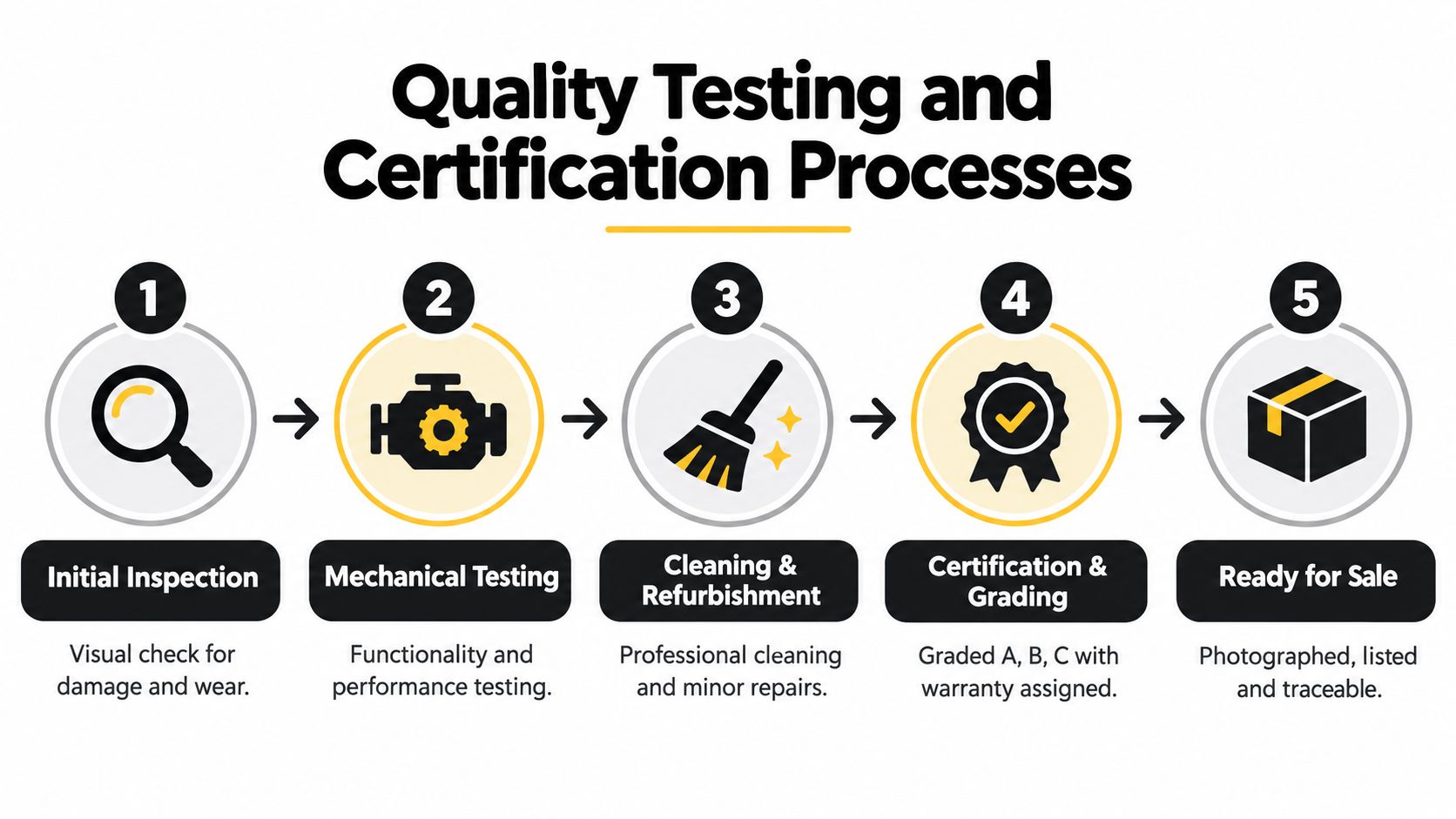
That second inspection matters. Cleaning can reveal cracks, repaired areas, damaged threads, faded labels, or broken clips that weren’t clear when the component was still on the donor vehicle. It also creates a useful checkpoint between initial removal and final listing.
Compliance supports proper reuse
UK ELV regulations require producers to provide dismantling information to authorised treatment facilities. The rules define reuse as using a component for the same purpose it was originally designed for. The UK ELV regulations therefore support a controlled process in which reusable parts can be identified, stored, and tested for reinstallation.
That doesn’t turn every recovered component into a suitable replacement. Safety-critical, heavily worn, or badly damaged items may need new parts or specialist remanufacturing. A responsible supplier should state limitations rather than describe every item as equivalent to new.
The following video provides another visual explanation of green-parts handling and vehicle recycling:
Before buying, ask whether the component was tested, whether the listing shows the actual item, what warranty applies, and whether the supplier can confirm the manufacturer part number. Those checks do more to protect you than the word “green” on its own.
Tracking Fitment Accuracy and Compatibility
A functioning part that doesn’t fit is still the wrong part. This is especially true for modern vehicles, where the same model name can cover several engines, body styles, trim levels, lighting systems, wiring configurations, and production revisions.
Professional suppliers reduce that risk with manufacturer part number data. The number printed or moulded on the component provides a more reliable reference than a general description such as “Golf alternator” or “Ford Focus headlamp”. A correct match can still require confirmation of engine code, year, body style, side of vehicle, connector arrangement, and specification.
The ordering process that prevents mistakes
Give the supplier as much information as possible:
-
Registration number: This can identify the vehicle’s basic specification and guide the initial search.
-
VIN or chassis details: Use these when the model has multiple revisions or when the registration lookup isn’t enough.
-
Manufacturer part number: Photograph the label or casting if you already have access to the original part.
-
Vehicle position: State left or right, front or rear, driver’s or passenger’s side where relevant.
-
Known modifications: Aftermarket lighting, engine swaps, imported vehicles, and previous accident repairs can affect compatibility.
The supplier described here uses manufacturer part number data to determine exact fitment. That’s the right approach for DIY buyers because it replaces guesswork with a searchable reference. It also helps an independent mechanic order the correct component before removing the vehicle from the workshop schedule.
Match the part, then inspect the vehicle
Part-number matching isn’t a substitute for checking the repair itself. A damaged mounting bracket, corroded wiring plug, bent chassis point, or previous non-standard repair can prevent a correctly catalogued part from fitting. The garage should compare connectors, mounting points, dimensions, and visible identification before installation.
Demand patterns also affect availability. UK used-parts reporting identifies headlights and bumpers as unmet-demand items, while external body components account for a larger share of demand than supply and internal body parts are heavily oversupplied. The UK used automotive parts market report helps explain why a clean headlamp or matching bumper may be harder to find than a less fashionable internal component.
Body panels and cosmetic parts, including headlamps, bumpers, bonnets, and doors, remain common green-part requests. Their value often comes from avoiding a long wait for a painted or manufacturer-supplied replacement, but colour and condition must be confirmed. A panel in the wrong shade may still require paintwork, so the cheapest listing isn’t automatically the cheapest installed solution.
Using Parts Finder and Valuation Calculator Tools
Online tools are useful when they collect the right vehicle details before someone starts searching through stock. A parts finder should narrow results by registration, model information, component category, and manufacturer reference. It works best as a compatibility filter, not as permission to buy the first listing with a familiar model name.
Start with the vehicle registration and the exact component required. If you’re ordering a door, specify the side, body style, colour, glass condition, mirror equipment, and whether the vehicle has features such as keyless entry or electric folding mirrors. For an alternator, provide the engine details and compare the manufacturer number against the listing.
A sensible parts-finder routine
-
Describe the failure: Tell the supplier whether you need a complete replacement, a housing, a motor, a lamp unit, or a small associated fitting.
-
Enter the vehicle details: Use the registration lookup, then verify the returned model and engine against the V5C or service information.
-
Check the reference: Compare the manufacturer part number, connector arrangement, mounting points, and side of vehicle.
-
Review the actual images: Look for cracks, missing clips, corrosion, paint damage, and label details.
-
Confirm dispatch and returns: Availability only helps if the part can leave the warehouse in time and can be returned under stated conditions.
A valuation calculator answers a different question. If your vehicle has failed its MOT, suffered accident damage, or developed a repair bill that exceeds its practical value, enter the vehicle information and assess whether repair, sale, or compliant recycling makes sense. The result should be treated as an opening valuation, not a promise that ignores missing keys, stripped components, severe damage, or collection constraints.
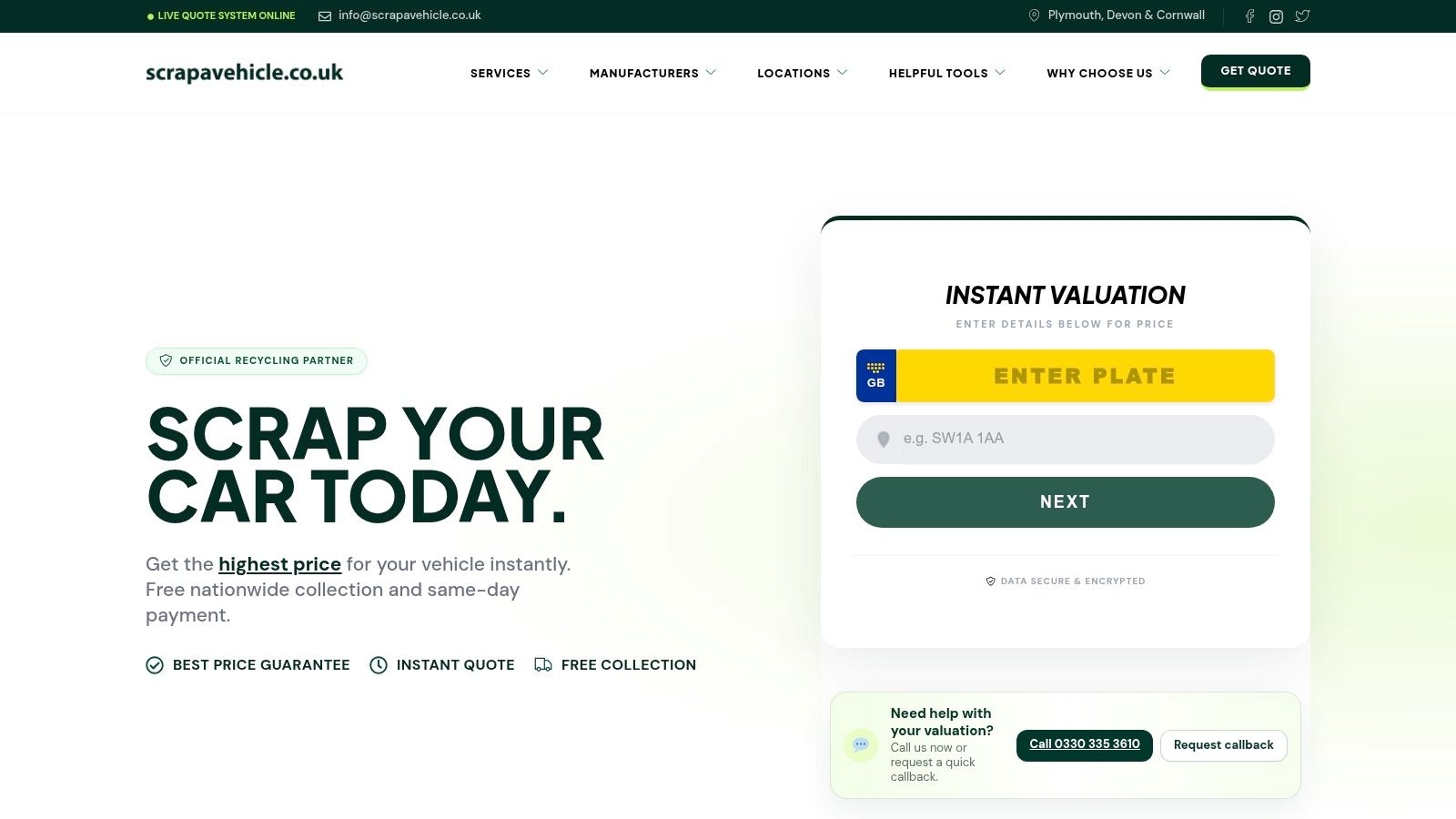
Scrap A Vehicle provides online tools for vehicle valuation, MOT history, tax, emissions, parts finding, and locating a scrap yard. It also handles vehicle purchasing, recycling, and green-parts supply, so an owner can consider the repair decision alongside the vehicle’s end-of-life value.
Use the tools together
Check the MOT history for recurring failures, use the emissions or tax information to understand running obligations, then compare the repair quotation with the vehicle’s condition and market role. If the vehicle is uneconomical to repair, a compliant recycler can recover suitable parts rather than sending the whole car directly into a low-value disposal route.
Making the Final Decision on Your Next Car Repair
The right choice depends on the part, the vehicle, the repair risk, and the time available. A green part is often a strong option for body panels, headlamps, bumpers, doors, bonnets, alternators, starter motors, and other components where a tested original part can meet the vehicle’s needs. It becomes particularly useful when a new OEM item is delayed and the vehicle is occupying a workshop bay.
New OEM remains appropriate where the repair involves a safety-critical system, a high-wear item, a component with no trustworthy used supply, or a part whose history cannot be established. An aftermarket alternative may also work when the manufacturer specification is clear and the supplier has a dependable quality record. The decision should be based on evidence rather than the label attached to the part.
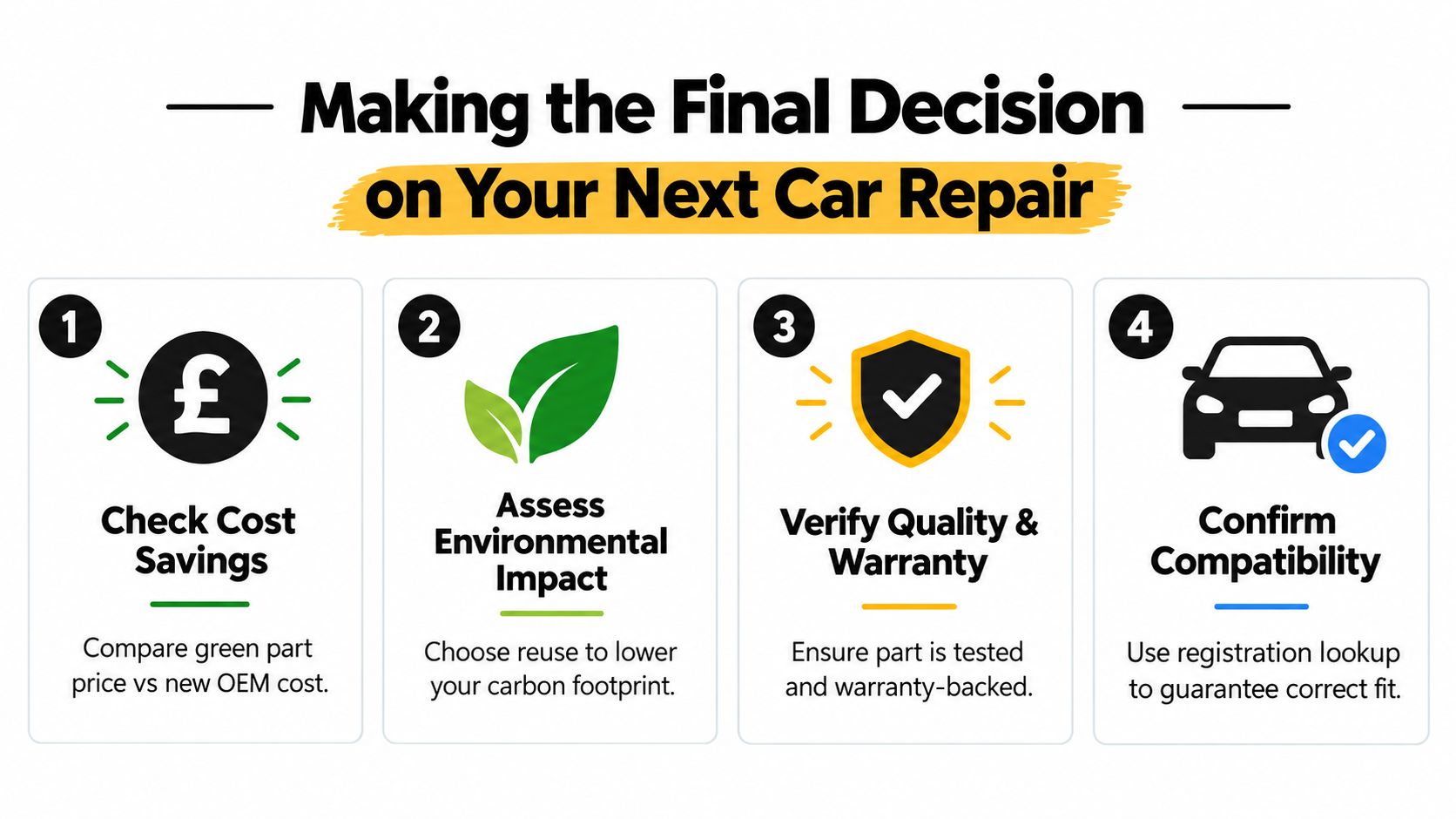
A practical buying checklist
-
Check the total cost: Compare the green part, new OEM, and suitable aftermarket options, then ask how labour and delivery timing affect the final repair.
-
Check the evidence: Look for testing details, clear photographs, condition notes, manufacturer references, and written warranty or returns information.
-
Check the fitment: Confirm the registration, VIN where needed, engine or body variant, side, connector, and exact manufacturer part number.
-
Check the repair risk: Ask the technician whether the component is suitable for reuse and whether a new part is required for the specific safety system.
-
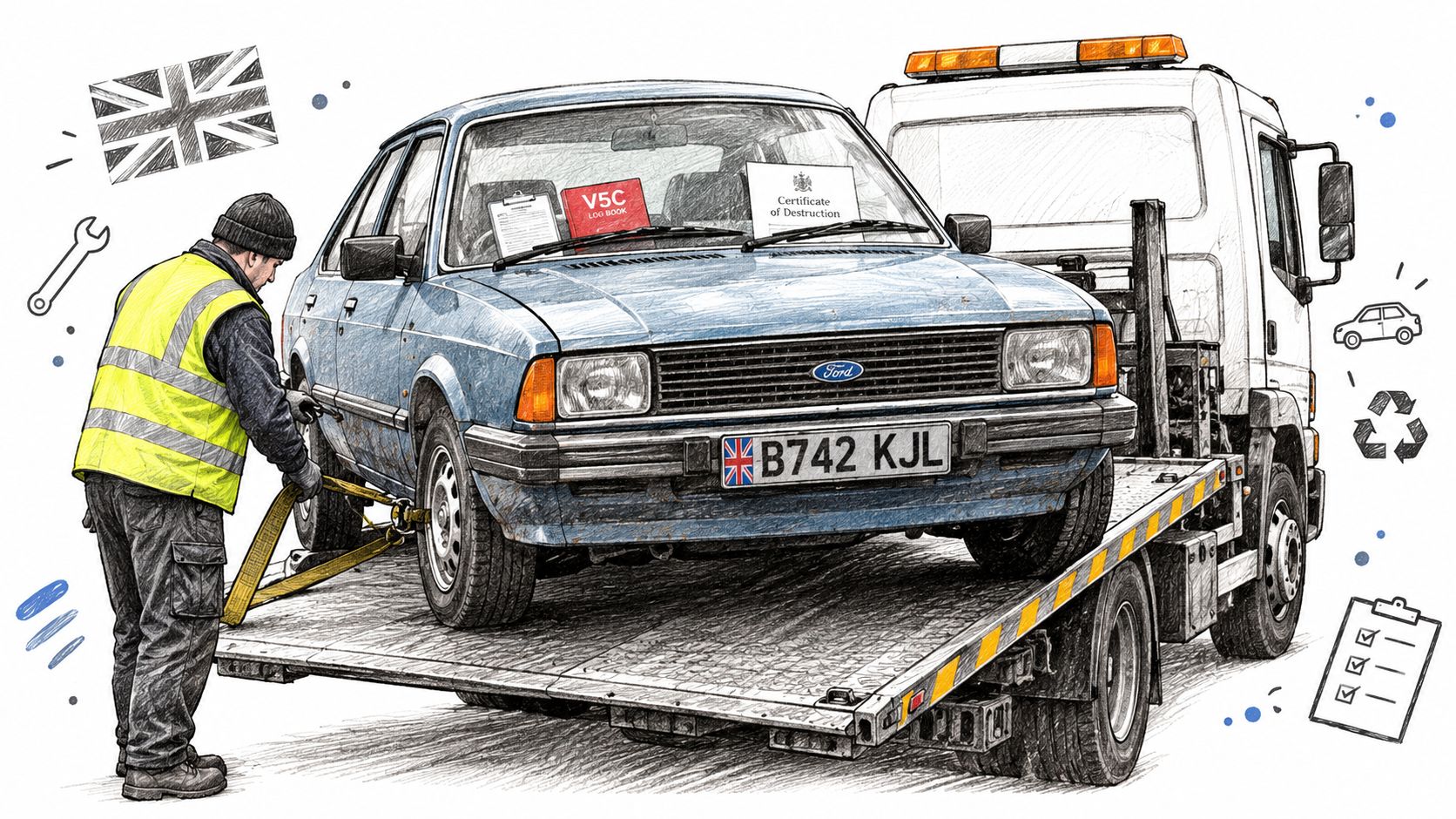
Check the supplier route: For end-of-life vehicles, use an authorised treatment facility that can manage depollution, recycling, and DVLA documentation correctly.
The environmental side matters, but it shouldn’t override safety or compatibility. A part that arrives quickly but needs adaptation is a false economy. Conversely, automatically ordering a new OEM component when a tested original is available can add cost and delay without improving the result.
Green car parts work best when three people have the same information, the owner, the supplier, and the technician. The owner understands the price and warranty, the supplier verifies the component, and the technician confirms that the vehicle and repair requirements match.
One useful difference with Scrap A Vehicle is its connection to the UK’s largest ATF network. That matters because recyclers within that network can factor in the potential resale value of reusable green parts when valuing an end-of-life vehicle. In practical terms, that can help owners receive a stronger price for their vehicle, rather than being paid only for scrap weight and basic commodity value.
If you want to source certified recycled parts directly, you can also browse Part Pro, a partner website that sells green parts from certified ATFs.
Scrap A Vehicle offers vehicle valuations, nationwide collection, compliant end-of-life recycling, and tested green parts for owners and repairers looking to reduce cost and avoid unnecessary delays. Visit Scrap A Vehicle to find a suitable used part or request a valuation for a damaged, failed-MOT, or end-of-life vehicle.