Your car fails its MOT, won’t start, or needs to go this week because you’ve already replaced it. In that moment, you aren’t looking for a lecture on used-car pricing. They want a number they can trust, a collection date they can book, and payment that arrives without a chase.
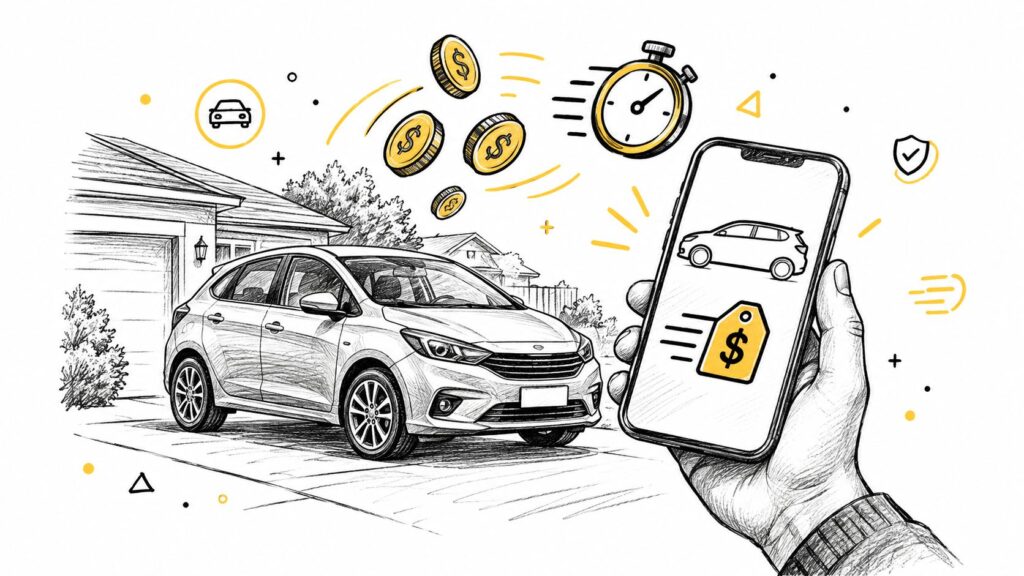
That’s where a sell my car instant valuation tool helps. The good ones don’t just guess from age and mileage. They use live market inputs and turn your registration, postcode, mileage and condition into a price you can act on quickly. Our customers can get a quote in less than 20 seconds.
Speed matters because the UK market is moving at national scale, not village scale. The Society of Motor Manufacturers and Traders reported 2,009,318 used-car transactions in Q2 2026 and 4,025,550 transactions in H1 2026, up 0.2% year on year according to this UK used-car market report. In a market that busy, ringing around local buyers one by one is usually slower and less accurate than using a live valuation system.
Table of Contents
- Introduction to Instant Valuation and Fast Sale
- What You Need Before You Get Your Instant Quote
- How Your Instant Valuation Is Calculated Behind the Scenes
- Proven Ways to Maximise Your Instant Valuation Price
- What Happens After You Accept Your Valuation
- Final Checks Before You Sell With Confidence
Introduction to Instant Valuation and Fast Sale
A lot of sellers arrive at instant valuation for the same reason. The car is taking up space, the repair bill doesn’t make sense, or they need the funds released quickly. That might be a tidy hatchback with a fresh MOT, or it might be a non-runner that has reached the end of the road.
What instant valuation promises is simpler than it seems. It gives you a fast price based on the details you enter and the current market signals behind the scenes. It is not the same thing as typing your registration into a basic checker and getting a generic average.
What the fast sale usually looks like
In practice, the journey tends to follow this pattern:
- You enter the core details: registration, postcode, mileage and contact details.
- The system matches the vehicle profile: make, model, derivative and likely market route.
- A quote appears quickly: often fast enough to decide there and then whether it’s worth proceeding.
- You choose what happens next: collection timing, paperwork and payment method.
That’s why instant valuation works well for urgent situations. If your car is roadworthy, damaged, or only worth parts and scrap, a live quote gives you a starting point based on how buyers would place it today.
A fast quote is useful when it shortens the whole sale, not just the first screen.
Why timing changes the outcome
Used-car values don’t stand still. Buyer demand shifts. Supply tightens and loosens. Regional appetite changes. If you leave an old quote sitting in your inbox and come back later, it may no longer reflect what the vehicle is worth on the day you sell.
That’s why a proper instant valuation beats phoning round for rough opinions. It gives you a structured route from quote to collection, bank payment and the handover side of the DVLA process, instead of leaving you to stitch everything together yourself.
What You Need Before You Get Your Instant Quote
Most under-valuations happen before the quote even appears. The seller leaves out something important, guesses the mileage, or picks the wrong trim. Then the number looks disappointing, when the issue is the input.
Have the right details ready and the process is much smoother.
The details that matter most
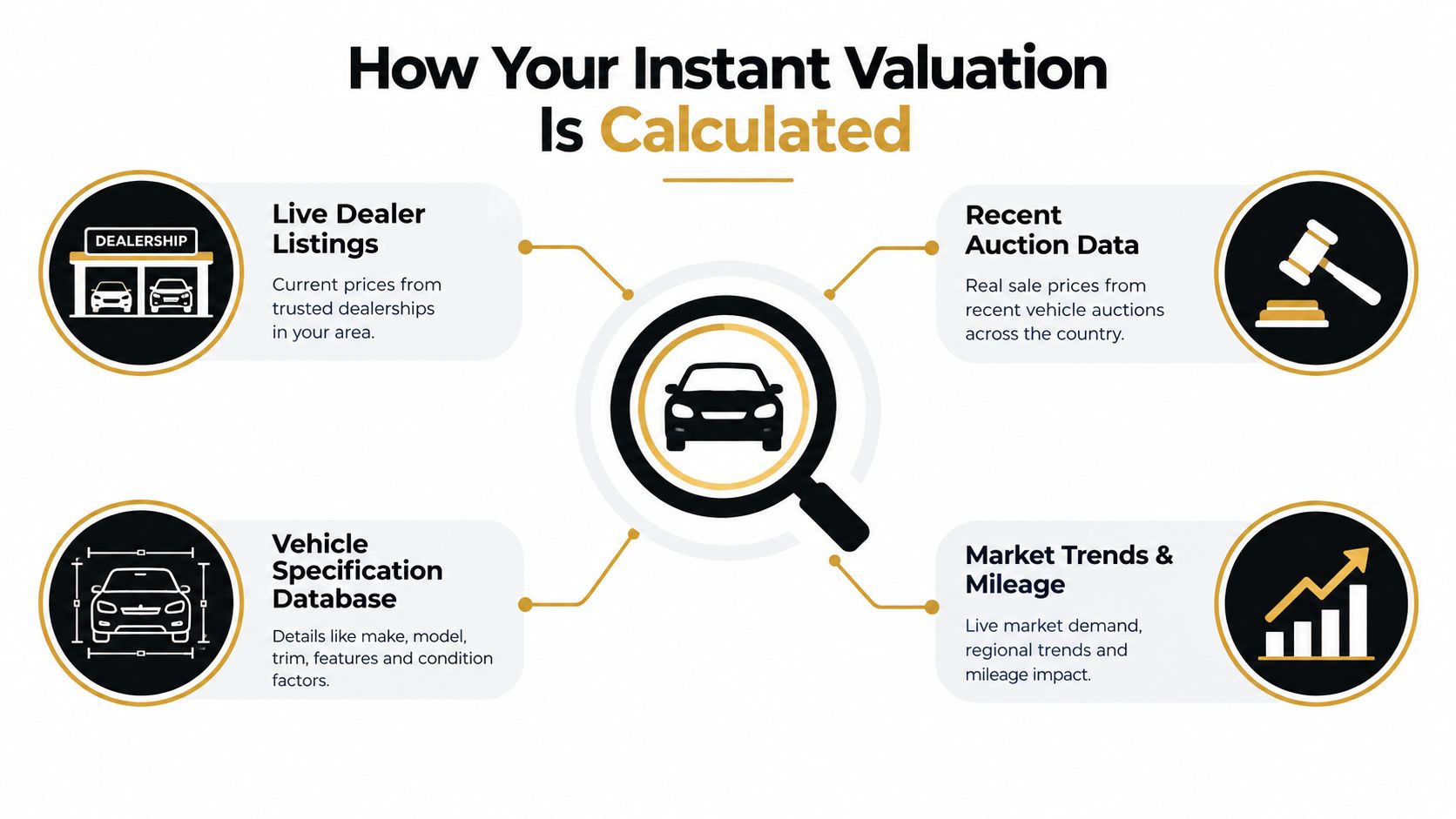
Before you start, gather these:
- Registration: this is the quickest way to identify the base vehicle record.
- Postcode: local demand can affect how a buyer places the vehicle.
- Exact mileage: not an estimate. The odometer reading matters.
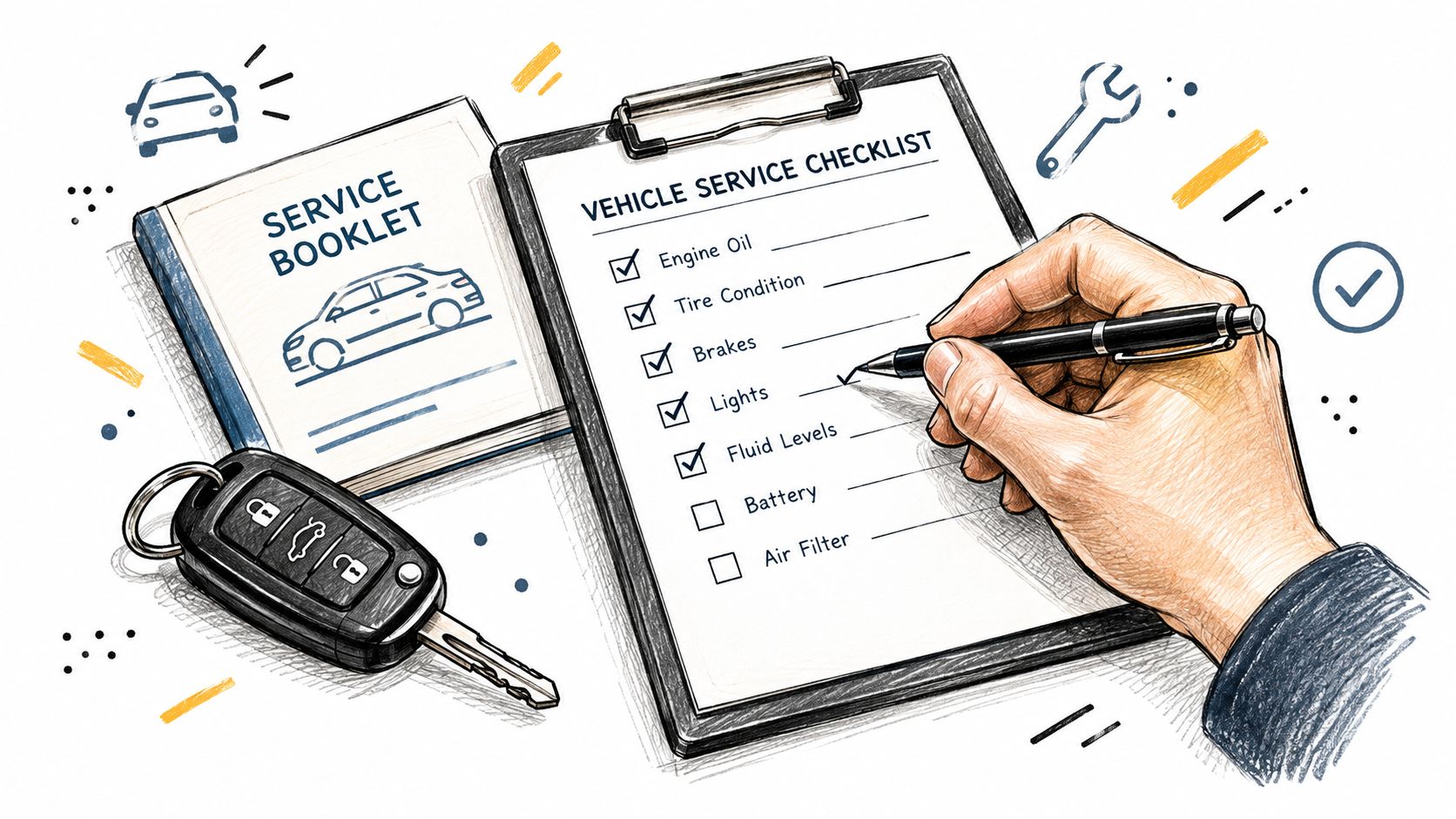
- Service history: full, partial, or none. Say what you have.
- Optional extras: upgraded infotainment, leather, factory packs, towing equipment, and similar spec details.
- Condition notes: dents, warning lights, interior wear, missing keys, non-start issues, or accident damage.
- Accident and repair history: this can change whether the car is valued as retail, trade, salvage, or parts-led stock.
The main reason these details matter is derivative matching. CAP HPI’s valuation engine is described as processing thousands of buying and selling prices every day from more than 50 suppliers, and it reportedly crunches 160,000 motor trade transactions plus 700,000 daily retail adverts to generate about 10 million values across 2,300 model ranges and more than 70,000 derivatives in Autocar’s look at how second-hand car values are set. If your trim or mileage is wrong, the system may map your car to the wrong derivative before it prices it.
Accuracy rule: the fastest way to lose money is to treat a valuation form like admin. Every missing detail pushes the quote back toward an average.
Estimate or collect-on-the-day offer
This catches people out more than anything else. Some tools give a rough market estimate. Others are designed to support a real collection booking and a sale.
A rough estimate is useful for orientation. A stronger quote usually comes from more complete inputs, plus a follow-up review where needed. That’s one reason online scheduling matters. You’re not just checking a number. You’re moving the vehicle into an actual sale process.
Our customers can get a quote in less than 20 seconds, and they can arrange collection online 24/7. That combination matters because it keeps the momentum going. If you have to stop and wait for business hours just to move forward, “instant” quickly stops feeling instant.
How Your Instant Valuation Is Calculated Behind the Scenes
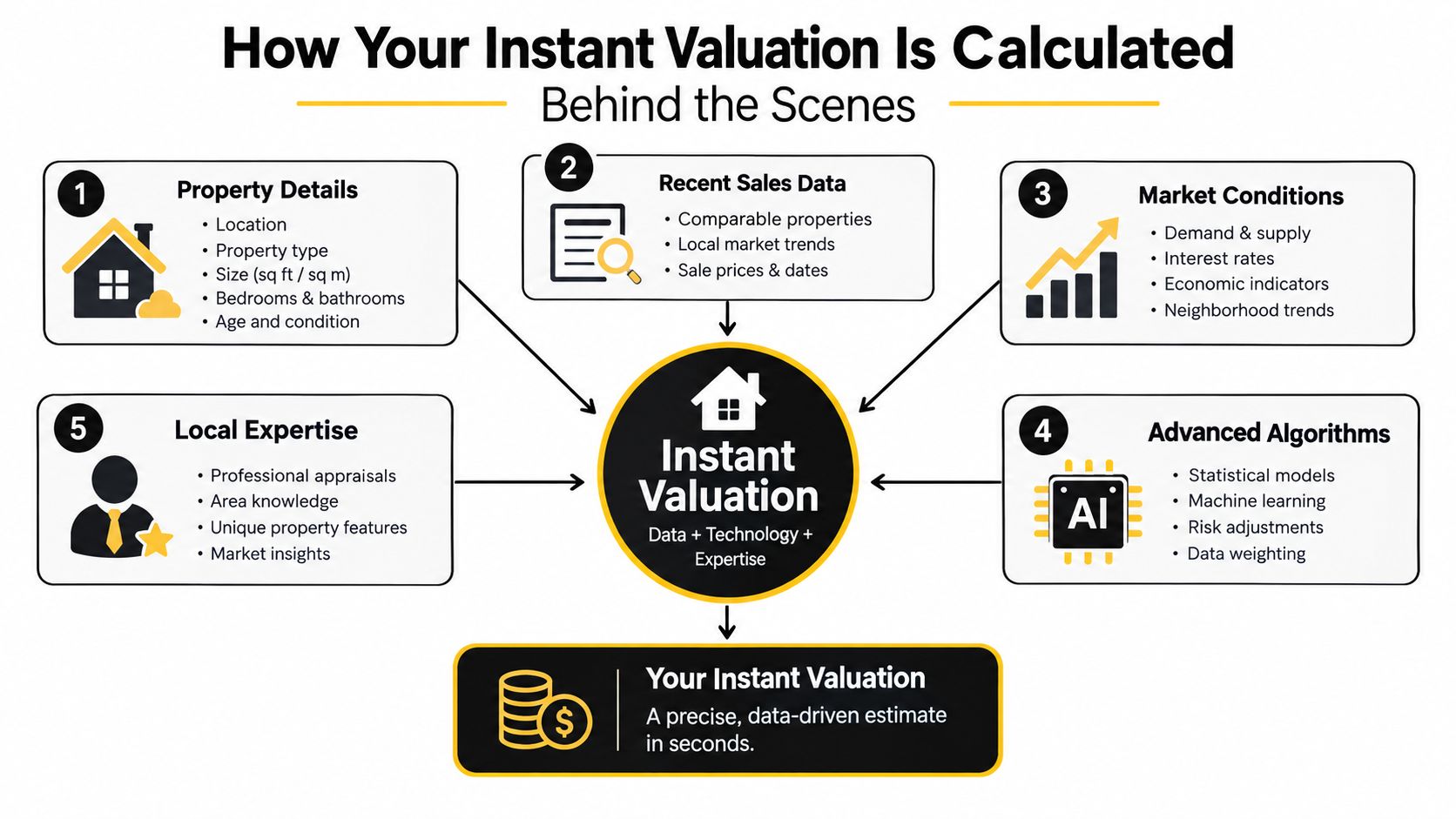
A serious valuation engine does much more than compare your reg to a price guide. It is continuously matching vehicles to live market behaviour, then deciding which value route fits best.
The live feeds behind the number
A technically sound UK valuation workflow combines live retail-market signals with trade and wholesale references, then adjusts for the exact vehicle profile and local demand. One published description includes live auction results, dealer forecourt listings, private-sale completions and part-exchange records, with adjustments for age, mileage, condition, fuel type, specification and regional price differences in this explanation of car valuation methods.
That matters because asking prices alone can mislead. A dealer might advertise high and still reduce later. A better system weights sold and trade data, checks for outliers, and refreshes values frequently enough to keep pace with the market.
Why five value routes matter
Instant valuation becomes more useful than a basic reg lookup. We use a five-way calculation that can incorporate:
| Value route | What it captures |
|---|---|
| Salvage | Damaged vehicles that still have repairable or resale value |
| Trade | What a buyer can justify within the motor trade |
| Auction | Live disposal value in competitive wholesale channels |
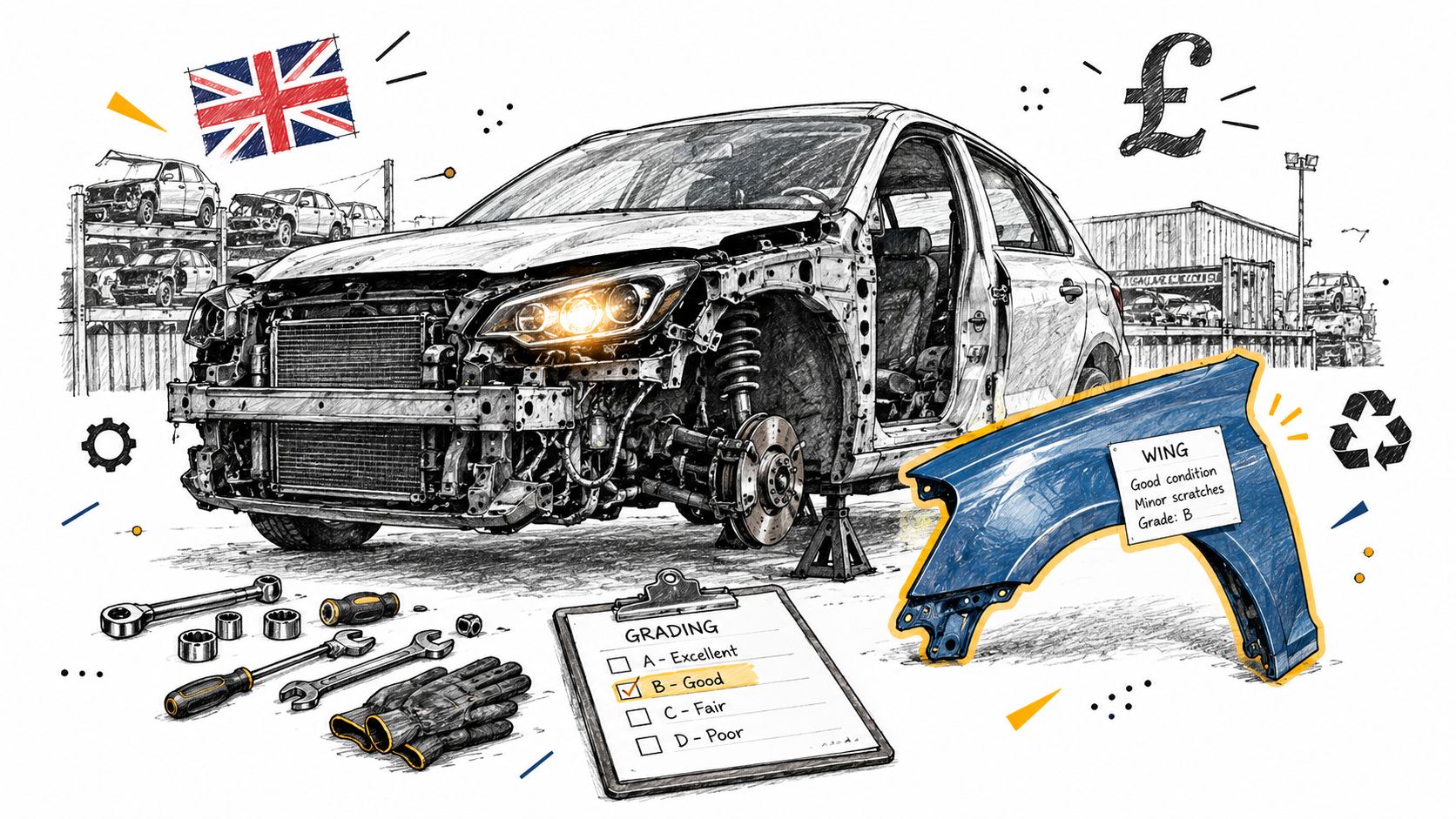
| Parts | Breaker value where components matter more than the whole car |
| Scrap | End-of-life value tied to metal weight and commodity conditions |
That approach matters because scrap value and salvage value are not the same thing. Industry guidance explains that scrap value is based on vehicle weight and current metal prices, while salvage value applies when a damaged car still has repairable value or parts that can be sold individually, as outlined in this UK scrap and salvage guide.
Why quotes move even when your car hasn’t changed
The car on your drive may be the same today as it was last month. The market around it isn’t. Autotrader’s April 2026 Retail Price Index reported an average used-car price of £17,397, with prices up 1.8% month on month on a like-for-like basis, according to MotorCheck’s summary of UK used-car price movement in 2026. On a market average like that, a monthly move can materially change a seller’s result.
That’s why stale valuations are dangerous. An instant quote should reflect the market now, not what a monthly guide said weeks ago.
If a buyer can only explain your car’s value with age and mileage, the quote is probably too blunt.
Proven Ways to Maximise Your Instant Valuation Price
The easiest way to improve your result is not polishing the dashboard. It’s giving the valuation team the information they can price.
Declare what makes the vehicle different
A real example shows why this matters. We recently valued a Volkswagen Transporter at £1250.00, then found out from the customer that it had a campervan conversion. Once customer service escalated it to the buying team, we were able to pay £2550.00.
That wasn’t a random goodwill uplift. The first quote reflected an incomplete picture. The conversion changed how the vehicle should be assessed and who would want to buy it.
What lifts a quote and what usually hurts it
Use this as a working checklist:
- Be exact on mileage: if the odometer is available, read it properly. Rounded numbers invite a later adjustment.
- List factory extras and meaningful modifications: a camper conversion, upgraded trim, or specialist equipment can change the buyer pool.
- Tell the truth about damage: cracked bumpers, warning lights, missing paperwork, and non-start issues should go in up front.
- Mention service history clearly: full history and documented maintenance help the buyer place the car with more confidence.
- Ask for review if the result looks off: unusual vehicles often need a human escalation rather than a standard automated path.
For a useful benchmark, some tools also make this more transparent by showing how inputs like condition, service history, accident history and extras can shift the result, as discussed in Motorway’s guidance on what affects car value.
Honesty usually pays more than cosmetic effort. A clean description prevents a painful repricing on collection day.
Don’t confuse neatness with value
A wash helps the handover go smoothly. It rarely transforms the economics of the sale. Buyers care more about whether the car starts, drives, has the right spec, and matches what was declared.
If you want a practical next move, compare your details against a live sell my car value tool and make sure the mileage, condition and any specialist features are included before you accept. That’s especially important for vans, imports, classics, damaged vehicles and anything with conversion or parts-led value.
What Happens After You Accept Your Valuation
Once you accept, the process should become simpler, not more confusing. This is the point where speed, paperwork and payment all have to line up.
Booking collection and getting paid
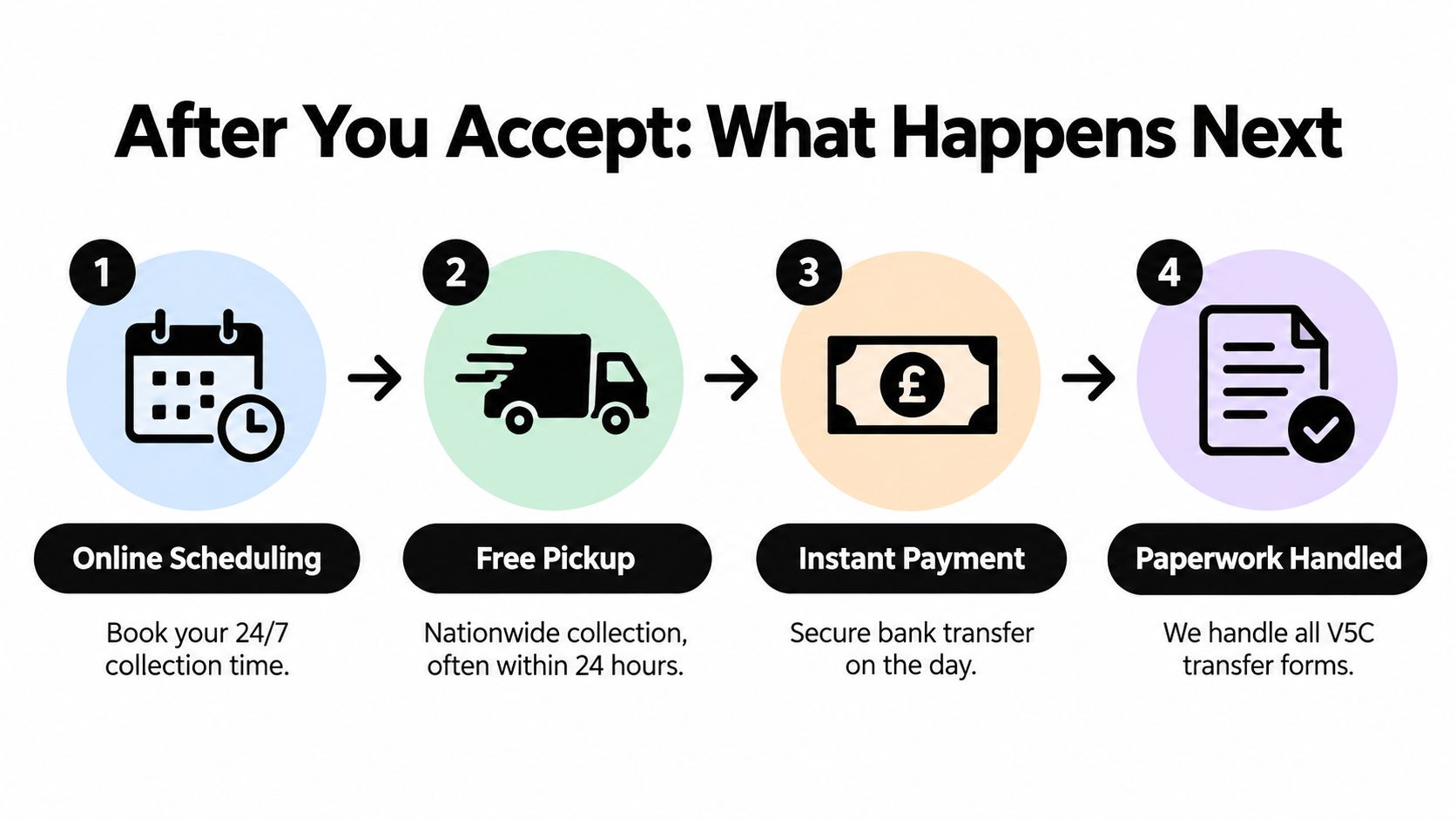
A modern instant valuation service usually lets you schedule the next step online, rather than waiting for someone to call you back. One national car valuation service says users can enter registration, mileage, email and postcode to get a free instant valuation, then choose a date, time and branch for follow-up through its online car valuation journey.
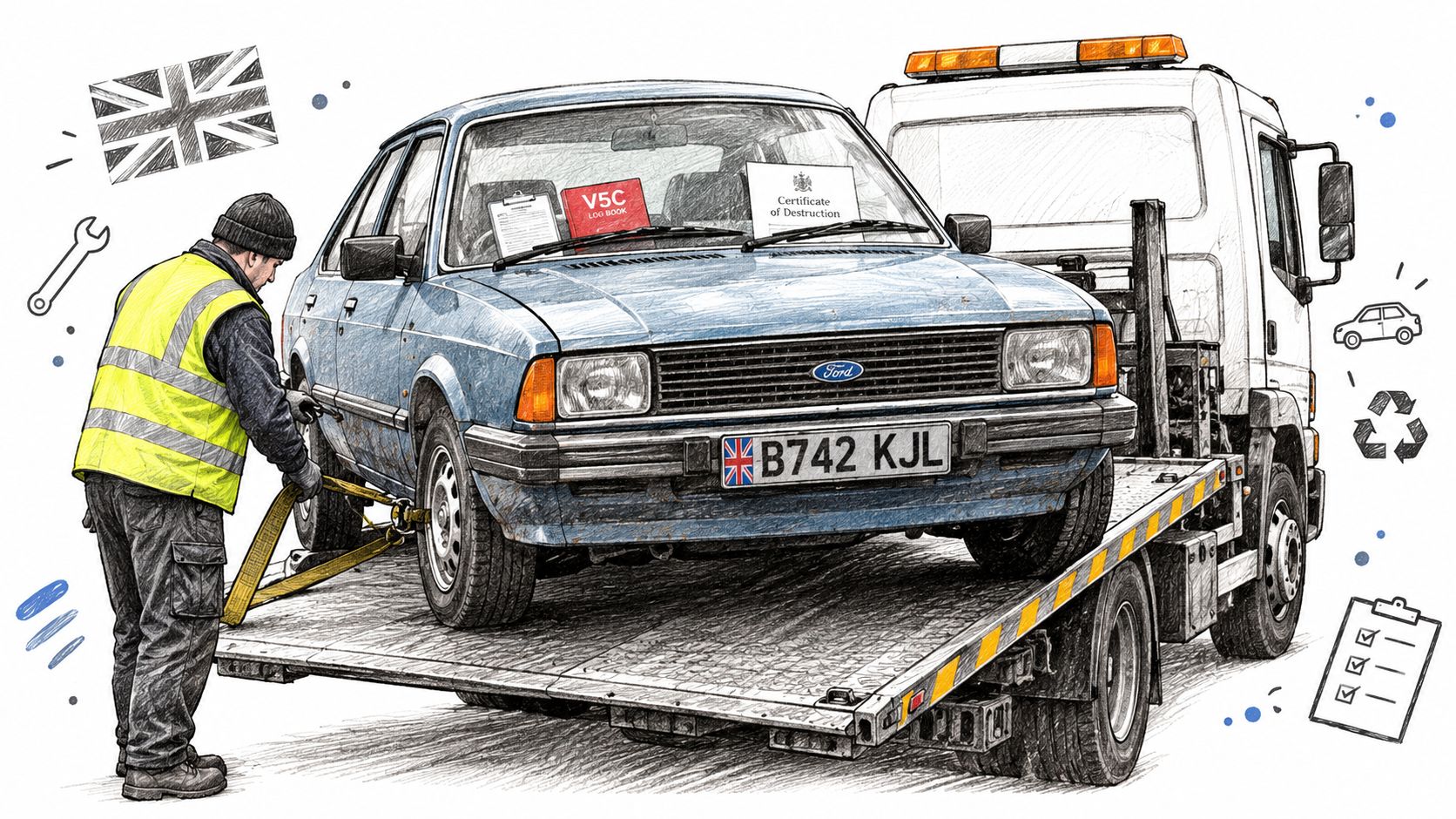
Collection and payment are often built for speed too. One UK buyer and breaker service states that same-day or next-day collections are available, payment is made by secure bank transfer as soon as the driver picks up the car, and collection can be arranged from home, work or wherever the car is parked through its collection and payment process.
In plain terms, you should expect a booked slot, a straightforward handover, and payment that is confirmed on the day.
The paperwork side people forget
Sellers get caught. The valuation is only the commercial part of the transaction. The legal transfer still has to be done properly.
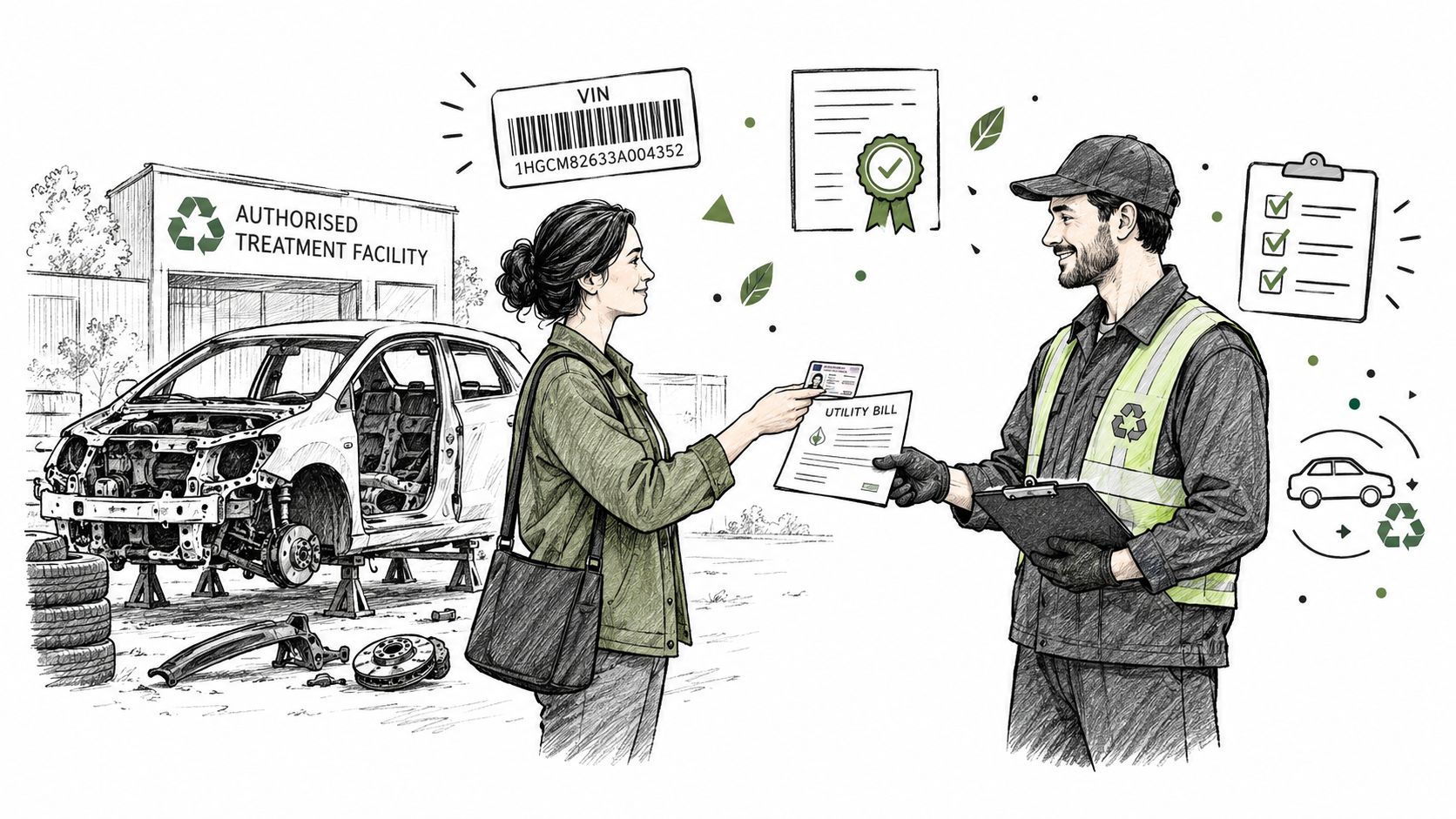
GOV.UK says the seller must tell DVLA they’ve sold the vehicle and provide the buyer’s full name and address. If the keeper doesn’t have a V5C, they must write to DVLA with the vehicle details and sale date, as set out in the official DVLA guidance on selling a vehicle.
For end-of-life vehicles, the chain is tighter again. An ATF can issue a Certificate of Destruction, notify the DVLA and complete the disposal process so the keeper is removed from future liability, according to this ATF disposal and Certificate of Destruction FAQ.
Don’t leave the paperwork as an afterthought. If DVLA still shows you as keeper, the sale isn’t clean from your side.
Final Checks Before You Sell With Confidence
A strong instant valuation comes down to three checks.
First, make sure the input is accurate. Registration alone is not enough if the mileage is wrong, the trim is missing, or a major feature hasn’t been declared. Unusual vehicles deserve extra attention before you accept the quote.
Second, understand what kind of number you’ve been given. The better systems don’t rely on a single scrap figure or a broad market average. They look across salvage, trade, auction, parts and scrap routes, then place your vehicle where it belongs.
A quick decision filter
Use this before you go ahead:
- Accept the quote if the vehicle description is complete and the sale route is clear.
- Ask for escalation if the car is modified, converted, rare, imported, damaged in a specific way, or clearly doesn’t fit a standard profile.
- Pause the sale if the provider can’t explain collection, payment timing, or who handles the DVLA side.
What usually goes wrong
Most sale delays come from old quotes, missing details, or paperwork confusion. A valuation can be fast and still be wrong if the seller treats it as a rough browse instead of a real transaction. A clean sale needs the price, the collection plan and the transfer process to match up.
If those three pieces are in place, a sell my car instant valuation does exactly what it should. It turns a car on the drive into a booked collection and cleared funds, without the usual back-and-forth.
If you want a fast route from quote to collection, Scrap A Vehicle offers instant online valuations, collection booking and payment for roadworthy, damaged and end-of-life vehicles. It’s built for sellers who need a live-market price and a compliant handover without chasing multiple buyers. Visit Scrap A Vehicle to get your valuation and arrange the next step.