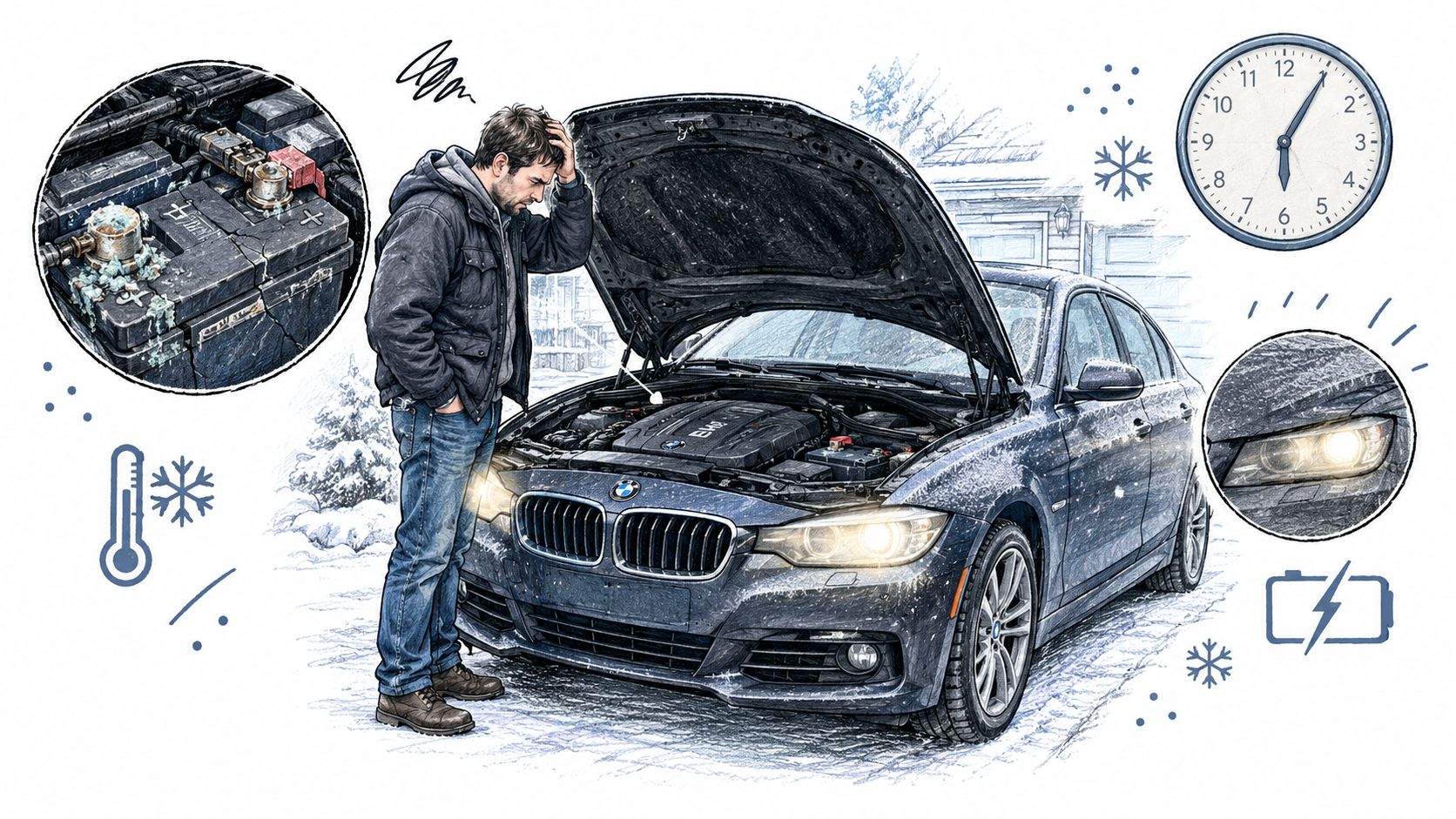
It’s a cold morning, you’re already late, and your BMW turns over slowly before giving up. The interior lights dim, a warning appears, and you’re left wondering whether you need a battery, a jump-start or an expensive electrical repair. Before buying anything, establish which battery system you’re dealing with and why it has lost power. On a BMW, getting the physical replacement right is only part of the job.
Table of Contents
- Why Your BMW Battery Fails and How to Spot It
- Identifying the Correct Battery for Your BMW
- New Battery Versus Recycled Green Parts
- Safe Battery Removal From Your BMW
- Battery Registration and Coding Explained
- Disposal and Recycling Rules for BMW Batteries
- DIY Replacement Versus Professional Service
Why Your BMW Battery Fails and How to Spot It
A diesel BMW that’s been standing unused can struggle when the temperature drops. A larger diesel engine generally needs more starter-motor torque, while cold weather thickens the engine oil and reduces the battery’s available starting power. Infrequent use and repeated short journeys make that combination harder to manage, as described in specialist UK guidance on BMW battery problems.
That doesn’t mean a particular BMW model is more prone to battery failure. The more useful questions concern the engine, how the car is used and whether the battery can still meet its starting demands. A larger battery isn’t protection against being left undercharged.
Read the symptoms together
Slow cranking is a strong reason to investigate the starting supply, but it isn’t a complete diagnosis. Dimming interior lights, stop-start becoming unavailable and apparently unrelated electrical warnings can also accompany a low-voltage condition.
- Slow starting after standing: Record how long the car was unused and whether the problem returns after charging.
- Warnings alongside dimming lights: Ask for a low-voltage investigation before approving several unrelated component replacements.
- Stop-start deactivation: Treat it as supporting evidence, not proof that the battery has failed.
- Repeated discharge: Tell the technician about trackers, dash cameras and other aftermarket equipment.
The pattern matters. A car that struggles after prolonged storage presents a different diagnostic problem from one that repeatedly loses charge despite regular use.
A flat battery may be the victim
Boot modules, aftermarket trackers, dash cameras or a vehicle that doesn’t enter sleep mode can cause parasitic drain. Replacing the battery without investigating that drain leaves the underlying fault in place.
Practical rule: A jump-start gets you moving. It doesn’t establish whether the battery, charging system or an unwanted electrical load caused the breakdown.
A sensible diagnosis combines a rested battery test with connection checks and charging-system checks under electrical load. If the battery is weak, that gives you a reason to replace it. If it tests acceptably but keeps losing charge, ask for further investigation rather than another battery.
Before the appointment, write down when the symptoms occur, what accessories are fitted and whether the car has recently spent time unused. That information is more useful than just reporting that the BMW won’t start.
Identifying the Correct Battery for Your BMW
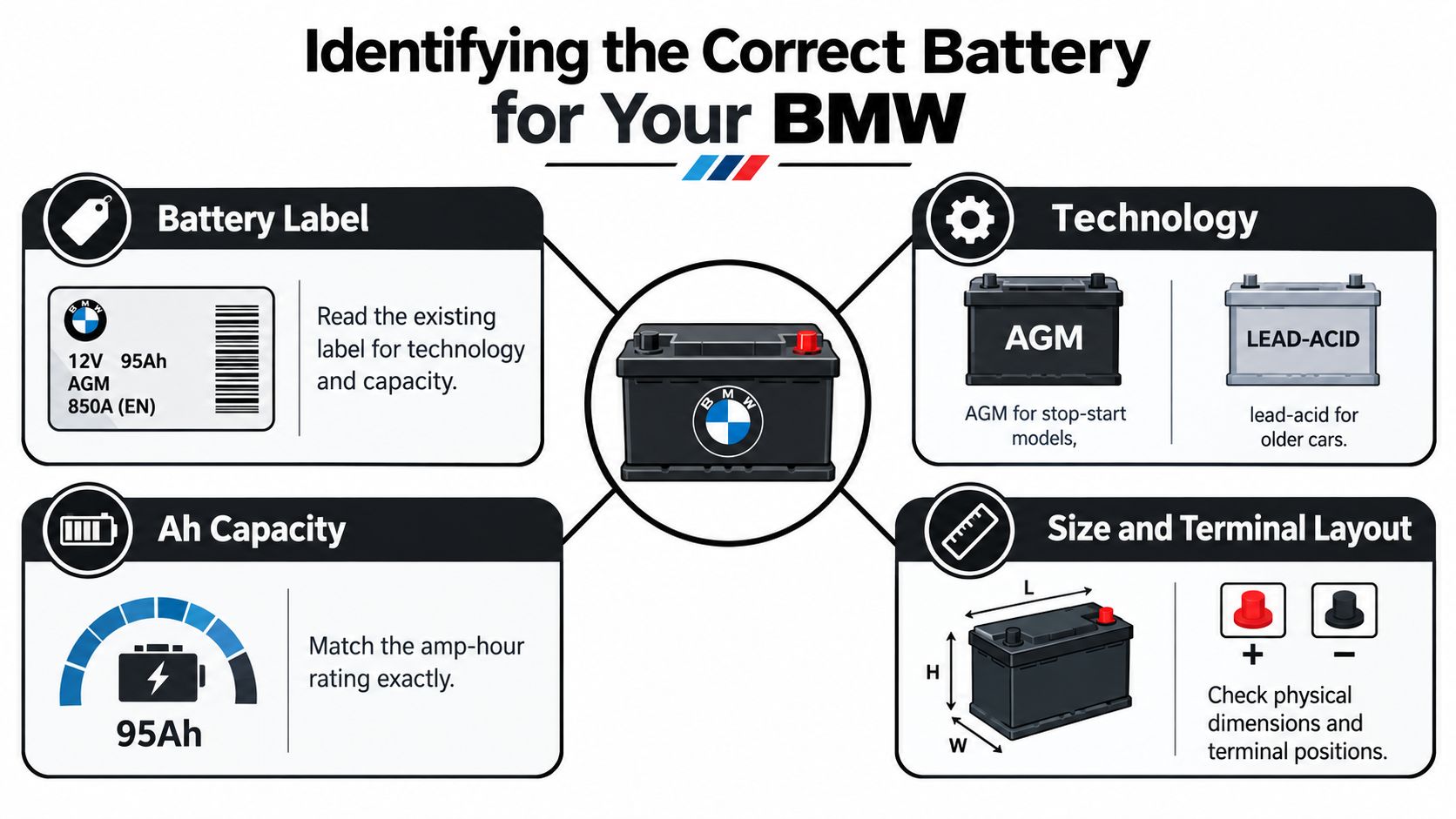
Don’t order a replacement solely because a seller lists your BMW model. Establish the required specification, then check that the proposed battery matches it. The existing label is a useful starting point, although it shouldn’t override vehicle-specific information if a previous owner fitted the wrong battery.
Record the battery technology, its amp-hour capacity, and its cold-cranking rating. Also check the physical dimensions, terminal positions and retaining arrangement. A battery can look broadly suitable while still being wrong for the tray or the vehicle’s charging configuration.
Separate technology from capacity
AGM, EFB and conventional flooded batteries aren’t interchangeable buying labels. AGM is itself a lead-acid technology, so a listing that merely says “lead-acid” doesn’t establish whether it meets an AGM requirement.
Installing a cheaper conventional flooded battery where AGM is specified is a poor saving, particularly on a BMW with stop-start, substantial electrical loads or energy recuperation. The vehicle needs the appropriate technology, not just something that fits and starts the engine.
| Label or fitment detail | What to establish before ordering |
|---|---|
| Battery technology | Whether the vehicle requires AGM, EFB or a conventional flooded battery |
| Ah capacity | The specified capacity and any approved alternative |
| Cold-cranking rating | Whether the replacement meets the starting requirement |
| Case and terminals | Correct dimensions, terminal layout and secure mounting |
For a broader buying checklist, CARLOCK’s guide can help you find the right battery for your car. Use it alongside the BMW-specific fitment information, rather than treating a general buying guide as vehicle approval.
Inspect before committing to a purchase
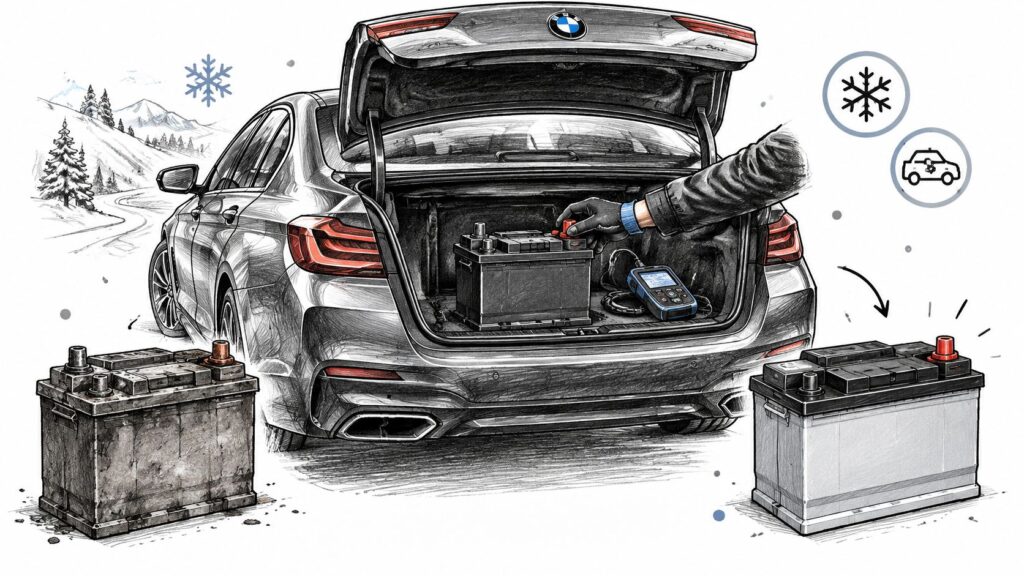
On many BMWs, you’ll find the battery in the boot. Check the terminals, earth straps, positive safety terminal and Intelligent Battery Sensor, usually shortened to IBS, for corrosion or damage.
Have a conductance test performed after the battery has rested, followed by charging-system checks with the engine running and electrical loads applied. This vehicle-specific workflow, including matching technology and capacity, is addressed in BMW battery technology and replacement guidance.
Leave this stage with a written specification, not a guess. It should identify the required technology, capacity, starting rating and physical fitment. That makes comparisons between a retailer, independent specialist and dealer much more meaningful.
New Battery Versus Recycled Green Parts
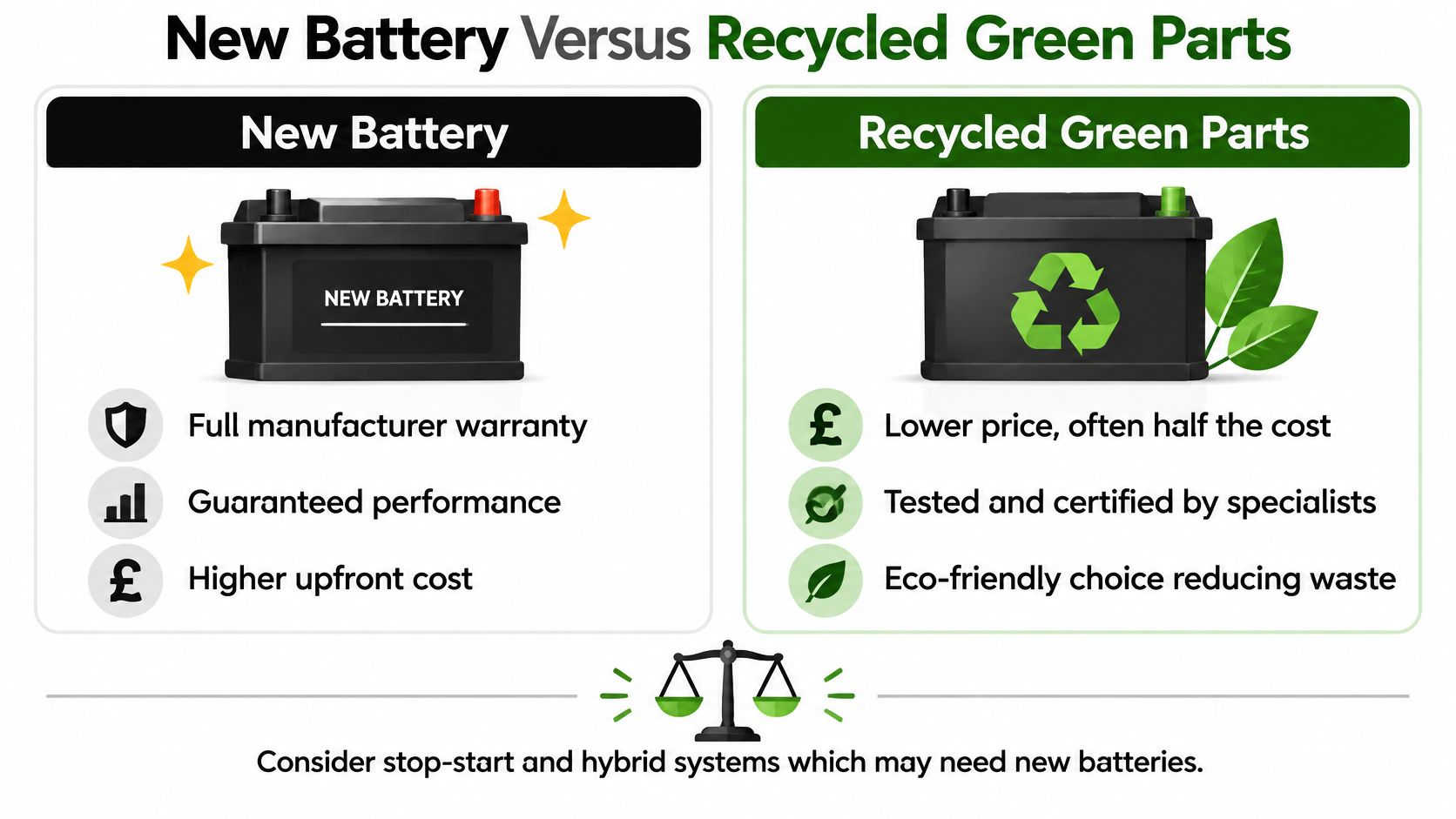
A new battery buys you a fresh starting point. A tested used battery offers a lower-cost route, provided its condition and specification are suitable. Neither option excuses skipping diagnosis or fitting the wrong technology.
Modern BMW battery requirements can make replacement expensive, particularly where stop-start or hybrid systems influence the specification. A second-hand battery may cost a fraction of a new equivalent, but there’s no honest universal saving: compare actual quotations for matching batteries.
Compare evidence rather than labels
| Buying consideration | New battery | Tested recycled battery |
|---|---|---|
| Previous service | No previous vehicle use | Previous use needs considering |
| Condition evidence | Check the supplied specification and warranty terms | Request the actual test result and available history |
| Purchase cost | Usually the higher upfront commitment | Potentially a substantially cheaper option |
| Ownership plans | A sensible preference for long-term ownership | Worth considering for a budget-sensitive repair |
| Environmental choice | A newly manufactured replacement | Reuses an existing serviceable component |
A healthy battery doesn’t become unusable just because its donor car has reached the end of its life. If the vehicle was scrapped because of an unrelated mechanical fault or damage, its battery may remain suitable for reuse after proper assessment. That’s the practical basis of supplying it as a green part, rather than sending a usable component straight for material recovery.
Explore the available recycled green car parts, then ask what testing supports the particular battery being offered. A useful test assesses its present condition, but it can’t guarantee exactly how much service remains.
Buy a used battery on its specification and test evidence, not on the fact that the donor car started.
Choose around the car’s future
For a BMW you intend to keep for many years, I’d favour a new, correctly specified battery if the budget allows. The same preference makes sense when electrical demands are high and you want to reduce uncertainty about previous use.
For an older car needing an economical repair, a suitable tested recycled battery can be a reasonable choice. Ask about returns, any warranty offered and whether installation and diagnostic work are included.
Don’t assume a stop-start BMW must always receive a new battery, or that a recycled unit is automatically suitable. Condition and correct specification come first. This comparison concerns the conventional starter battery, not buying or installing a used high-voltage traction pack.
Safe Battery Removal From Your BMW
These instructions concern a conventional starter battery only. Confirm the model-specific procedure before beginning, and don’t apply this sequence to a hybrid or electric vehicle’s high-voltage system. If you can’t confidently identify the battery and its connections, stop and use a professional.
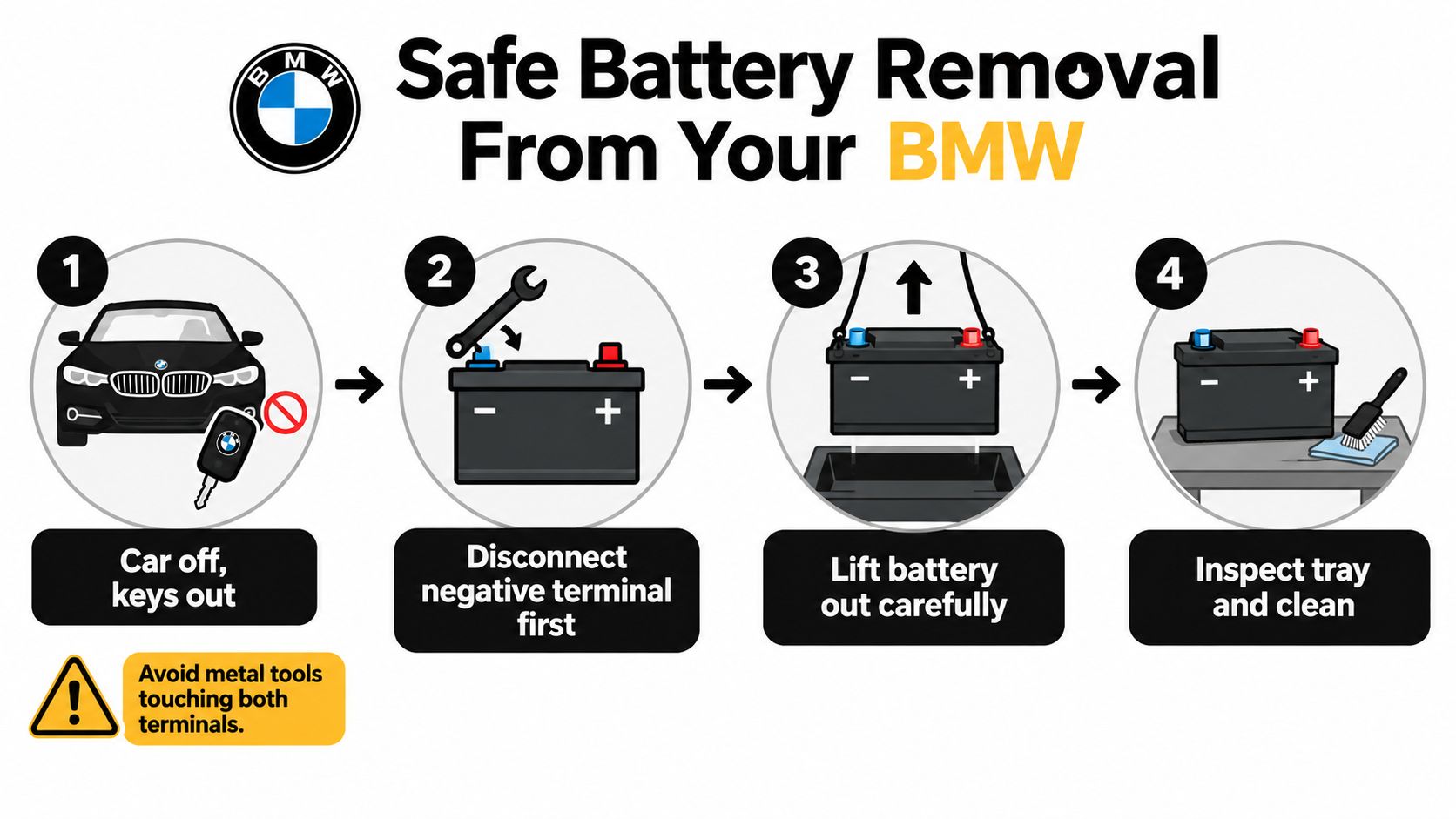
Switch the vehicle off, remove the keys from the ignition and secure the car. Open the boot before disconnecting power, since that’s where many BMW batteries are located. Arrange clear access and a suitable place to put the battery before releasing anything.
Disconnect in the correct order
Disconnect the negative terminal first, then the positive terminal. Keep disconnected connections from accidentally returning to their posts while you work.
Removing the negative connection first reduces the risk of creating a short circuit between the positive terminal and the vehicle body with a tool. It doesn’t make careless tool placement safe, so keep metal tools clear of both terminals together.
Release the retaining hardware only after the electrical connections have been dealt with correctly. The clamp bolts may need a socket extension, and awkward access is a reason to improve your working position rather than force the tool.
Safety boundary: If the casing is damaged or leaking, stop treating the job as a routine battery change.
Lift and contain it properly
A BMW battery can be heavy. Arrange a stable lifting position, keep it upright and get help if you can’t lift it safely from the tray without straining your back.
- Check the casing: Look for damage before moving the battery.
- Protect the work area: Keep the battery on a suitable impermeable surface, not directly on vulnerable flooring.
- Plan the handover: Arrange an appropriate recycling route rather than leaving the removed battery loose in the car.
UK battery treatment requirements include suitable impermeable surfaces, weatherproof covering or containers, and removal of fluids and acids during treatment under the Waste Batteries and Accumulators Regulations. A leaking battery should never be transported casually in a passenger compartment.
When fitting the replacement, secure it correctly and reconnect in reverse terminal order: positive first, negative last. Leave the IBS connection undisturbed unless the relevant repair procedure specifically requires otherwise. The physical work should finish with the battery firmly retained and the connections checked, not merely with the engine starting.
Battery Registration and Coding Explained
Registration and coding are different jobs. A quotation that uses those terms interchangeably deserves a follow-up question, because the work required depends on whether the replacement specification changes.
Registration records that a replacement battery has been installed. The vehicle’s energy-management system can then reset its battery-age and state-of-charge assumptions rather than continuing to manage it as the previous battery.
Coding, or configuration, changes the stored battery technology or capacity. A like-for-like replacement may need registration without recoding; changing technology or Ah capacity can require both.
Follow the specification decision
| Replacement situation | Diagnostic requirement |
|---|---|
| Same approved technology and capacity | Register the replacement where required |
| Different technology | Confirm suitability and configure the changed specification |
| Different Ah capacity | Check the approved configuration and code accordingly |
| Uncertain existing fitment | Establish the correct specification before making changes |
Specialist guidance states that nearly every BMW built since 2008 uses an AGM or EFB battery requiring registration after replacement, making model-year verification important rather than optional guesswork (BMW battery replacement and registration guidance). For an older car, don’t assume that age alone settles the question: confirm its equipment and diagnostic requirements.
The practical distinction is straightforward. Registration tells the vehicle that a replacement has arrived; coding tells it that the specification has changed. Neither process repairs a faulty connection or resolves an underlying drain.
What happens if registration is skipped
Failing to register a replacement generally won’t immediately immobilise the car. The more realistic concerns are unsuitable charging behaviour, unavailable stop-start, electrical warnings and premature deterioration of the replacement battery.
A BMW that starts after a battery swap hasn’t necessarily had its battery replacement completed correctly.
Use BMW-compatible diagnostic equipment with the appropriate battery service functions. Before paying for a tool or booking a garage, confirm it supports the required operation on your particular vehicle, rather than assuming any fault-code reader can perform it.
A recycled battery also deserves a discussion with the installer about its tested condition and the appropriate replacement procedure. Registration isn’t a way to turn a worn battery into a healthy one.
If the original battery tests acceptably, replacing and registering another unit may be the wrong next move. Where the fault keeps returning, spend the diagnostic effort on establishing why the vehicle loses charge. Correct registration completes a justified replacement; it isn’t a substitute for justifying that replacement first.
Disposal and Recycling Rules for BMW Batteries
A removed BMW starter battery isn’t ordinary scrap metal. Conventional automotive batteries are hazardous waste, and UK rules prohibit automotive and industrial battery disposal through landfill or incineration. They must go through an approved battery treatment operator or an approved battery exporter.
Lead-acid automotive batteries have an approximately 95% UK recycling rate, reflecting established routes for recovering their lead content, as outlined in UK battery disposal and recycling guidance. That recovery route depends on batteries reaching the appropriate facilities, not being placed in mixed scrap.
Separate starter batteries from traction packs
A conventional BMW, a mild-hybrid model and a fully electric BMW shouldn’t receive the same battery-handling advice. Identify the vehicle’s systems before arranging removal, recovery or dismantling.
| Battery situation | Appropriate response |
|---|---|
| Removed conventional starter battery | Arrange a suitable regulated battery recycling route |
| Damaged or leaking battery | Declare its condition and obtain handling advice |
| Hybrid or EV battery warning | Identify which system has reported the fault |
| Crash- or water-damaged electric vehicle | Request specialist recovery and assessment |
BMW’s high-voltage safety requirements are explicit: these batteries must not be opened or removed except in accordance with BMW guidelines, and high-voltage repairs must be performed by an authorised repairer. Those restrictions appear in the BMW vehicle warranty and roadside assistance handbook.
A battery fault in an i3, i4, i5 or i7 doesn’t automatically establish that the traction pack has failed. An electric BMW can still need a conventional low-voltage diagnosis, but that doesn’t make its high-voltage pack suitable for DIY investigation.
Declare the condition before collection
Tell the collector whether the vehicle is conventional, mild-hybrid, plug-in hybrid or fully electric. Declare accident damage, water exposure, leakage and any known battery warnings before anyone arrives to move it.
A non-running EV isn’t automatically electrically safe. Recovery and dismantling personnel need the correct model-specific isolation information and appropriate training, rather than an assumption that a silent car has no stored energy.
For a removed conventional battery, prevent terminal short-circuits and keep damaged or leaking units segregated. Store it upright on an impermeable surface with suitable weatherproof covering or containment, following the storage requirements noted above. Don’t place it in household waste, leave it in general scrap or conceal its condition from the receiving facility.
DIY Replacement Versus Professional Service
DIY replacement is reasonable only when you can complete the whole job safely, including the vehicle-specific diagnostic work. Being comfortable with a socket set doesn’t automatically mean you have the equipment to finish a BMW battery replacement.
The attraction is straightforward: you may save labour costs and choose your own supplier. The trade-off is responsibility for confirming fitment, handling a heavy battery, completing the required electronic procedure and arranging lawful disposal.
Choose the service around the problem
BMW UK directs owners towards a BMW Retail Centre for replacement battery installation. That route is worth considering when you want model-specific installation and a clear point of responsibility for the work.
An independent BMW specialist is another option. Judge the proposal by what the garage will test and complete, rather than assuming either a dealer or an independent automatically offers the right scope.
- Ask about diagnosis: Will the garage test the existing battery and investigate the reason for failure?
- Confirm the replacement: Which technology and capacity will it fit?
- Check diagnostic completion: Does the quotation include registration and any necessary configuration?
- Clarify the terms: What warranty covers the battery and installation, and what evidence will you receive?
If warranty coverage might apply, establish that before authorising work. Don’t assume that a high-voltage battery warranty also covers an ordinary starter-battery problem, or that every battery-related repair has identical terms.
Know when to hand it over
Repeated low-voltage faults, suspected parasitic drain, damaged connections or uncertainty around the IBS justify professional attention. So does a battery you can’t lift or access safely.
For an EV or hybrid, keep ordinary low-voltage checks separate from any high-voltage warning. Specialist isolation and recovery arrangements aren’t optional extras when the traction system may be involved.
The balanced choice is to DIY only when your confidence, workspace, tools and diagnostic access match the vehicle. Otherwise, pay for a properly diagnosed and completed job, not just the quickest battery swap.
Scrap A Vehicle offers used green parts and purchases non-running, damaged and end-of-life vehicles with free nationwide collection. If your BMW needs an economical replacement part or no longer makes sense to repair, visit Scrap A Vehicle to enquire about parts or request a vehicle valuation, declaring its battery type and any known damage.