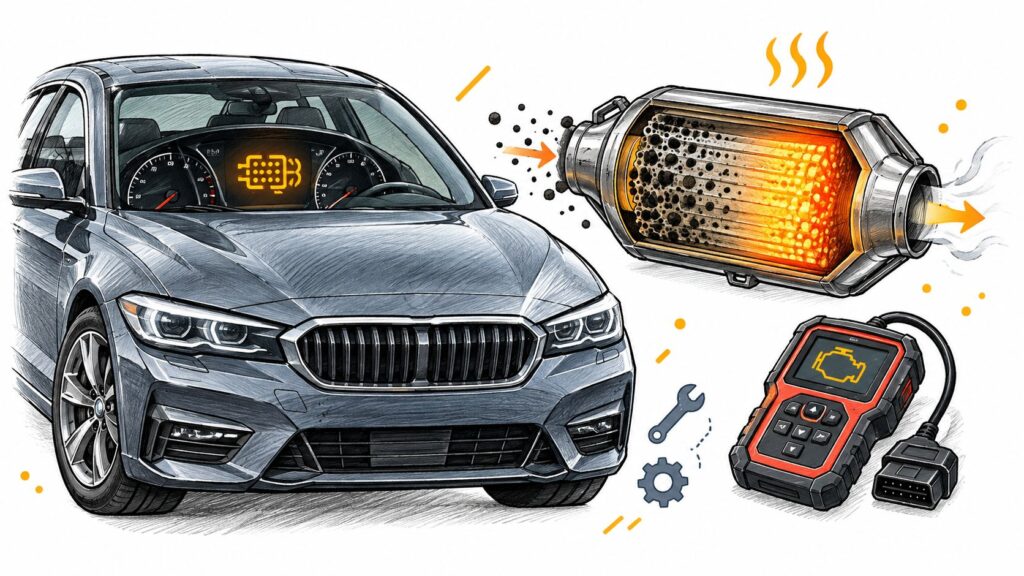
An amber exhaust symbol lights up halfway through a short trip. The car feels fine, so can you ignore it? Not for long. That DPF warning light may mean your diesel needs a proper run to clear trapped soot. Keep making the same short trips, though, and a manageable warning could become a repair bill bigger than the car’s value.
Table of Contents
- What a DPF Warning Light Means
- Common Causes Behind the Light
- What to Do the Moment the Light Appears
- How a Garage Diagnoses the Problem
- Repair, Cleaning or Replacement Compared
- When Scrap or Salvage Makes More Sense Than Repair
- Owner Checklist and Next Steps
What a DPF Warning Light Means
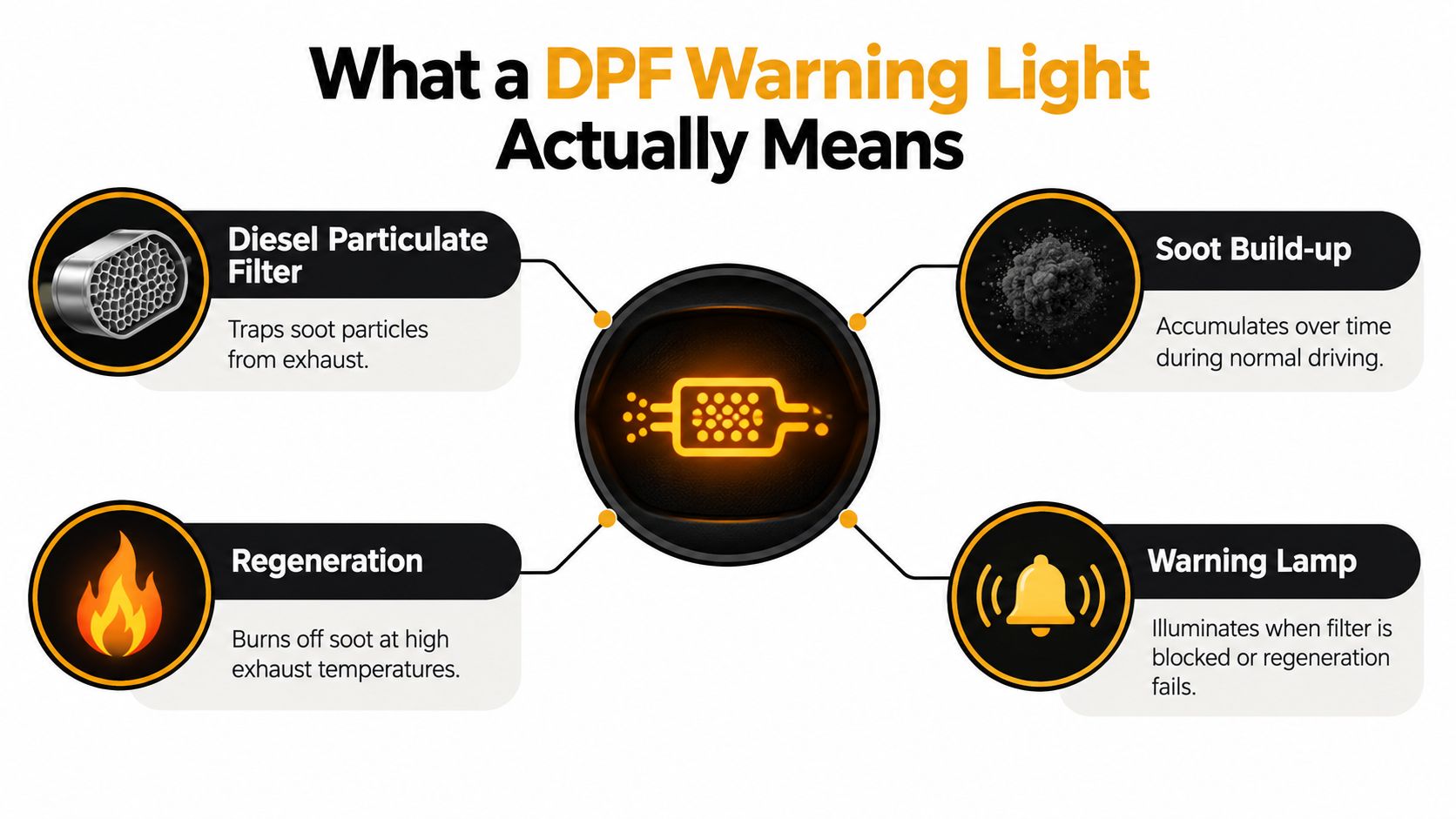
A diesel particulate filter sits in the exhaust and traps soot that would otherwise leave the tailpipe. It cannot hold soot forever, so the engine periodically burns the load off at high exhaust temperature. That burn is called regeneration, and the GOV.UK diesel particulate filter guidance describes it as turning trapped soot into gas at very high temperature, leaving only a small residue behind.
The lamp means that burn has not kept pace with what the engine is producing. It does not mean the filter has cracked, melted or failed. In workshop terms the light is a status report on soot loading, and the expensive question comes later: whether the fix costs more than the car is worth.
Passive and Active Regeneration
Passive regeneration happens during longer, hotter running, typically motorway or A-road work, when exhaust heat is already high enough to burn soot as it arrives. Active regeneration is managed by the engine control unit, which adjusts fuelling to push exhaust temperature up when sensors report the filter filling. Both need sustained heat to finish. Kill the engine mid-cycle and the soot stays put.
Read the colour first: amber usually means act soon and try the correct drive cycle. Red, a flashing lamp or other engine warnings alongside it mean this has moved past a routine prompt.
Why the Light Alone Doesn’t Settle the Bill
The same lamp covers cheap faults and expensive ones, and it gives no clue which you have. A filter that needs one forced regeneration and a filter that needs replacing sit at opposite ends of the invoice.
From the dismantler’s side, owners get the maths wrong. A diesel with a blocked filter still holds value, and so does the filter itself. The unit carries recoverable material even when the vehicle around it is finished, which is why yards still want it off the car. Get the fault priced before you write the vehicle off, and get the vehicle valued before you authorise the repair. The light starts a valuation. It is not a verdict.
Common Causes Behind the Light
The pattern seen most often on collected cars is mundane. A diesel bought for economy ends up doing school runs, supermarket trips and short commutes. The exhaust stays cool, regeneration starts late or gets interrupted, and soot accumulates until the dash complains.
The RAC explains that frequent short journeys and stop-start driving can prevent the exhaust becoming hot enough, causing soot to build and trigger the warning, in its RAC business guide to diesel particulate filters. On a car that’s otherwise running cleanly, that’s a usage problem, not yet a parts problem.
Faults Upstream of the Filter
When the light returns quickly after a proper run, look beyond the filter itself.
- EGR valve faults: a sticking valve changes exhaust gas flow and can stop regeneration conditions being met.
- Injector or turbo problems: poor combustion creates extra soot faster than the filter can clear it.
- Failed sensors: incorrect pressure or temperature readings can block, mis-time or falsely report a regeneration.
- Additive system faults: on cars using a fuel additive tank, an empty or contaminated supply can prevent the burn completing.
- Missed servicing: as cars age, owners skip maintenance, and small engine faults are left to load the filter.
That’s why a diagnostic check comes before a replacement quote. The root cause is often a simpler repair elsewhere, and fixing it lets the filter recover. Owners comparing regimes sometimes look at how emissions checks work overseas, such as a diesel smog test in Antioch, but the UK issue is the same physical one. The filter can’t compensate indefinitely for an engine producing too much soot.
Tampering and Tuning
Removal, delete kits and maps that write out DPF functions create a different category of trouble. The lamp may go out, but the car is left non-compliant for its MOT and the underlying hardware may be damaged. Yards see these cars when the next test, buyer or insurer asks questions the modification can’t answer.
A car can also light up shortly after routine work if a sensor is disturbed, a hose is left loose or an existing marginal fault is finally logged. Timing doesn’t prove the garage caused it. Fault codes and live data settle that argument faster than guesswork.
What to Do the Moment the Light Appears
Start with the handbook, not a generic internet recipe. Symbols, required road speed and engine speed vary by model, and some cars show a specific message telling you to keep driving. Confirm whether the warning is amber or red, and note whether any other lamp has joined it.
The Staged Regeneration Drive
If it’s amber only and the car drives normally, plan a sustained run rather than several short hops.
- Choose the right road: use a motorway or suitable A-road where you can hold a steady speed safely and legally.
- Hold temperature: RAC guidance describes approximately 10 to 15 minutes at a suitable road speed, commonly around 40 mph or above and approximately 2,500 rpm, in its RAC advice on diesel particulate filters.
- Give it longer if needed: the same guidance also describes a 30 to 50 minute steady run as useful for passive regeneration, provided the car remains comfortable at speed.
- Judge the result: a light that goes out and stays out suggests soot from short-trip use. A light that returns within days points back to an upstream fault.
Don’t rev the engine hard on the driveway, and don’t keep repeating motorway runs for weeks hoping for a different result. You’re trying to complete one controlled burn, not punish the car.
If power drops, the engine runs roughly or smoke becomes excessive, the regeneration drive has stopped being the right answer.
When to Stop and Book Diagnosis
Treat a red warning, limp mode, difficult starting, additional engine-management lights or a persistent amber light as escalation points. At that stage soot loading may be beyond what normal driving can remove, or another system may be preventing regeneration entirely. Continued driving can worsen the blockage and turn a workshop regeneration into cleaning or replacement.
There’s no universal success rate for the drive because regeneration strategy, soot loading, sensor calibration and exhaust design differ by vehicle. One attempt, done to handbook spec, gives you useful evidence. After that, you need data from the car rather than more miles on it.
How a Garage Diagnoses the Problem
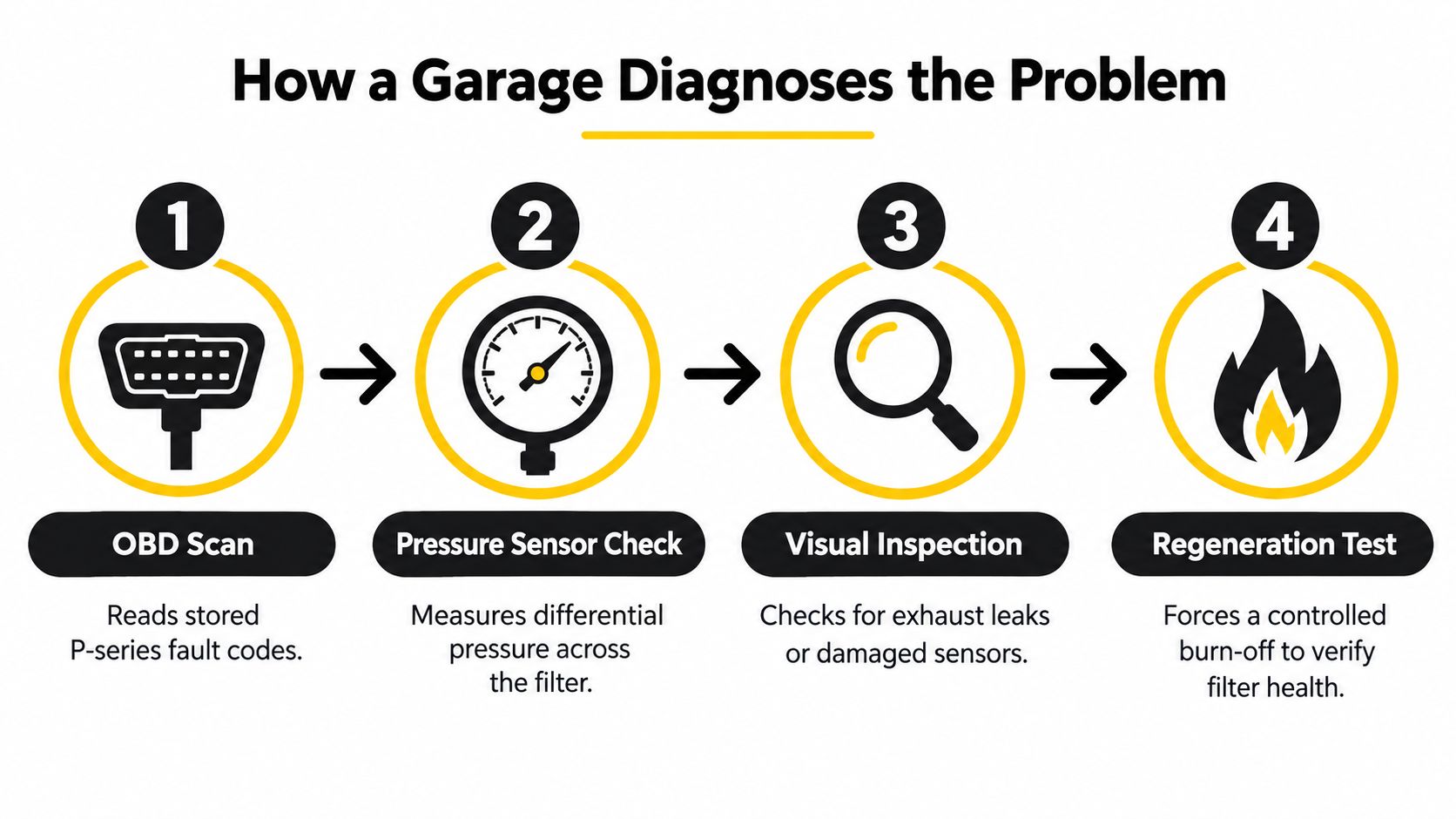
A competent garage doesn’t start by quoting a new filter. It starts by asking why regeneration failed, then proves whether the filter can still be recovered.
The sequence below shows the basic path from fault codes to a controlled test.
Codes, Live Data and Pressure Readings
First comes an OBD scan for stored fault codes covering pressure sensors, temperature sensors, EGR operation and failed regeneration attempts. Codes alone don’t finish the job, so the technician checks live data, especially differential pressure across the filter. That reading indicates how restricted the filter is and whether a forced regeneration is safe to attempt.
Sensor plausibility matters just as much. A split pressure hose or drifting sensor can make a serviceable filter look blocked. For owners facing power loss alongside the lamp, these DPF derate troubleshooting tips cover useful preparation before a diagnostic visit, including noting when the derate occurs.
The short video below gives a useful visual sense of what technicians are checking before they condemn a unit.
Forced Regeneration and Ash
A workshop-controlled regeneration uses diagnostic equipment to run a controlled burn while temperatures and pressures are monitored. It can clear soot, but it can’t burn off ash, the residue that accumulates over the filter’s life. That’s why an older filter can fail assessment even when soot is manageable.
Before authorising work, ask for the fault codes, the differential pressure reading, the reported soot loading and the reason regeneration was blocked. If a garage can’t show that evidence, you’re being asked to buy a conclusion it hasn’t demonstrated.
Repair, Cleaning or Replacement Compared
Once diagnosis is in hand, you’ve got three realistic routes, plus one shortcut that creates legal trouble. UK consumer guidance describes potential repair bills of roughly £750 to £3,000 for a clogged filter, a figure noted in the RAC guidance on diesel particulate filter costs and regeneration. From the dismantling side, a brand-new unit can range from £1,000 to £4,000 before you consider fitting time on some models.
DPF Repair Options at a Glance
| Option | Typical Cost | Best For |
|---|---|---|
| Forced regeneration | Lowest workshop option | Soot loading only, root cause fixed |
| Professional cleaning | Below new replacement | Blocked but undamaged filter, moderate ash |
| Used green-parts DPF | A fraction of new price | Compatible, verified unit from a dismantled car |
| New replacement | £1,000 to £4,000 for the unit | Cracked, melted or heavily ashed filter on a valuable car |
Chemical or ultrasonic cleaning can restore flow, but it isn’t a guaranteed fix on a heavily ashed or physically damaged unit. Ask how the cleaner tests flow before and after, and what happens if the substrate is found cracked once it’s off the car.
A used DPF is hugely cheaper than new, though it still costs more than ordinary exhaust parts because the catalyst metals inside hold value. It must match your exact application, have an intact substrate and come from a traceable donor vehicle. A cheap, unverified unit of unknown loading just moves the problem.
The Delete Trap
Removal may clear the dash, but it doesn’t make the car compliant. GOV.UK reported that from 20 May 2018, visible smoke of any colour from a DPF-equipped diesel and evidence of tampering became a major fault, and 238,971 diesel cars failed the revised emissions test between 20 May and 19 November 2018 compared with 58,004 in the equivalent 2017 period, in its GOV.UK announcement on new MOT standards.
Match the option to the car. Low mileage and good value justify proper repair. High mileage, repeated warnings and a quote approaching the car’s worth point elsewhere.
When Scrap or Salvage Makes More Sense Than Repair
Scrapping isn’t surrender. It’s arithmetic. If a new filter plus labour, diagnosis and the upstream fault that caused the blockage outweighs what the car is worth, replacement rarely makes sense, however attached you are to it.
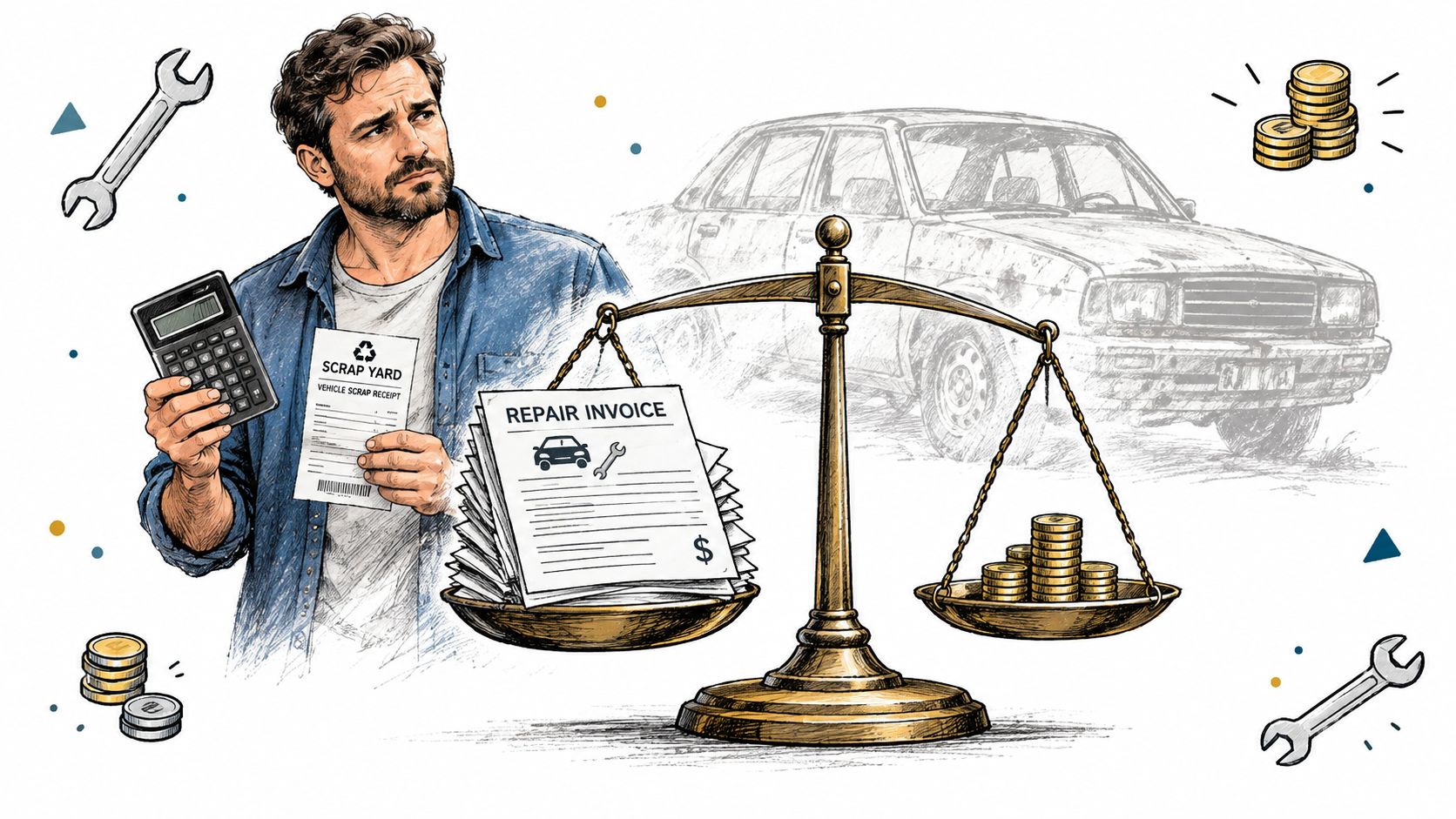
DPF problems have become one of the biggest reasons older diesels arrive as uneconomical repairs. Maintenance gets missed as values fall, blockages become expensive, and eventually the filter costs more than the vehicle around it. If your car has already failed its MOT on emissions, that repair-versus-value test becomes urgent rather than theoretical.
Why Yards Still Want a Blocked Filter
A dead filter isn’t worthless. DPFs are built with platinum and palladium catalysts, which means a blocked filter can still hold meaningful scrap value through specialist precious-metal recovery, even when it can’t be reused, as explained in the Scrap Car Network guide to DPF replacement versus scrap. Recoverable value depends on make, part number, catalyst loading, condition and current metal prices, so don’t assume a fixed sum.
Separate the two values: repair value is what the filter is worth back on a compliant car. Recycling value is what its catalyst is worth when repair no longer stacks up.
Through a licensed Authorised Treatment Facility route, Scrap A Vehicle provides online valuation, free nationwide collection, bank payment on collection and a DVLA Certificate of Destruction. Salvage buyers will also take non-runners and MOT failures that private buyers avoid, which matters when the car can’t legally or safely be driven to viewings.
Get the repair quote in writing, get a scrap or salvage valuation, then compare both against realistic market value after repair. The right answer is whichever number survives that comparison.
Owner Checklist and Next Steps
An amber light on a car you drive daily is a scheduling problem. A red or flashing one is a stop-driving problem. Work through this sequence in order, and don’t skip the evidence steps.
- Confirm the colour: amber means act promptly, red or flashing means get diagnosis and avoid unnecessary driving.
- Try one proper drive: follow the handbook for speed, engine speed and duration on a motorway or A-road.
- Book diagnosis if it stays: ask for fault codes, differential pressure and the reason regeneration failed.
- Check MOT timing: a test due soon changes how much time you have to experiment.
- Put three numbers on paper: total repair cost including the root cause, realistic market value after repair, and a scrap or salvage valuation.
- Keep the scrap route open: if the numbers fail, salvage or ATF disposal is a rational outcome, not a last resort.
The Legal Line You Can’t Cross
As noted earlier, GOV.UK guidance confirms that, since February 2014, the MOT exhaust inspection has included checking that a DPF is present on vehicles originally fitted with one, and a missing filter is an automatic MOT failure. Removal is not a compliant shortcut for a road car, whatever the forums suggest.
Don’t let the warning light make the decision for you. Check how urgent it is, find out why regeneration failed, then compare the full repair quote with what the car would be worth afterwards. If repair makes sense, act before the blockage worsens. If it doesn’t, you still have a way forward.
When the repair costs more than the car is worth, find out what your diesel is worth as salvage. Enter your registration and postcode for an instant quote from Scrap A Vehicle. If you accept, you can arrange free nationwide collection, bank payment on collection and the correct DVLA paperwork, including a Certificate of Destruction where the car is scrapped.