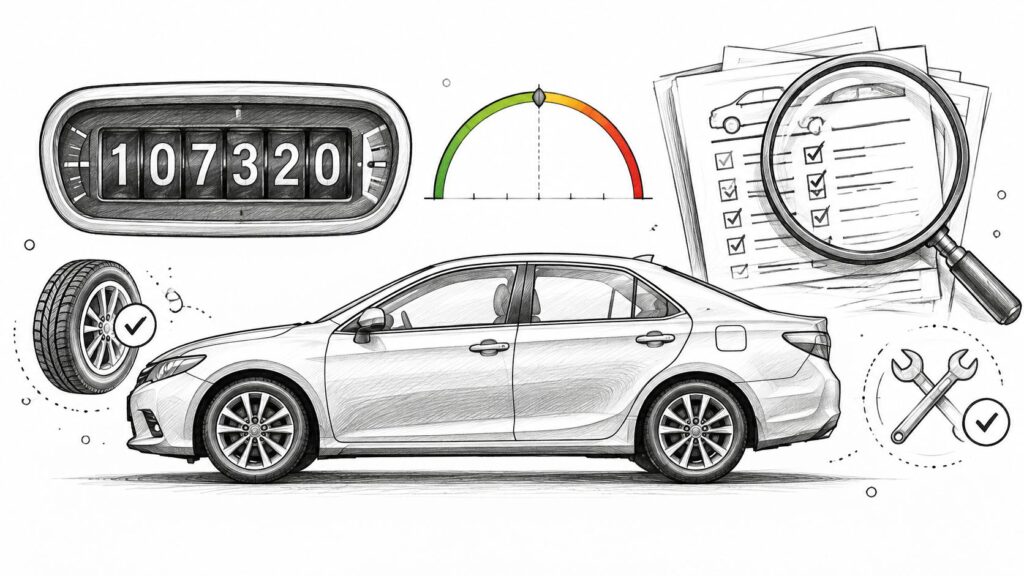
A car can look tidy, start cleanly and still carry a history that changes what it’s worth. The number on the dashboard is often where that judgement starts, but it’s rarely where it should finish. Miles on a car tell you how much work the vehicle has done, not how carefully that work was looked after, how the miles were driven, or whether the record itself can be trusted.
That distinction matters whether you’re buying, keeping or disposing of a car. Read the odometer alongside age, fuel type, MOT evidence and service history, and it becomes a useful measure of exposure and risk. Read it alone, and you can reject a sound car or pay too much for one that’s been left standing.
Table of Contents
- Why Miles on a Car Still Matter
- How Mileage Shapes Value and Reliability
- Reading Mileage Against Age and Fuel Type
- When High Mileage Still Makes Sense
- Checking True Mileage and Spotting Odometer Fraud
- Comparing Selling, Repairing and Scrapping Options
- Choosing Your Next Step With an Older Car
Why Miles on a Car Still Matter
UK cars are being driven less each year than they once were, which changes what counts as a high reading. Department for Transport historical statistics on vehicles show average annual mileage for four wheeled cars fell from approximately 9,700 miles in 1995 to 1997 to 8,430 miles in 2010, a reduction of about 1,270 miles per car per year, or roughly 13%. That long decline means you shouldn’t judge today’s odometer against habits from a generation ago.
The pattern has continued in more recent data. National Travel Survey mileage data by car age and fuel type underpin summaries showing about 7,100 miles per year for all cars in 2024, compared with roughly 9,100 miles in 2004, a fall of around 2,000 miles, or approximately 22%. A reading that looks modest today may therefore represent normal, steady use rather than an unusually sheltered life.
A familiar buying decision
Two cars of the same age sit side by side. One shows lower mileage but has gaps in its servicing and a patchy MOT record. The other has covered more ground, yet its invoices, test readings and annual increases line up consistently.
Many buyers instinctively favour the first car. An assessor is more likely to start with the second, because a credible history makes the higher figure easier to interpret. The odometer has done its job by raising the question, but the paperwork determines whether the answer is reassuring.
Practical rule: Treat mileage as a prompt to investigate, not as a verdict on condition.
Mileage still matters because every mile adds operating exposure. Engines complete more heat cycles, transmissions shift more often, brakes and suspension absorb more load, and emissions equipment spends more time working. Those effects don’t arrive at one fixed point, and they don’t affect every model equally.
Lower average annual use also doesn’t mean cars are necessarily retired earlier. Owners may keep a vehicle for more years while adding miles slowly, until age related deterioration, an MOT failure or an uneconomic repair changes the decision. That’s why resale, salvage and scrap assessments place mileage beside condition and maintenance rather than using it as a solitary cutoff.
How Mileage Shapes Value and Reliability
Mileage is one indicator of wear, not a countdown to failure. Distance usually means more use across the engine, gearbox, suspension, steering, brakes and emissions systems. The odometer cannot show how hard those parts worked, whether fluids were changed on schedule, or whether the car mostly made steady motorway journeys or short trips from cold.
The flowchart shows how recorded distance can relate to wear, maintenance needs and value.
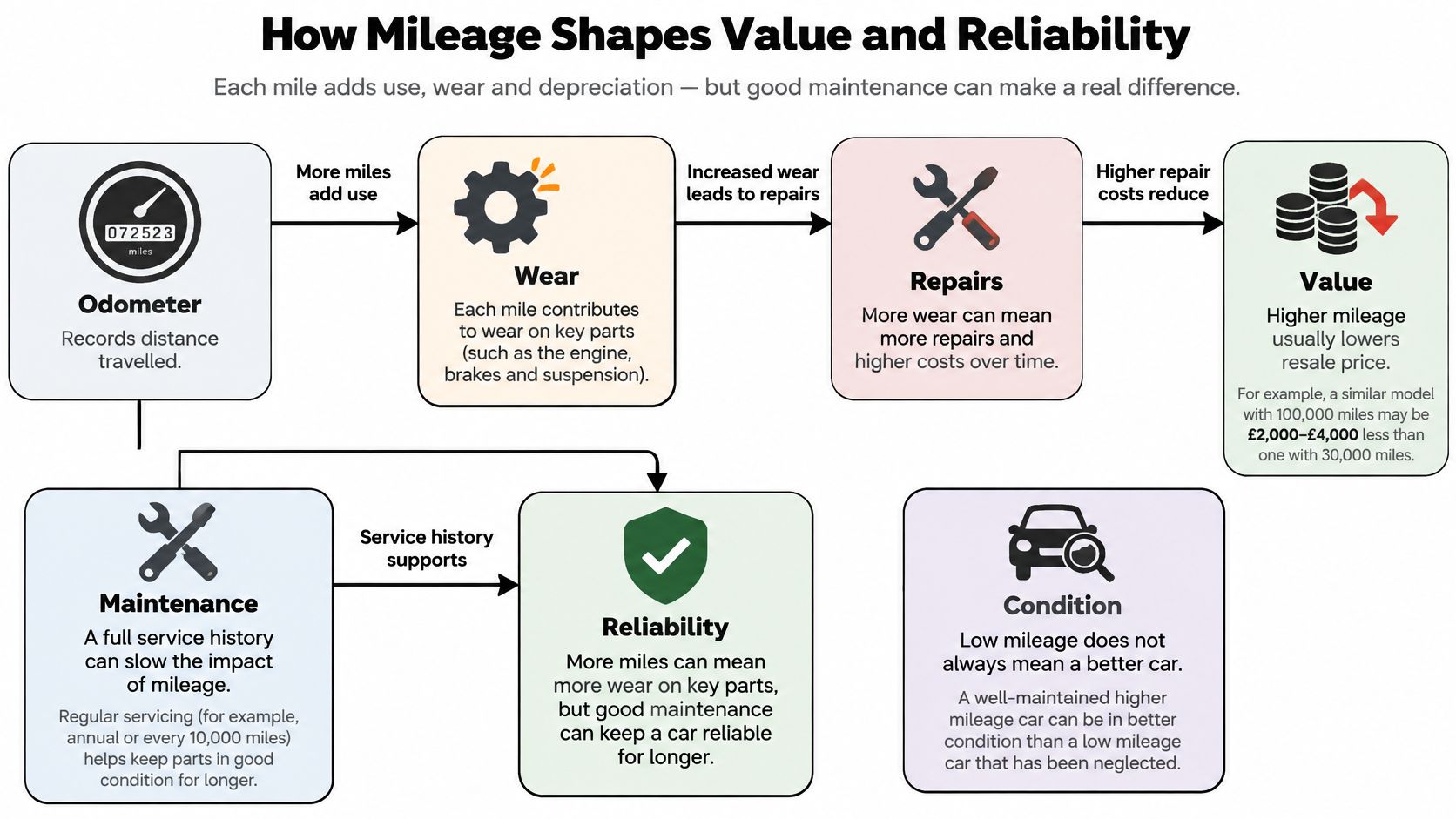
For a roadworthy or repairable car, higher mileage can reduce buyer confidence because the next owner may face major maintenance sooner. The impact depends on the car’s age, powertrain, MOT history and repair exposure, as well as its service records. If a repair estimate approaches or exceeds the car’s market value, compare the cost with the likely value after repair before deciding.
Why scrap value follows a different logic
An end-of-life car is assessed on recoverable parts and materials, not mileage alone. Scrap A Vehicle prices cars by parts, including the engine, gearbox, panels and catalytic converter, rather than just weight. Mileage may affect whether components have resale value, while the condition of those parts and the shell also shapes an offer.
For a car with some roadworthy value, checking what you could sell your car for can help you compare selling with repair or scrapping. The Brill Motors Vitz pricing guide offers a model-specific pricing comparison from another market, though its figures should not be treated as UK valuations.
The video below shows how accumulated use affects the systems buyers inspect.
A high odometer reading can still sit alongside a sound car with consistent maintenance records. A lower reading does not cancel out a failed engine, serious corrosion or missing documentation. Judge the mileage against the vehicle’s history and condition, then compare repair costs with its likely value.
Reading Mileage Against Age and Fuel Type
A mileage figure only becomes useful when you compare it with what’s normal for that type of car. UK average car age and mileage statistics summarise National Travel Survey data for 2024 at approximately 7,100 miles per car overall, 6,200 miles for petrol cars, 8,300 miles for diesel cars and 8,900 miles for battery electric vehicles. On that basis, the same total can be average for one powertrain and comparatively light use for another.
| Category | Average annual mileage (2024) |
|---|---|
| All cars | 7,100 miles |
| Petrol cars | 6,200 miles |
| Diesel cars | 8,300 miles |
| Battery electric vehicles | 8,900 miles |
Use the table as a sense check, not as a grading system. A five year old petrol car with mileage near the petrol average has lived a typical life. The same total on a diesel or electric car suggests lighter annual use, which may support value if the condition and records agree.
Age changes the pattern
Newer cars generally cover more miles each year, then usage tends to ease as vehicles age and move into second car or local duty. That’s why dividing total mileage by age gives only a rough annual average. A car may have done heavy commuting early and very little later, or changed owners and usage patterns several times.
Check the year by year pattern where you can. Steady increases usually look more credible than long flat periods followed by sudden jumps, although a change of keeper or working pattern can explain either. You’re looking for a story that matches the invoices and MOT dates, not for perfectly even numbers.
When low mileage needs scrutiny
Unusually low mileage isn’t automatically good news. Cars used infrequently can suffer from:
- Battery discharge: Repeated deep discharge shortens battery life and can leave electrical faults.
- Brake corrosion: Discs, calipers and handbrake mechanisms deteriorate when they sit unused.
- Tyre ageing: Rubber hardens and cracks with age even when tread remains deep.
- Seized components and degraded fluids: Lack of movement and old fluids can create problems that mileage alone won’t reveal.
A low figure without documentation tells you less than a higher figure supported by regular maintenance.
That doesn’t make a lightly used car a poor buy. It means you should price in recommissioning work and verify why the car was used so little. For end of life decisions, the same caution applies in reverse. A complete high mileage car may retain component value, while a lower mileage car with accident damage, corrosion or missing history may be worth mainly its recoverable parts and regulated recycling.
When High Mileage Still Makes Sense
The idea that a car is finished once it passes a round number doesn’t match the UK fleet. RAC reporting on cars exceeding 100,000 miles cites DVSA derived 2025 MOT data identifying more than 4.3 million cars with at least 100,000 miles, over 1.2 million between 150,000 and 199,000 miles, 286,630 between 200,000 and 249,000 miles and 2,699 above 500,000 miles, alongside an average licensed car age of 10 years at the end of 2025, average annual mileage of 6,727 miles in 2025 and 3,860 miles annually for cars aged 20 or more. High mileage is now a normal condition of ownership, not an exception.
In assessment work, the point at which a car becomes uneconomic varies greatly by make, model and engine, and by how well it’s been maintained. Some cars commonly fail around the point many buyers treat as a cutoff, while others continue far beyond it. The model specific weak points matter more than the headline figure.
Two contrasting cars
Consider a high mileage car with continuous MOT readings, dated invoices and advisories that were dealt with promptly. Its suspension, brakes and emissions equipment have been maintained as wear appeared. You can estimate its remaining risk with some confidence because the evidence is visible.
Now consider a lower mileage car that spent long periods unused, missed services and returns with corroded brakes, old tyres and repeated electrical problems. Its odometer looks kinder, but your immediate repair exposure may be higher. The first car can represent better value despite having travelled further.
Age related MOT patterns explain why evidence matters so much. Analysis of consecutive MOT odometer readings and pass rates gives average annual mileage of about 8,081 miles for three year old cars, 7,183 miles at ages eight to ten, 6,439 at eleven to fourteen and 5,567 at fifteen to nineteen, while first time pass rates fall from 89.5% at the first test to 58.0% for vehicles aged fifteen to nineteen. Mileage alone doesn’t cause that decline, but older cars accumulate both distance and deterioration.
Electric cars need the same nuanced approach. Reporting on the 2025 Battery Performance Index describes more than 8,000 electric cars and vans across 36 brands, from new to 12 years old and up to more than 160,000 miles, with average battery State of Health of 95.15%, a median of about 85% at eight to nine years, and high mileage vehicles above 100,000 miles often recording 88% to 95%. For an EV, measured battery health, charging behaviour, warranty position and accident damage tell you more than distance alone.
Checking True Mileage and Spotting Odometer Fraud
Start with the official record before you form a view on price. Guidance on checking odometer rollback against MOT records explains that MOT mileage records for vehicles tested in England, Scotland and Wales are available free through GOV.UK from 2005 onward, Northern Ireland is administered separately by the Driver and Vehicle Agency, and 2.27% of checked UK cars in the cited 2025 European Market Transparency Index showed signs of clocked mileage. Verification is therefore a practical safeguard, not an accusation.
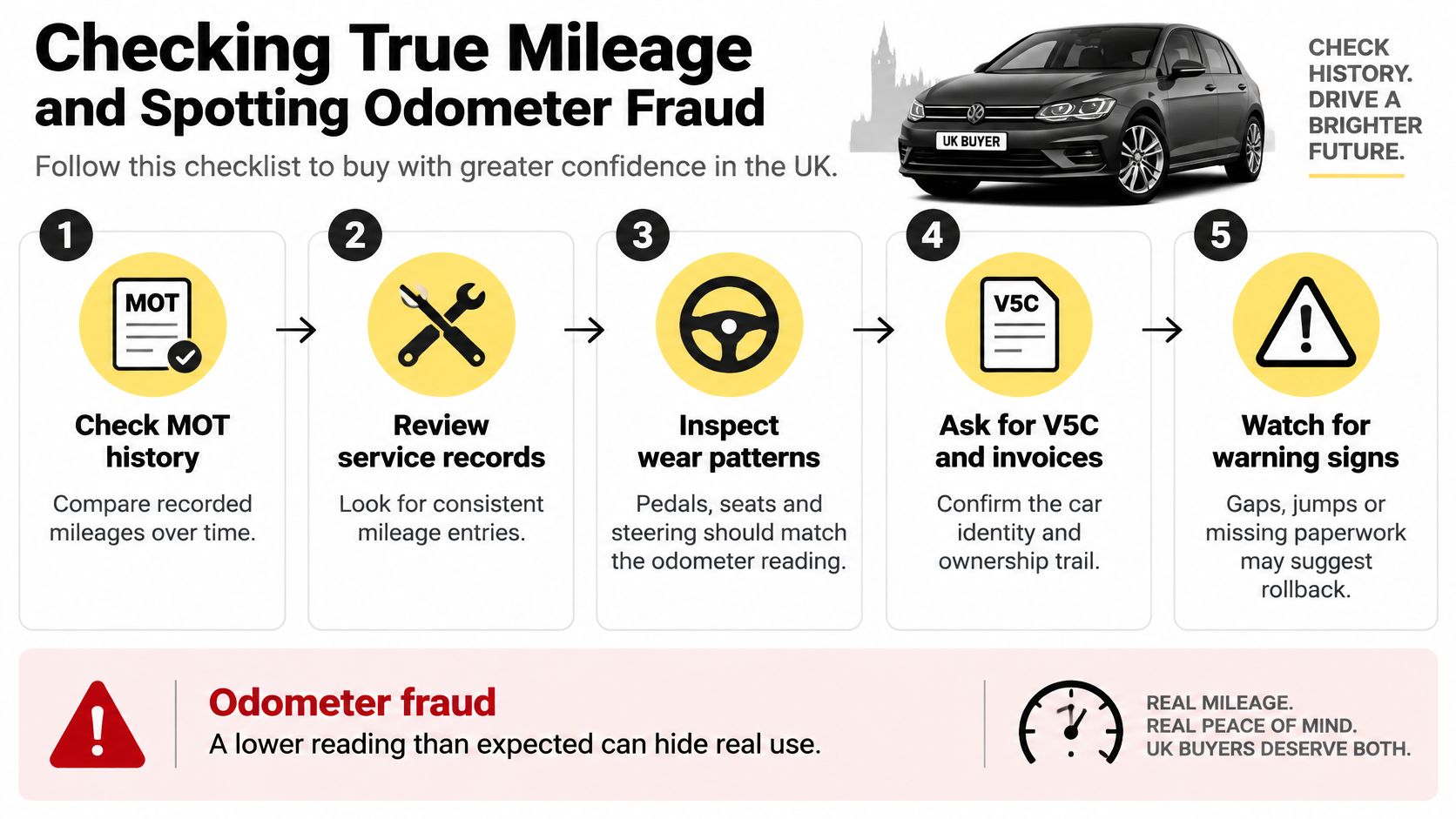
The checklist below summarises the order in which to work through the evidence.
A clear checking sequence
- Open the MOT history first: List every recorded reading in date order and compare the latest one with the dashboard today.
- Calculate the gaps: Look at how many miles were added between tests and whether that pattern fits the seller’s account of use.
- Match the service invoices: Dated garage paperwork should show readings that sit sensibly between MOT entries.
- Inspect wear against the claim: Pedal rubbers, steering wheel, driver’s seat bolster and gear lever should look consistent with the stated distance.
- Ask for identity documents: Check the V5C details against the car and keep the ownership trail with the invoices.
A reading that decreases between two MOT tests is a direct warning sign. It can indicate rollback or a replaced instrument cluster, and either explanation needs documentation before you proceed. Remember the limit of the record. A database can reveal inconsistencies within recorded testing history, but it can’t prove what happened before the first available entry.
Before you pay: If the seller can’t explain a falling or implausible reading with paperwork, pause the purchase and price the car as unverified.
Other signals are softer but still useful. Missing service history, long unexplained gaps between tests, mismatched tyres with inconsistent wear, or interior wear that looks far heavier than the claimed miles all justify further questions. None proves fraud on its own, and heavy town use can wear a cabin quickly, so weigh the whole picture calmly.
We see suspected rollback more often than many buyers realise, which is why a vehicle data check and a full review of previous MOT history on GOV.UK should always happen before purchase. If you’re selling, keep invoices in date order, record mileage at every service, and disclose cluster replacement or known discrepancies in writing. A transparent file protects your price because the buyer doesn’t have to discount for uncertainty.
Comparing Selling, Repairing and Scrapping Options
Once you know the true mileage, judge each route against the same criteria. Does the car run and drive safely. Is the MOT current, and what do recent advisories suggest. How does the repair estimate compare with realistic market value. How much value sits in reusable parts rather than in the car as transport.
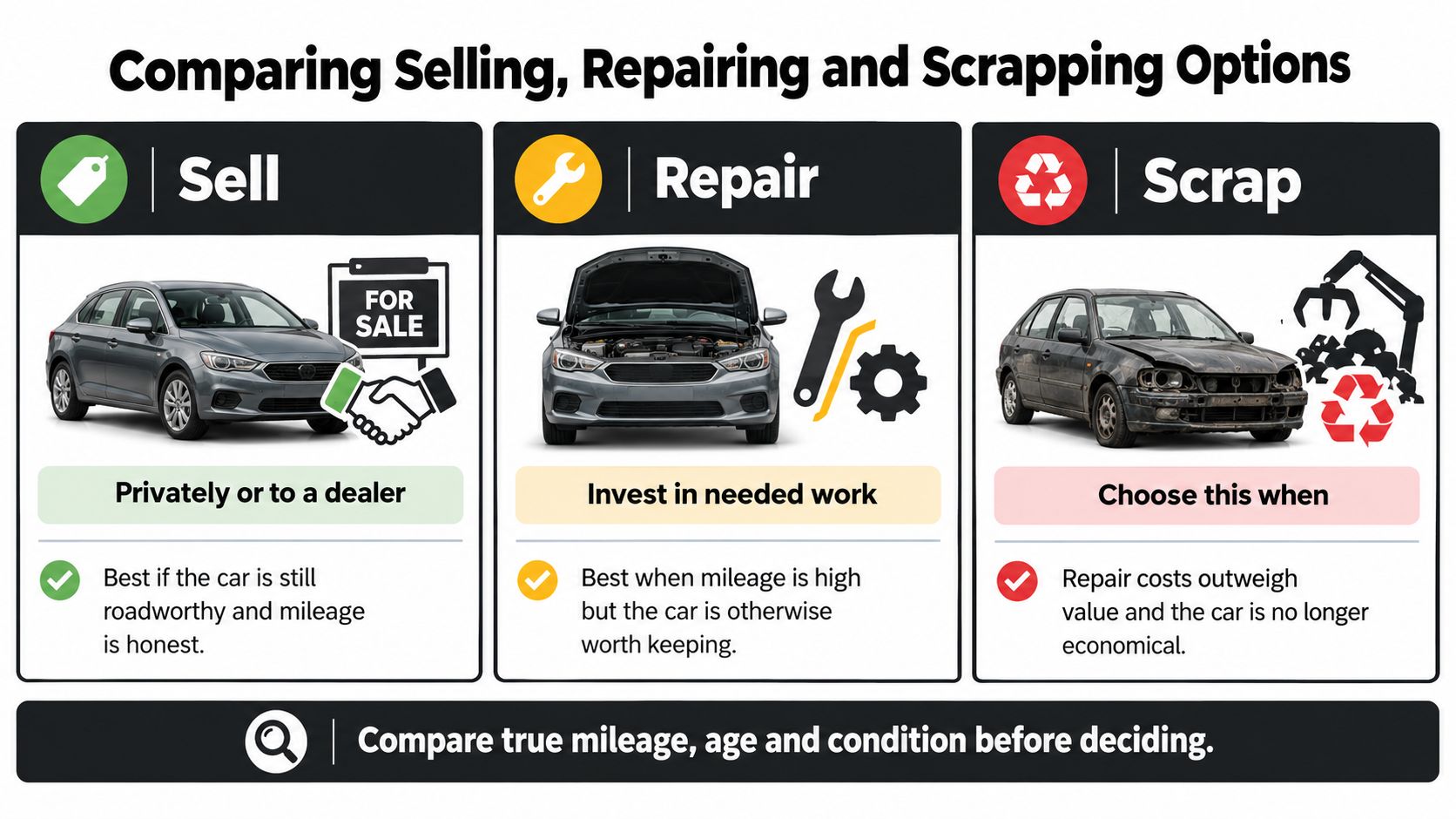
The comparison below puts the three main routes side by side.
Selling, repairing or scrapping
- Sell privately or to a dealer: This usually works best when the car is roadworthy, the mileage record is consistent and any faults are minor enough to disclose without destroying value. Documented high mileage can still sell well to a buyer who understands the model.
- Repair and keep it: This makes sense when the structure is sound, the history is known and the required work restores reliable use for a reasonable period. It makes less sense when one repair is likely to be followed by several others.
- Scrap or sell as salvage: This becomes the sensible route when the car doesn’t run, corrosion or accident damage is severe, or the repair bill outweighs what the finished car would be worth.
The range arriving for purchase or disposal is wide. Department for Transport National Travel Survey mileage tables sit behind 2024 averages of 7,100 miles overall, 6,200 miles for petrol cars and 8,300 miles for diesel cars, while separate analysis of approximately 17.4 million cars found average annual mileage for cars aged new to ten years fell from 11,381 miles at the beginning of 2014 to 9,654 miles by February 2024. In recent collections we’ve handled cars at both extremes of use, and mileage alone didn’t decide either valuation.
That’s because salvage and scrap are priced on different strengths. A repairable car depends on remaining mechanical life, so mileage has a big impact. A car sold primarily for recycling depends more on completeness, weight and component demand, so the odometer has much less effect.
Scrap A Vehicle is one UK option for end of life, damaged or non running cars, offering instant online valuations, free collection and certified recycling through licensed facilities. Wherever you enquire, describe damage, missing parts and non running faults accurately. An honest description gives you a firmer figure and avoids renegotiation when the car is inspected.
Choosing Your Next Step With an Older Car
Work through the decision in order. First verify the displayed mileage against MOT readings and service invoices. Then compare annual use with the car’s age and fuel type, review recent advisories, and obtain a realistic repair estimate before you decide what the car is worth to keep.
That sequence prevents the two common mistakes. You won’t scrap a documented high mileage car that still has saleable life in it, and you won’t spend heavily on a low mileage car whose storage damage or missing history makes further repairs hard to justify.
What an end of life valuation focuses on
For a damaged or non running car, expect the assessment to look beyond weight. We price cars on parts, not just weight, valuing the engine, gearbox, panels and catalytic converter, so good cars earn more. Completeness matters, which is why removing valuable components before collection usually reduces the final return.
Our process also asks about the car’s condition after the price is shown, not before, so you see the valuation first and then confirm the details. Describe the vehicle accurately at that stage, including accident damage, mechanical failure, missing parts and whether it starts. The driver can change the price on collection day only if there’s a material difference between what was described and the actual vehicle, and you’re under no obligation to proceed if you’re unhappy with any adjustment.
Check the record first, then choose the route that matches the car’s evidence, not its dashboard alone.
Your concrete next step is simple. Pull up the MOT history, gather the service file, note the current reading, and request an instant valuation using the registration and postcode. With those facts in hand, selling, repairing or scrapping becomes a measured decision rather than a guess based on miles on a car.
If your checks show that repair no longer makes economic sense, Scrap A Vehicle can value your car on its usable parts as well as its weight, arrange free collection and handle the DVLA paperwork for compliant recycling. Enter your registration and postcode for an instant valuation, confirm the condition accurately, and let the mileage evidence support the best price for the car you have.